Accuracy note: The familiar set of six treasures comes from the prose narrative in Snorri Sturluson’s Skáldskaparmál. Older poems mention several objects separately, but they do not preserve this entire contest as one continuous account.
Six famous possessions of the Norse gods emerge from a single disastrous wager. Loki first needs golden hair to repair the harm he has done to Sif. He then challenges another smithing household to surpass the first three objects, interferes with the work, loses the judgment, and still tries to evade payment. The episode is as much about craft and slippery contracts as it is about magical equipment.
Why does the contest begin?
Loki has cut off Sif’s hair. Thor threatens him until he swears to obtain a replacement from the dwarfs: hair made of gold that will grow like natural hair when placed on Sif’s head. Loki goes to the sons of Ívaldi, who produce not only the hair but also a spear and a ship.
Nothing in the prose episode explains Loki’s motive for cutting the hair. Modern retellings often invent a prank, jealousy, romance, or harvest allegory. Those ideas may work in new fiction, but they are not facts supplied by Snorri.
The sons of Ívaldi make the first three gifts
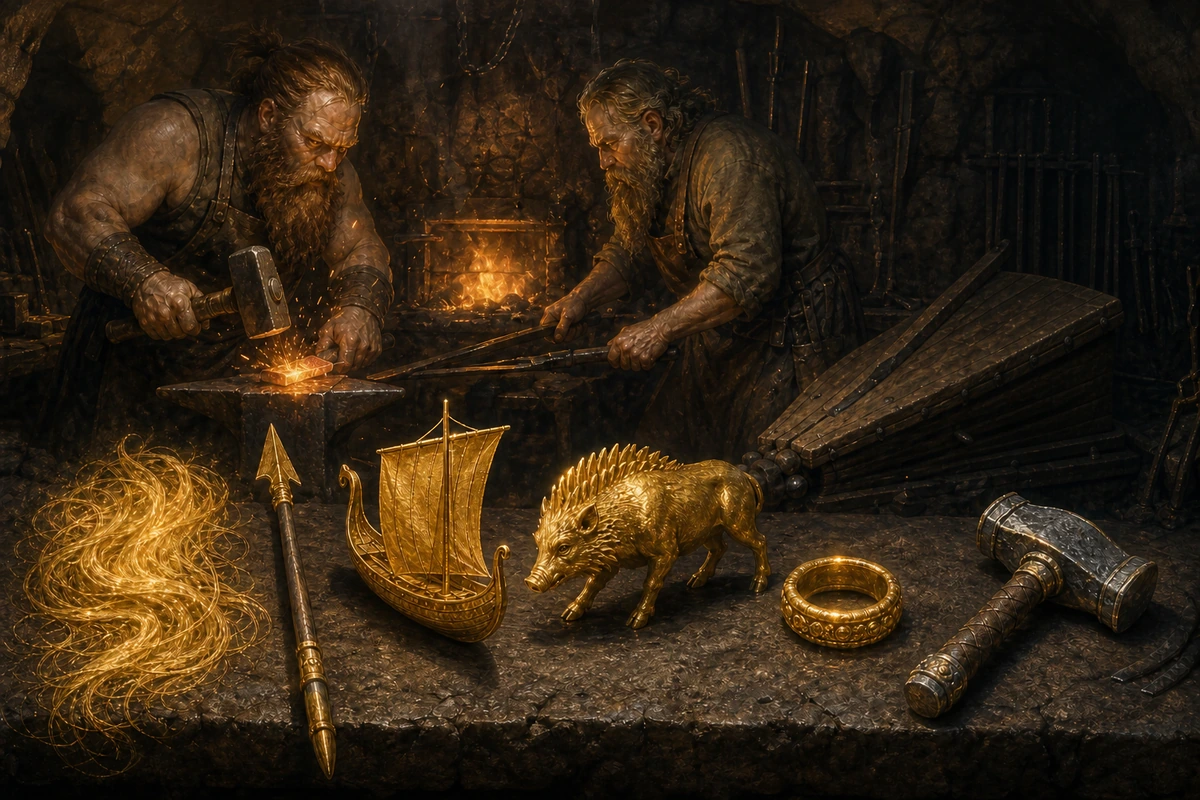
The sons of Ívaldi forge Sif’s golden hair, Odin’s spear Gungnir, and Freyr’s ship Skíðblaðnir. The narrative describes their marvelous properties when Loki presents them to the gods. The hair takes root on Sif. The spear does not fail in a thrust in the prose translation. The ship receives a favorable wind when its sail is raised and can be folded like cloth for storage.
The smiths are identified collectively in this episode. Assigning an individual maker to each of their three works goes beyond what the passage says.
Loki wagers his head
Loki tells the dwarf Brokkr that Brokkr’s brother cannot make three objects as good as those already produced, and he stakes his own head on the claim. The brother’s name appears as Sindri in an important manuscript tradition and as Eitri in many editions and retellings. Treating the two forms as entirely separate smiths can therefore create a false extra character.
At the forge, the master places material in the fire and orders Brokkr to work the bellows without stopping. Loki becomes a fly and bites Brokkr during each of the three heats. Brokkr endures the first two attacks. On the third, a bite near his eye makes him pause long enough to wipe away blood, and the interruption affects the final object.
The six treasures compared
| Treasure | Recipient | Maker in the contest | Property emphasized by Snorri |
|---|---|---|---|
| Golden hair | Sif | Sons of Ívaldi | Attaches and grows like natural hair |
| Gungnir | Odin | Sons of Ívaldi | The spear does not fail in a thrust |
| Skíðblaðnir | Freyr | Sons of Ívaldi | Always gains wind and folds for storage |
| Gullinbursti | Freyr | Brokkr’s brother | Runs through air and water; its bristles give light |
| Draupnir | Odin | Brokkr’s brother | Produces eight equal-weight rings every ninth night |
| Mjölnir | Thor | Brokkr’s brother | Strikes its target, returns, and can be carried concealed |
Why is Mjölnir’s handle short?
The final forging uses iron. When Loki’s bite makes Brokkr interrupt the bellows, the hammer comes from the forge with a handle the text calls somewhat short. The flaw does not make Mjölnir a failure. The gods judge it the best defense against the frost jötnar and award Brokkr the wager.
Modern pictures often give the hammer proportions based on much later art or popular entertainment. Viking Age hammer pendants vary greatly and do not illustrate this prose scene like a storyboard.
The dispute over Loki’s head
After losing, Loki runs away using magical footwear, but Thor catches him. Loki then argues that Brokkr may take his head but has no right to damage his neck. Unable to collect the wager under those terms, the dwarfs sew Loki’s lips together instead. The ending turns a bodily stake into another dispute over the literal boundaries of a promise.
The smiths’ victory remains intact even though Loki escapes decapitation. Their works become instruments of divine authority, fertility, travel, wealth, and defense, while the instigator of the contest is marked for abusing language.
Dwarfs are not one modern fantasy species
Old Norse dvergar are associated with stone, earth, hidden spaces, names, knowledge, and extraordinary making. The sources do not provide a consistent encyclopedia of their height, appearance, politics, or moral alignment. Some named figures act as smiths; many others appear in genealogies, poetic lists, and cosmological settings.
It is accurate to say dwarfs forge these six treasures in Snorri’s story. It is not accurate to project every convention of modern fantasy dwarfs backward onto the medieval text.
Primary text and related reading
- Skáldskaparmál: “Loke’s Wager with the Dwarfs”, public-domain Anderson translation
- Project Gutenberg, The Younger Edda: full translation and glossary
- Mythology Vault: Loki cuts Sif’s hair
- Mythology Vault: the later theft of Mjölnir in Þrymskviða