
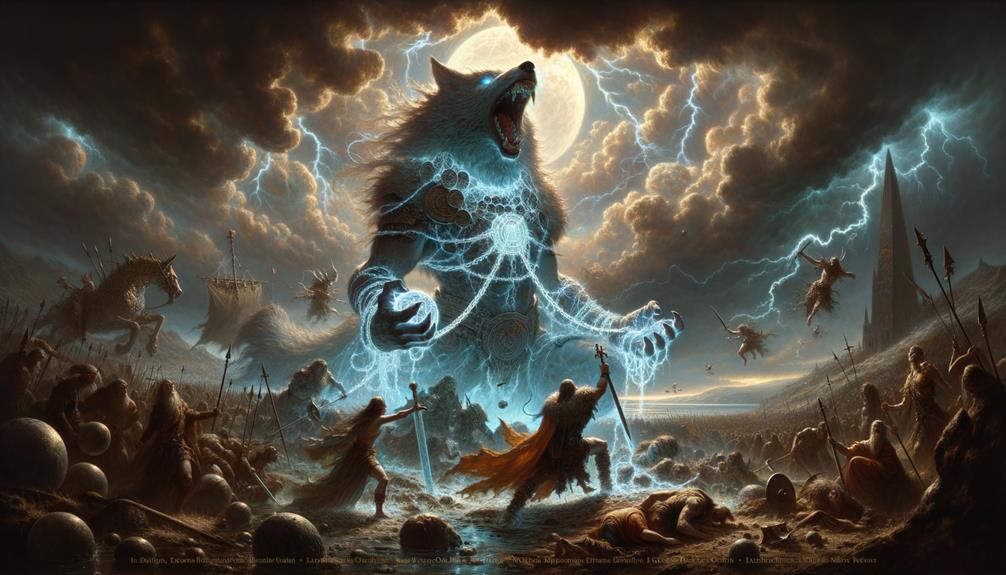
Accuracy note: The fullest continuous account of Fenrir’s binding is in Snorri Sturluson’s thirteenth-century Prose Edda. The Poetic Edda confirms parts of Fenrir’s wider story, especially his role at Ragnarök, but it does not preserve the entire Gleipnir episode as one poem.
Fenrir is not bound because he has already attacked the gods. In Snorri’s narrative, the Æsir act because prophecy and the wolf’s rapid growth make them fear what he will become. Their solution succeeds physically, but it also depends on a false promise. Týr’s lost hand makes the cost of that decision impossible to hide.
Who is Fenrir?
In Gylfaginning, Fenrir is one of three children of Loki and the jötunn Angrboða. His siblings are the Midgard Serpent, Jörmungandr, and Hel. The gods learn prophecies that great harm will come from the three, so Odin has them seized. Jörmungandr is cast into the sea, Hel is sent to rule a realm of the dead, and Fenrir is raised among the Æsir.
Only Týr is willing to approach and feed the growing wolf. That detail makes the later pledge more than a random act of courage: the god who has dealt with Fenrir most directly is also the one who risks his body when the others propose a deceptive test.
The first two fetters fail
The gods present the heavy chain Lædingr as a test of strength. Fenrir allows himself to be bound and breaks it. They then make a stronger fetter named Drómi. Fenrir understands that accepting another test may bring fame if he escapes, and he breaks this restraint as well.
The names and sequence come from Snorri’s prose. Modern illustrations often turn these trials into battles, but the text frames them as challenges the wolf voluntarily accepts. Force alone has already failed before the gods turn to craft and trickery.
What is Gleipnir made from?
Odin sends Skírnir, Freyr’s messenger, to the realm of the dark elves to commission a new restraint from dwarfs. Gleipnir looks like a soft, smooth ribbon, yet it is stronger than iron. Its makers use six impossible ingredients: the sound of a cat’s footfall, a woman’s beard, the roots of a mountain, a bear’s sinews, a fish’s breath, and a bird’s spittle.
Snorri adds that these things cannot now be found because they were used in the making. The list is playful and self-explaining: each material names an absence. Gleipnir’s power is not shown through bulk but through knowledge capable of turning impossibility into a bond.
Lyngvi and Týr’s pledge
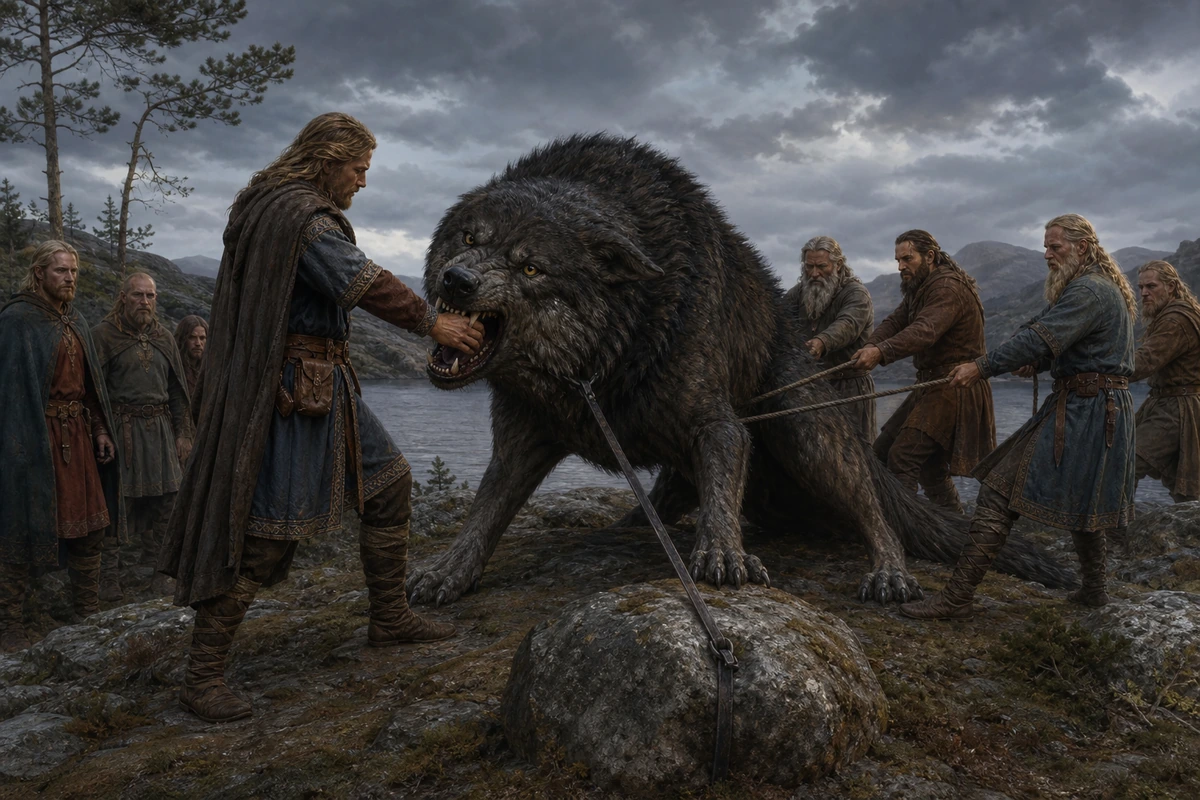
The Æsir take Fenrir to the island Lyngvi in the lake Amsvartnir. The wolf distrusts the ribbon because it looks too slight to earn fame if he breaks it, yet he also suspects magic. He agrees to the trial only if one of the gods places a hand in his mouth as a pledge that they will release him if he cannot escape.
The gods look at one another, knowing what they intend. Týr extends his right hand. When Fenrir struggles and Gleipnir tightens, the Æsir laugh—all except Týr. They refuse to free the wolf, and Fenrir bites off the hand at the wrist. The episode explains why later texts call Týr one-handed, but it does not present the injury as an accidental battle wound.
The final restraint
Snorri names a cord called Gelgja, a stone slab called Gjöll, and a fastening stone called Þviti as parts of the binding. The gods wedge a sword between Fenrir’s jaws; his drool forms the river Ván. These details belong to the prose account and should not be silently expanded into a universal “Viking belief” documented in every region.
Fenrir remains bound until Ragnarök. At the world’s destruction he breaks free, advances with jaws stretched wide, and kills Odin. Víðarr, Odin’s son, then avenges him by killing the wolf. Surviving sources differ in how they picture Víðarr’s act, so a retelling should identify whether it follows Völuspá, Vafþrúðnismál, or Snorri.
What the binding actually establishes
| Claim | What the sources support |
|---|---|
| Fenrir attacks first | No; the gods bind him because of fear, prophecy, and his growth |
| Gleipnir is an iron chain | No; it appears as a soft ribbon made from impossible ingredients |
| Týr loses his hand in combat | No; he places it in Fenrir’s mouth as a pledge |
| Fenrir is killed at the binding | No; he remains bound until Ragnarök |
| The story is ethically simple | No; it pairs protection from a foretold threat with deliberate betrayal |
Why the broken promise matters
The story can be read as a myth about fate, preventive violence, courage, oath-like pledges, and the consequences of fear. Those interpretations should remain interpretations. The text itself carefully stages a bargain in which one side knows it will not honor the apparent terms.
Fenrir is dangerous within the larger Ragnarök tradition, but the binding episode does not ask readers to ignore how the gods win. Týr’s missing hand becomes a permanent sign that containing the wolf required both extraordinary courage and a breached guarantee.
Primary texts and further reading
- Snorri Sturluson, Gylfaginning, Arthur Gilchrist Brodeur translation: Fenrir’s family, binding, and Ragnarök
- Project Gutenberg, The Younger Edda: public-domain English translation and notes
- Mythology Vault: Týr and the limits of the “war god” label