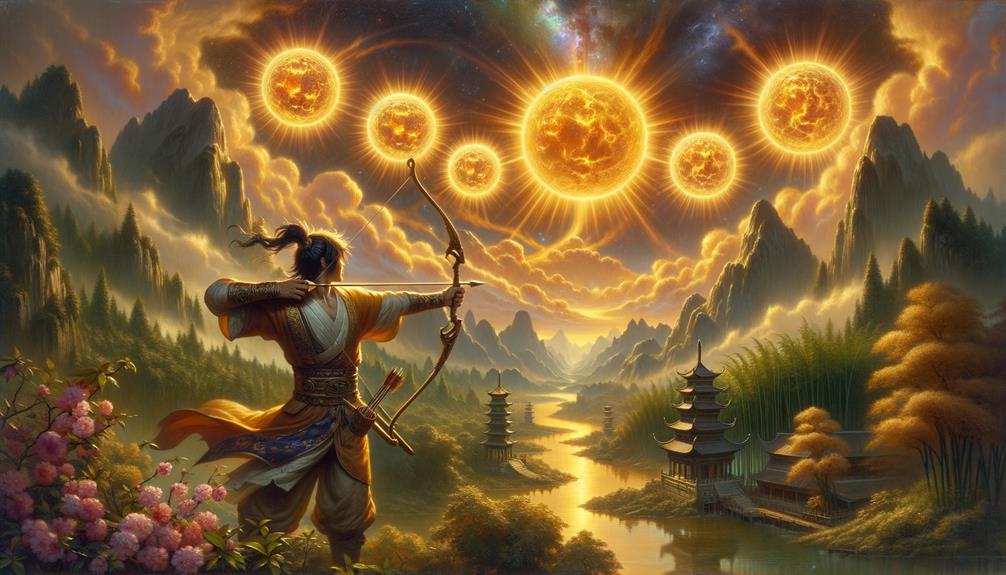
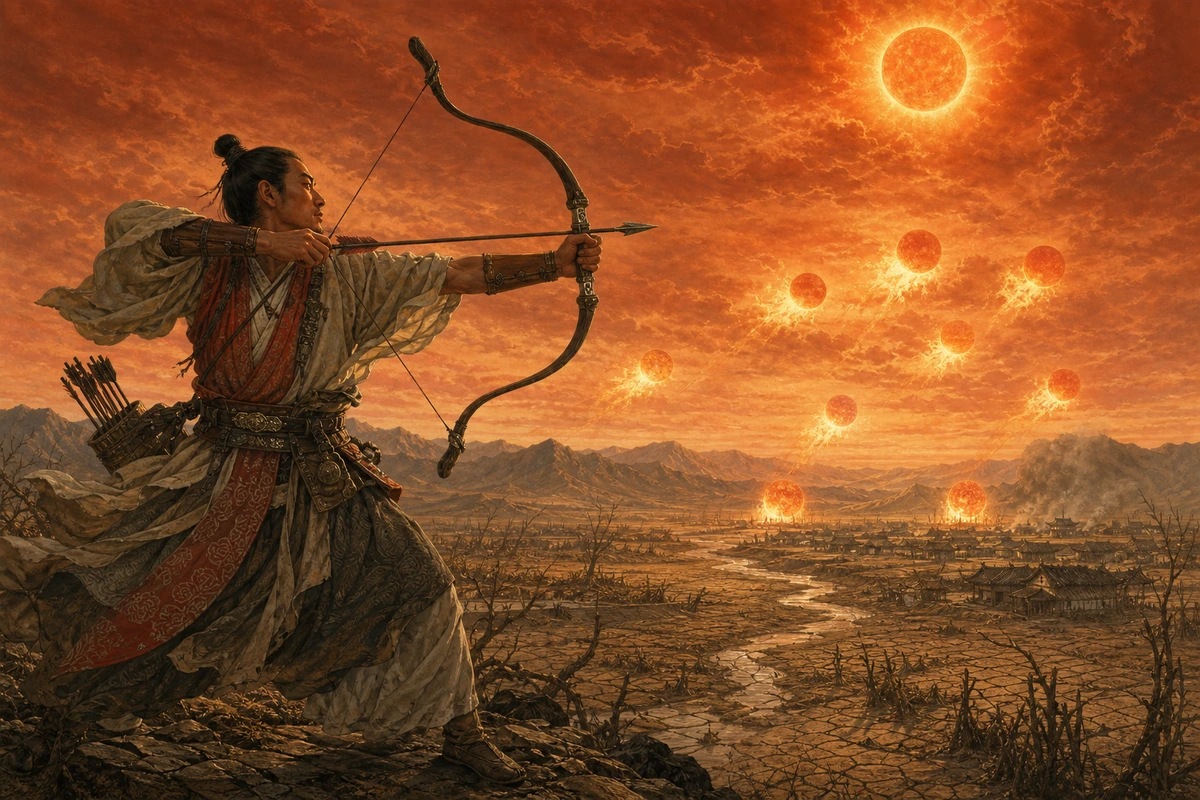
Archer Yi—usually called Hou Yi in modern retellings—saves the inhabited world when multiple suns blaze in the sky at once. The familiar story says that he shoots down nine of ten, leaving one sun to provide light and warmth. Early Chinese sources preserve the myth in fragments and do not always give the same wording, count, genealogy, or biography. Reading those layers separately reveals a richer hero than the single scene suggests.
Yi, Hou Yi, and the problem of names
The archer is called Yi (羿) in important early texts. Hou can function as a title, and later literature uses forms such as Hou Yi, Yi Yi, or Archer Yi. Chinese historical traditions also remember a ruler associated with the Xia named Yi or Hou Yi. Because exceptional archery belongs to both bodies of material, later writers sometimes merge their deeds.
A source-aware account does not assume that every Yi is one individual. The culture hero who fights cosmic disasters, the husband connected with Chang’e, and the ruler of Youqiong can overlap in later tradition without having begun as a single continuous biography. “Hou Yi” remains the most recognizable English name, but “Archer Yi” better reflects the wording of many early passages.
Where the ten suns come from
The Classic of Mountains and Seas preserves a cosmic geography in which Xihe, wife of Di Jun, gives birth to ten suns. They are associated with the Fusang tree in the east and with a patterned movement through the sky. Later retellings often say that the suns normally take turns and then rise together in defiance or play, but not every early passage supplies that complete narrative.
In the Huainanzi, compiled in the second century BCE, the age of the ruler Yao is overwhelmed when ten suns appear at once. Plants burn, crops die, and dangerous creatures afflict the people. Yao sends Yi, whose archery removes threats and makes the world habitable again.
Did Yi shoot nine suns or ten?
The received Huainanzi says that Yi shot at the ten suns above. Its brief line describes the target without explicitly narrating a surviving final sun. Later transmitted quotations state that he struck nine and that the solar crows’ feathers fell. The now-standard story combines these strands: ten appear, nine are shot down, and one is preserved.
This is not a trivial technicality. Saying that “the ancient source always states nine” hides the way myths develop through quotation, commentary, anthology, performance, and retelling. The single remaining sun is logically necessary for the ordered world, but different texts reach or imply that result in different ways.
Modern versions sometimes add that Yao or another figure hides Yi’s last arrow so he cannot extinguish the final sun. It is an effective dramatic device, but it should not be inserted into every early account without identifying it as a later elaboration.
The suns as birds
Chinese visual and textual traditions connect the sun with a crow, often a three-legged crow. In some forms of the Yi story, crows inhabit the solar discs and fall when the arrows strike. Archaeological images of sun-birds and later literary commentary belong to a broad symbolic history, but the exact number of legs, the birds’ parentage, and their role are not narrated identically everywhere.
The crow image turns archery into more than shooting inert lights. Yi targets living, moving powers whose normal activity has become catastrophic through multiplication or disorder. Yet the myth does not condemn the sun itself. One regulated sun is necessary; ten simultaneous suns destroy the conditions for life.
Yi’s feats in the source tradition
| Source layer | What it contributes | Reading caution |
|---|---|---|
| Classic of Mountains and Seas | Xihe, Di Jun, ten suns, eastern cosmic geography, and traditions connected with Yi | Separate passages do not automatically form one continuous story |
| Questions of Heaven | Ancient questions about where Yi shot the suns and what became of the crows | The poem asks rather than supplies a full narrative |
| Huainanzi | Yao’s crisis, scorching suns, destructive creatures, and Yi restoring order | The received line does not spell out every detail of the modern version |
| Later anthologies and commentaries | An explicit nine-sun outcome and fuller narrative connections | Later wording should not be silently pasted into earlier texts |
| Modern folklore and popular culture | A coherent heroic biography linking the suns, Chang’e, and the elixir | Coherence often combines once-separate traditions |
More than a solar archer
Yi’s commission includes a wider campaign against forces that make settlement impossible. The Huainanzi associates him with the defeat of monstrous beings and animals that threaten people. Lists and names vary in translation, but the pattern is clear: the archer clears a landscape overwhelmed by fire, flood, predation, and chaos.
Archery here represents precision under extreme conditions. Yi does not win through unlimited destruction. He identifies the dangerous excess and strikes selectively. This makes him an image of regulation—an ideal that fits the Huainanzi’s larger interest in ordered rule and the alignment of human society with cosmic processes.
The elixir and Chang’e
Another early strand says that Yi obtains a drug of immortality from Xiwangmu, the Queen Mother of the West. Chang’e takes the medicine and goes to the moon. Later versions greatly expand the episode: she may steal it, drink it to keep it from a violent intruder, act from curiosity, or be separated from Yi through tragic necessity.
Those motives should not be treated as if one source fixes them all. Even Chang’e’s relationship to Yi and the moral judgment placed on her shift across periods. The solar and lunar stories eventually create a powerful pair—the archer who regulates the sun and the woman who becomes associated with the moon—but that pairing is the result of a long literary history.
Myth, astronomy, and false history
Writers have tried to explain the ten suns as a memory of drought, a parhelion or “sun dog,” multiple volcanic lights, an eclipse sequence, or a calendar with ten-day cycles. Such comparisons can be interesting, but none is proven simply by the myth. The sources present a cosmological and political crisis, not a dated observational report waiting to be decoded.
Ancient Chinese thinkers could also criticize the story literally. Wang Chong’s Lunheng, written in the first century CE, argues against the physical possibility of ten real suns. His skepticism is a reminder that premodern audiences did not all read myth in the same way. Symbolic narrative, ritual tradition, natural speculation, and rational critique already coexisted.
What Archer Yi’s victory means
Yi is not praised for darkening the world. His achievement is leaving a world in which sunlight is useful again. The myth sets a narrow target for power: remove what is ruinously excessive while preserving what life requires. That is a more demanding virtue than force alone.
The story’s lasting image—a lone archer facing an impossible sky—makes cosmic order depend on disciplined human action. Its deeper textual history then complicates the hero, joining him with dangerous animals, political rule, immortality, loss, and the moon. Yi’s arrow travels across many sources, and each one aims it slightly differently.