
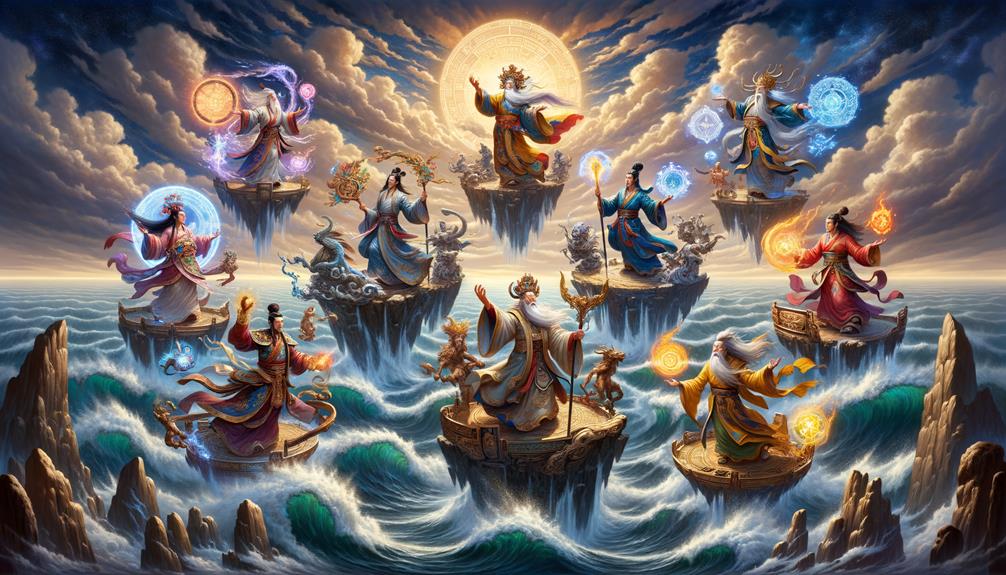
The Eight Immortals are a familiar group in Chinese religion, drama, and art, but they did not enter the record as one fixed company at the beginning of Daoist history. Their standard lineup became widely recognized in later centuries: Li Tieguai, Zhongli Quan, Lü Dongbin, Zhang Guolao, Cao Guojiu, Han Xiangzi, Lan Caihe, and He Xiangu.
Crossing the sea
In the best-known episode, the eight reach the shore on their way to a gathering and agree that each should cross by using a personal power. Their objects become the means of travel: a fan, sword, flute, lotus, basket, clappers, crutch, or other identifying attribute, depending on the telling. Trouble with the sea’s dragon rulers may follow, turning a display of skill into a contest.
The story gave rise to the saying that when the Eight Immortals cross the sea, each shows an individual ability. It is commonly used when people solve the same problem in different ways. The proverb is often more stable than the details of any single narrative.
A group formed over time
Individual immortals had separate legends before authors and artists brought them together. The membership also varied before the later set became conventional. Ming and Qing paintings, ceramics, plays, and prints helped make their attributes easy to recognize. This history matters because the crossing should not be treated as one event reported by an early Daoist canon.
The episode belongs to a long process in which religious figures, stage characters, and auspicious symbols met in popular culture. It can be read beside stories of Zhang Guolao and accounts of the Jade Emperor.