

Zhong Kui (鍾馗) is the great demon-queller of Chinese art and popular religion. He appears as a formidable bearded scholar-official who drives away harmful spirits, disease, and misfortune. Images of him have guarded homes at Lunar New Year and around the Double Fifth Festival. His legend is set in the Tang dynasty, but the surviving stories and pictures developed later and do not preserve one fixed biography.
The emperor’s dream
One famous account says that Emperor Xuanzong became ill and dreamed of a large demon capturing a smaller one that had stolen from the palace. The powerful figure introduced himself as Zhong Kui and promised to eliminate such threats. After the emperor recovered, he ordered the celebrated painter Wu Daozi to paint the figure from the dream.
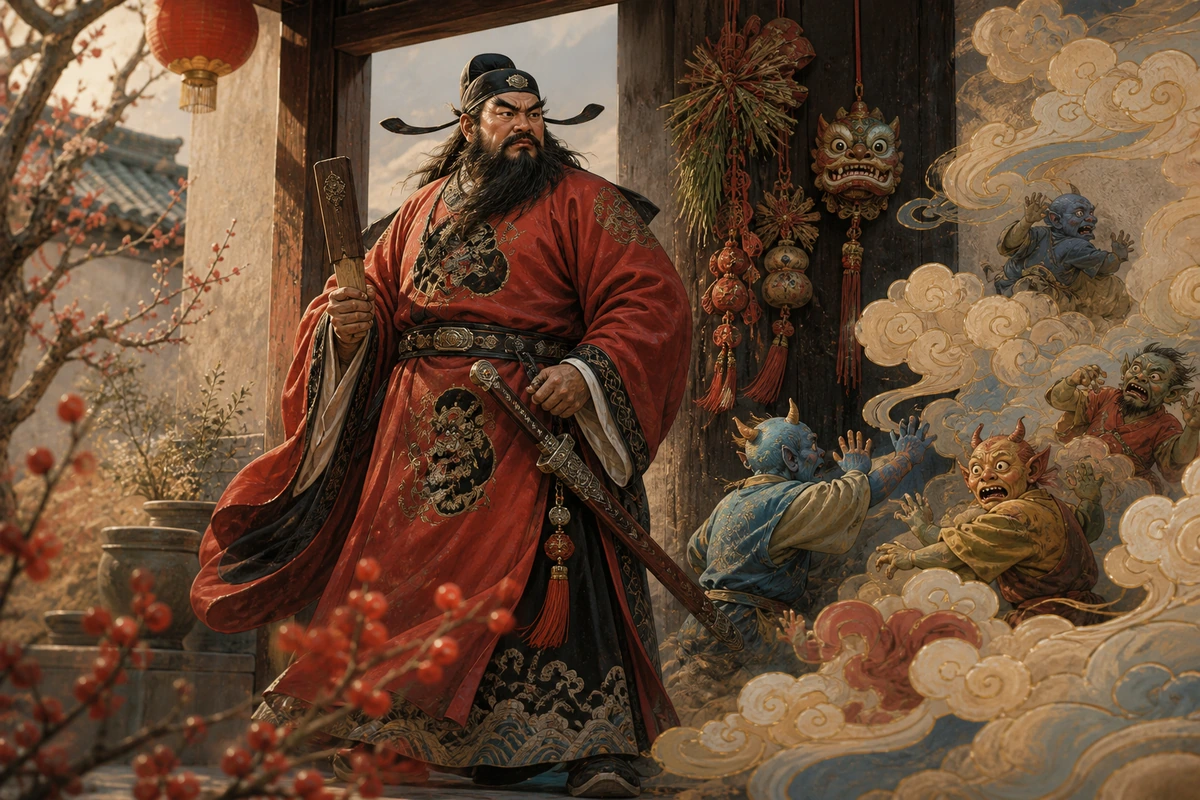
The British Museum notes an important caution: legends place this event in the eighth century, but the legends themselves postdate that setting. The dream explains the authority of Zhong Kui’s portrait; it is not contemporary court documentation of a supernatural encounter.
The rejected examination candidate
Another strand makes Zhong Kui an exceptionally talented examination candidate denied honors because an emperor or official finds his appearance unacceptable. He dies in anger or despair and later receives authority over ghosts. Versions change the ruler, the examination result, and the manner of death.
The story turns his official robes and stern face into a reversal of injustice. An appearance once treated as disqualifying becomes the visual proof of power, while the scholar denied an earthly appointment gains a supernatural office. Zhong Kui can therefore represent literary success and integrity as well as exorcistic protection.
A protective image in the home
Woodblock prints, paintings, charms, and door images show Zhong Kui alone or commanding subdued demons. He may carry a sword, official tablet, or scholar’s hat. Some comic scenes show demons serving him, carrying gifts, or participating in a procession. The contrast between his severity and their disorder made the subject both protective and entertaining.
Qing-period prints were displayed especially at New Year and at Double Fifth, a season historically associated with heat, illness, and dangerous influences. Hanging Zhong Kui’s image did not merely illustrate a story; it made the picture an active household safeguard.
Zhong Kui’s place among other protectors
Zhong Kui does not judge all souls or govern every part of the underworld. His signature office is confronting harmful spirits. Meng Po prepares souls for rebirth, while Zao Jun watches over household conduct from the kitchen. Keeping those roles distinct reveals the specialized texture of popular worship.