
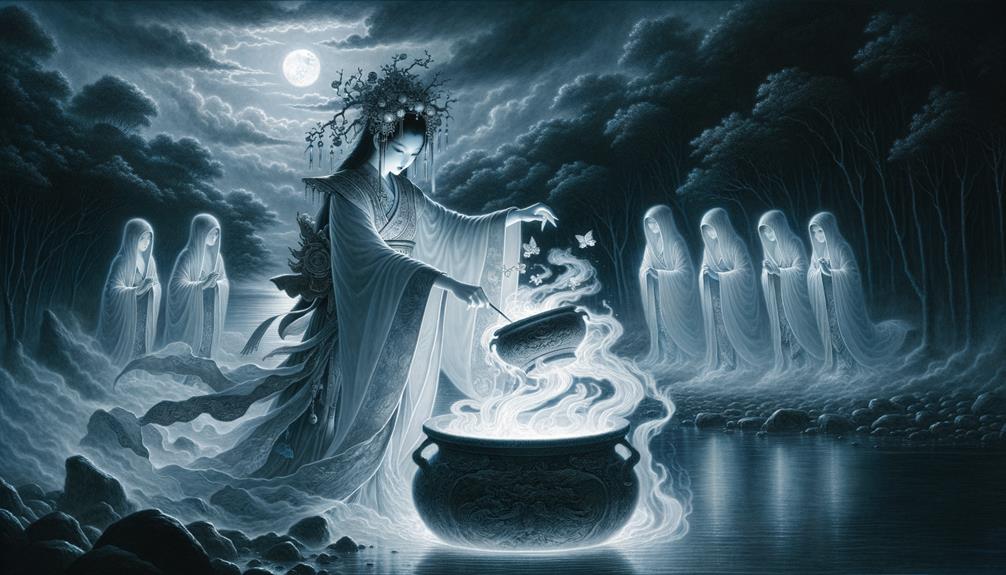
Meng Po (孟婆, “Granny Meng”) is the keeper of forgetfulness in later Chinese visions of the underworld. She prepares a five-flavored brew for souls who are about to be reborn, removing memories of earlier lives and of the courts below. The image is now familiar in novels, television, games, and temple culture, but it is not an unchanged doctrine from the earliest Buddhist or Daoist scriptures.
The final station before rebirth
Popular descriptions place Meng Po near a pavilion, terrace, or bridge associated with the River Nai. After the dead have passed through judgment and received a destination for rebirth, they drink her brew before returning to the human world. Forgetting creates a boundary between lives: a new person should not arrive carrying complete knowledge of a former identity or of the underworld’s secrets.

The drink is called soup, broth, tea, or an elixir in English. Some accounts describe five flavors—sweet, bitter, pungent, sour, and salty—suggesting the range of earthly experience. Ingredients listed in modern retellings are highly variable and should not be treated as a canonical recipe.
A figure shaped in late popular religion
Research on Chinese and East Asian hell imagery connects Meng Po’s best-known role with the Yuli baochao, the “Precious Record of the Jade Regulations.” This illustrated morality book circulated widely in Qing China in multiple editions. Its underworld combines bureaucratic courts, karmic consequences, moral instruction, and popular storytelling.
The familiar brew of forgetfulness became prominent in eighteenth- and nineteenth-century texts. That relatively late evidence matters. Meng Po should not be projected unchanged into early Chinese religion or presented as a core teaching of Buddhism. She belongs to a syncretic world in which Buddhist rebirth, Daoist and popular deities, Confucian moral duties, and the imagery of imperial administration meet.
Why forgetting matters
Meng Po is sometimes portrayed as threatening, but her function can also be read as merciful and orderly. Complete memory of every loss, punishment, relationship, and identity could make a new life impossible. The brew closes one chapter so another can begin.
Folktales often test that boundary. A soul may avoid the drink, retain a fragment of memory, or recognize someone from a former life. Such exceptions generate drama precisely because the expected rule is forgetting. Modern romantic stories frequently use the device to ask whether love can survive even when memory does not.
No single map of the Chinese afterlife
Chinese underworld traditions vary by period and community. The number and order of courts, bridges, officials, punishments, and routes to rebirth are not completely uniform. Meng Po’s station should therefore be described as a powerful later model, not a universally agreed geography.
Her task differs from Zhong Kui’s protective role and from the Jade Emperor’s celestial authority. Chinese popular religion often assigns specialized offices without requiring every tradition to use the same hierarchy.