Accuracy note: “The Book of Thoth” is not the name of one surviving Egyptian master book. It can refer to a magical scroll inside the First Tale of Setne Khamwas, a fragmentary Demotic dialogue given that title by modern scholars, or—more loosely—to the forty-two books of Hermes described by Clement of Alexandria. These sources are related through Thoth’s reputation for wisdom, but they are not the same work.
Stories about books attributed to Thoth combine a powerful idea with a warning: writing can preserve divine knowledge, but knowledge is not automatically safe or morally neutral. That theme is especially vivid in the Setne tale. It should not, however, be used to blur a work of fiction, an actual group of papyrus fragments, and a late Greek account of Egyptian priestly learning.
What “Book of Thoth” Can Mean
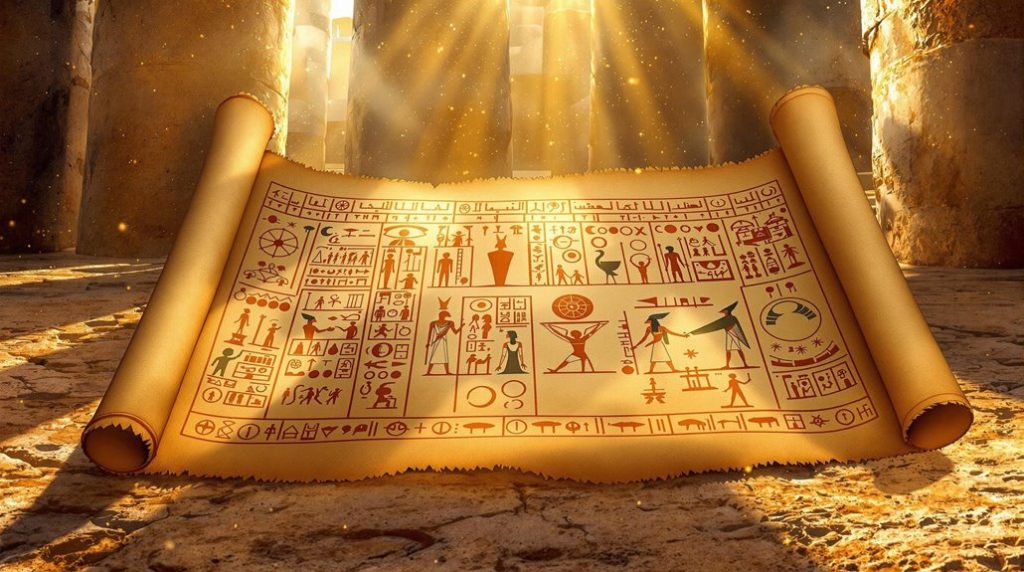
- Setne’s magic book: a marvelous object in a Ptolemaic-period Demotic story. It contains two spells and belongs to Thoth within the plot.
- The Demotic Book of Thoth: the modern scholarly title for fragmentary Graeco-Roman Egyptian texts structured largely as a dialogue between a master and a student.
- Clement’s forty-two books: a collection of writings attributed to Hermes—the Greek god identified with Thoth—in a description written around 200 CE. Clement does not call this collection the single “Book of Thoth.”
Setne’s Forbidden Book
The First Tale of Setne Khamwas survives in Demotic on a Ptolemaic-period manuscript. Its protagonist is based on Khaemwas, a historical son of Ramesses II, but the adventure is a much later literary creation. In the story, Setne hears that a book written by Thoth’s own hand lies in the tomb of Naneferkaptah and becomes determined to possess it.
Naneferkaptah’s ghost explains how he once pursued the same book. It was hidden near Coptos inside a series of boxes beneath the water and guarded by snakes, scorpions, and an immortal serpent. After taking it, Naneferkaptah copied its words onto fresh papyrus, washed the writing into beer, and drank the mixture so that its knowledge entered him. Thoth appealed to the sun god Pre (Ra), and Naneferkaptah, his wife Ahwere, and their son Merib died in the book’s catastrophic aftermath.
Setne ignores that warning and takes the book after a supernatural contest. He is then deceived and humiliated through a terrifying vision involving a woman named Tabubu. Only when the illusion breaks does he recognize the danger of his theft. He ultimately restores the book to Naneferkaptah’s tomb. The episode makes the scroll a narrative test of desire, restraint, and respect for divine property—not evidence that such an object once existed.
The Two Spells—and Their Cost
Miriam Lichtheim’s translation gives the fictional book two spells. The first enables its reader to enchant heaven, earth, the underworld, mountains, and waters; understand the speech of birds, reptiles, fish, and desert animals; and see fish in deep water. The second reveals the sun god and his Ennead, the moon, and the stars in their forms. These spectacular powers explain why both Naneferkaptah and Setne are willing to risk everything for the scroll.
The animal-speech passage is therefore authentic to the tale, but it does not document an Egyptian training method or a catalogue of sacred animal symbols. The story itself repeatedly frames possession of the book as transgression. Its point is not that readers can reproduce the spells; it is that even an accomplished scribe-prince can be mastered by the knowledge he tries to seize.
The Surviving Demotic Dialogue
The text that Egyptologists now call the Ancient Egyptian Book of Thoth is different. It survives in many fragments rather than as a complete roll with an ancient title page. The University of Copenhagen’s Papyrus Carlsberg inventory catalogs multiple Demotic fragments under this modern name, while editions by Richard Jasnow and Karl-Theodor Zauzich assemble witnesses held in several collections.
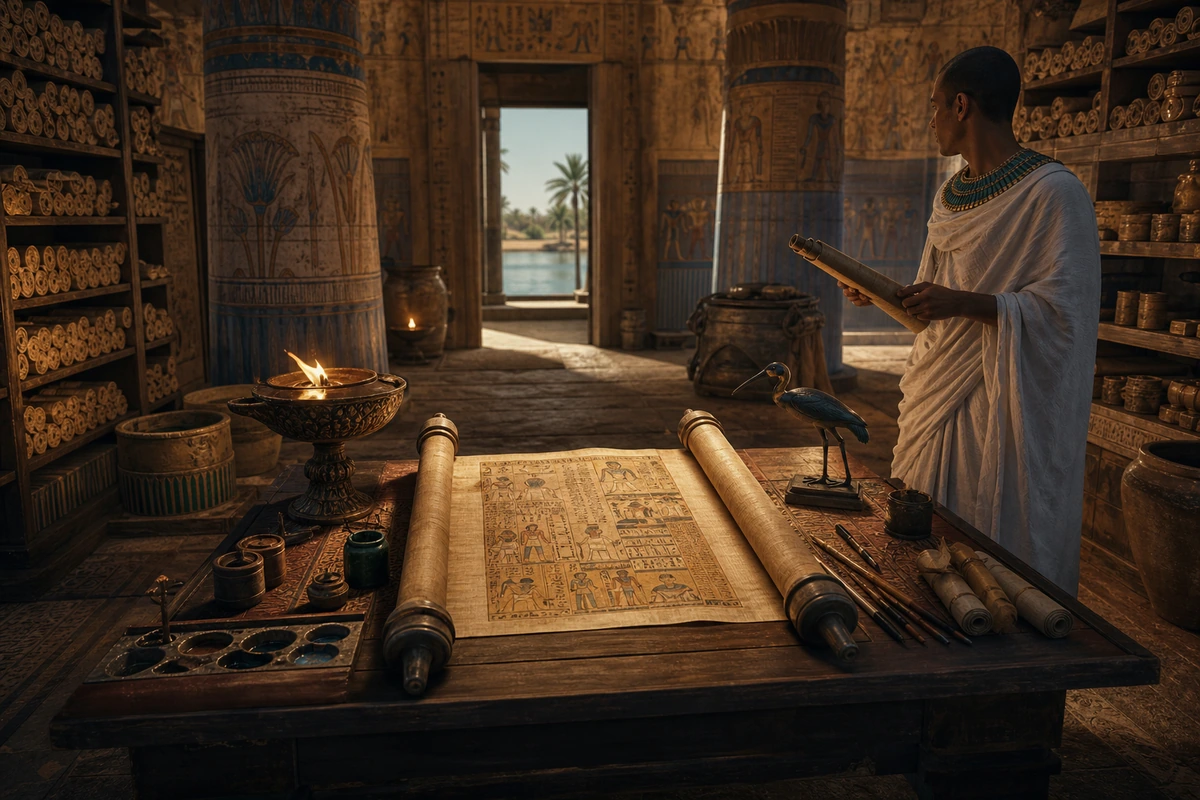
Much of the work takes the form of a difficult, allusive conversation between a master—perhaps represented as Thoth—and a disciple called “The-one-who-loves-knowledge.” Its subjects include scribal discipline, the writing palette and brush, sacred geography, the underworld, and forms of animal knowledge. The text is associated with the learned environment of the Egyptian “House of Life,” an institution connected with temples, scribes, and sacred writings.
This is a work about becoming a learned scribe and approaching restricted knowledge, not the two-spell scroll from Setne’s tomb. The overlap in themes is meaningful: both imagine Thoth as the divine source of writing and difficult wisdom. Yet no surviving evidence identifies the fragmentary dialogue as the physical book stolen by Setne. One is an actual text reconstructed from manuscripts; the other is an object inside a story.
Clement’s Forty-Two Books of Hermes
A third tradition appears in Clement of Alexandria’s Stromata. Describing an Egyptian priestly procession around 200 CE, Clement assigns books of Hermes to several specialists, including a singer, astrologer, sacred scribe, stole-keeper, and prophet. He totals forty-two writings: thirty-six concerning the Egyptians’ philosophy and six medical books dealing with the body, diseases, instruments, medicines, eyes, and women.
This passage is valuable evidence for how a late antique author represented Egyptian priestly knowledge. It is not a reference to one forty-two-volume copy of Setne’s magical book, nor does it give the modern Demotic dialogue its title. “Hermes” appears because Greek and Egyptian traditions identified Hermes with Thoth. The number forty-two belongs to Clement’s account of a corpus organized by priestly responsibilities.
Why Thoth Stands Behind So Many Books
Thoth’s wide intellectual authority made him a natural patron for more than one textual tradition. Egyptologist Martin Stadler summarizes him as god of writing and wisdom, lunar deity, divine vizier, and a complex cosmic figure whose worship continued into the Roman period. Under Greek and Roman rule, his identification with Hermes also contributed to the later figure of Hermes Trismegistus.
The safest conclusion is therefore plural. Ancient and late antique writers could attribute stories, teachings, and whole classes of learned books to Thoth or Hermes without referring to a single secret encyclopedia. Setne’s dangerous scroll, the Demotic master-disciple dialogue, and Clement’s forty-two writings illuminate related ideas about divine knowledge. Reading each in its own genre and historical setting makes those ideas clearer—and preserves the difference between mythic books and manuscripts that actually survive.
Sources and Further Reading
- Miriam Lichtheim, translation of the First Tale of Setne Khamwas
- Steve Vinson, The Craft of a Good Scribe: History, Narrative and Meaning in the First Tale of Setne Khaemwas (Brill)
- Richard Jasnow and Karl-Theodor Zauzich, Conversations in the House of Life (Harrassowitz)
- University of Copenhagen, Papyrus Carlsberg Demotic inventory
- UCL Digital Egypt, “House of Life: sources”
- Clement of Alexandria, Stromata, Book VI, chapter 4
- Martin A. Stadler, “Thoth,” UCLA Encyclopedia of Egyptology