
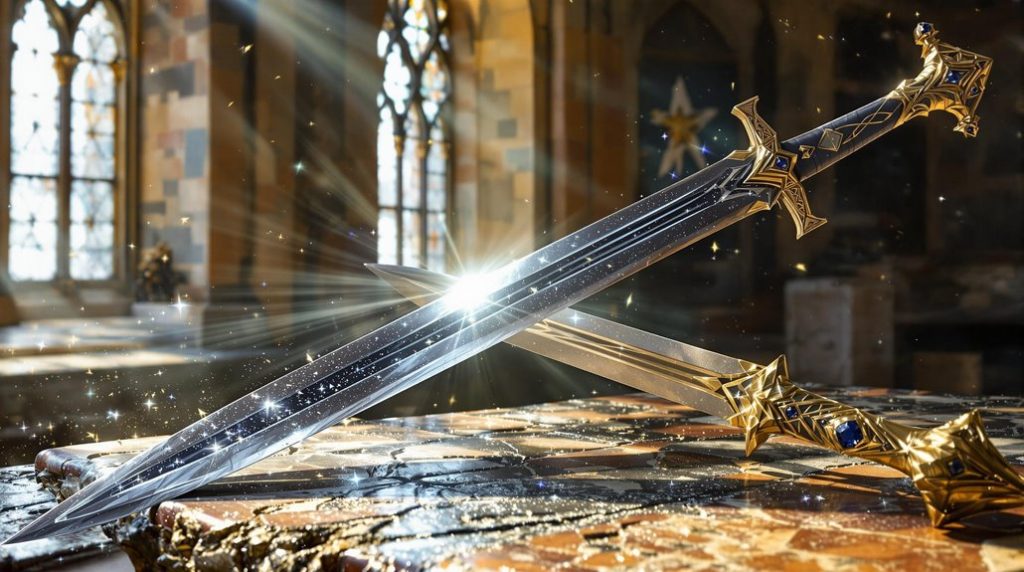
Durendal is the sword of Roland in the medieval French Song of Roland. It is not a weapon from Greek mythology, and its most famous scene is not a duel between two magical blades. As Roland dies at Roncevaux, he tries to destroy the sword so that it cannot fall into enemy hands, then lists the Christian relics said to rest within its golden hilt.
The sword in the Song of Roland
The Chanson de Roland, composed in Old French around the turn of the twelfth century, transforms a historical Frankish defeat in 778 into a Christian heroic epic. Roland commands Charlemagne’s rear guard. His sword is Durendal; his companion Oliver carries Hauteclere; and the horn with which Roland finally summons aid is the olifant.
History and epic are not the same
Charlemagne’s army was attacked while withdrawing through the Pyrenees, but the earliest historical report identifies Basques as the attackers. The poem, written centuries later, recasts the enemy as a vast Muslim army and reshapes the event around crusading-era ideals. Durendal belongs to this literary transformation, not to a securely documented eighth-century royal armoury.
Roland’s attempt to break Durendal
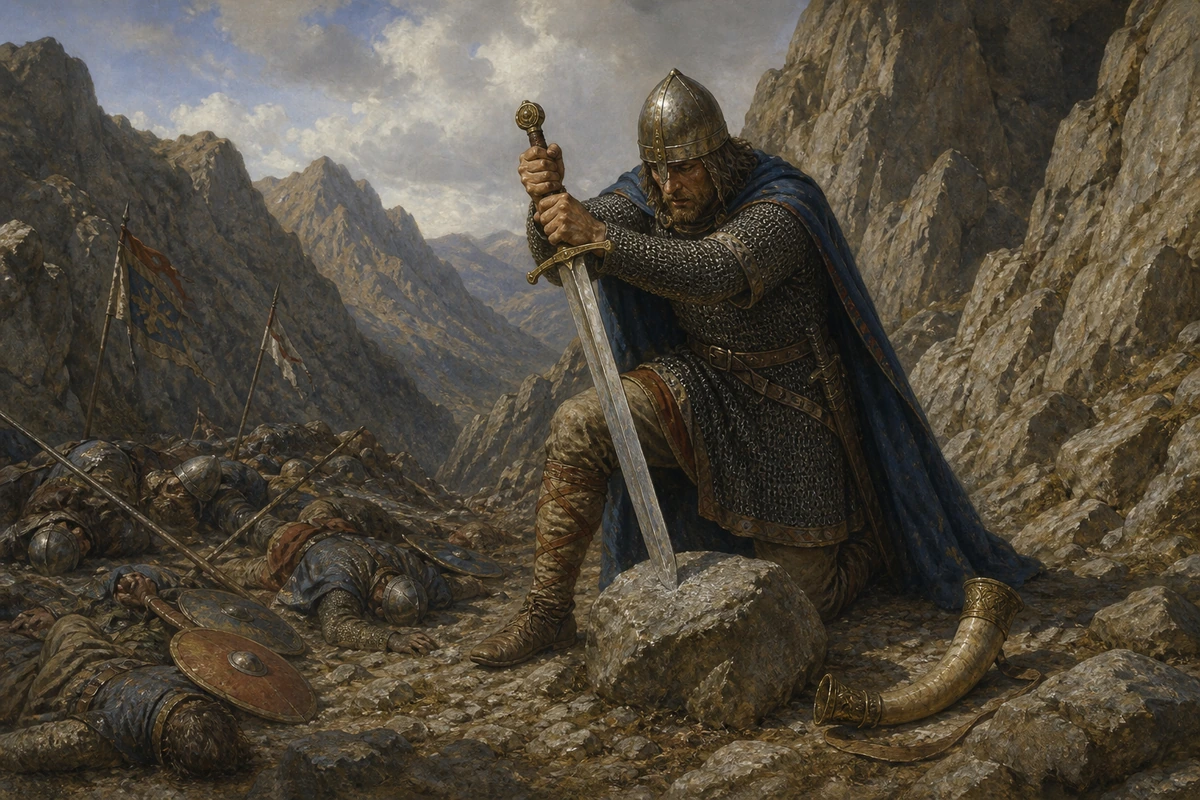
Mortally wounded, Roland fears that an enemy will take his sword. He strikes Durendal against stone, but the rock splits and the blade remains intact. The scene demonstrates the sword’s exceptional quality and Roland’s bond with it. It is often modernized into a magical test, although the poem’s emphasis is on loyalty, honour, and keeping a Christian warrior’s weapon from capture.
The relics in the hilt
Roland says the golden pommel contains sacred relics: a tooth of Saint Peter, blood of Saint Basil, hair of Saint Denis, and a piece of the Virgin Mary’s garment. Manuscripts and translations vary in wording. The list makes Durendal a reliquary as well as a sword, joining martial prestige to the sacred geography of medieval Christendom.
Who gave the sword to Roland?
In the Oxford version of the poem, an angel directs Charlemagne to give the sword to a captain, and the emperor girds it on Roland. Later medieval works offer different genealogies for the weapon and connect it with other heroes. There is no need to harmonize every chanson into one “canonical” origin story; medieval epic thrives on variation.
Durendal after Roland
Later traditions relocate the sword, extend its history, or claim physical traces of Roland’s final act. The cliffside sword long displayed at Rocamadour was popularly identified as Durendal, but a devotional object and a literary weapon are not the same kind of evidence. Such traditions show the poem’s cultural reach rather than proving where an eighth-century blade was kept.
Durendal, Excalibur, and other famous swords
Modern lists often group Durendal with Excalibur, Gram, Kusanagi, and Greek heroic weapons. Comparison can be useful, but merging their stories creates false episodes. Durendal’s defining text is an Old French chanson de geste; Excalibur belongs to Arthurian traditions; and Greek epic does not contain Roland or his sword.
Modern games and fiction
Games, anime, novels, and films freely reuse the name Durandal for swords, spaceships, characters, and technologies. Those adaptations are part of the name’s reception history, but they should be labelled as modern creations. They do not establish the medieval sword’s powers, appearance, or origin.
Why the sword matters
Durendal survives because the death scene joins an intimate farewell to a political and religious ideal. Roland addresses the sword almost as a companion, recalls the lands conquered with it, and grieves that it may pass to an enemy. The unbroken blade becomes a measure of the hero’s service and of the epic world he is leaving.
Sources and further reading
- The Song of Roland, Project Gutenberg English translation
- The Song of Roland, Oxford-version course text
- Gerard J. Brault, ed. and trans., The Song of Roland: An Analytical Edition
- Einhard, Life of Charlemagne, account of the 778 ambush