
Cangjie (倉頡) is the legendary inventor of Chinese writing and is often described as a scribe or official of the Yellow Emperor. His story gives literacy a memorable founder, but it is not an archaeological account of how the script began. The earliest substantial surviving Chinese inscriptions already use a mature system, and their development cannot be assigned to one documented individual.
A legendary observer of patterns
In later accounts, Cangjie realizes that knotted cords are not precise enough for keeping records. He studies tracks left by birds and animals and notices that distinct patterns reveal what made them. From footprints, constellations, turtle-shell markings, and the shapes of things, he creates signs that can distinguish names and meanings.
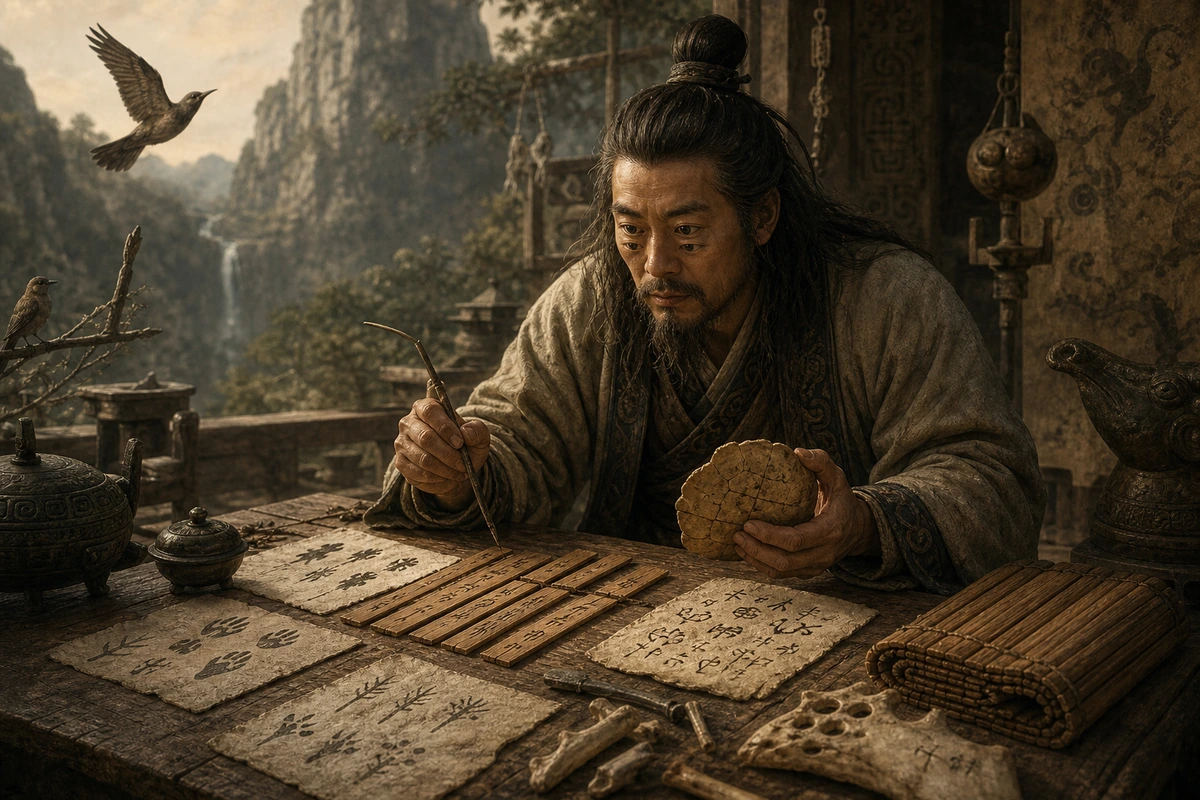
Artists sometimes give Cangjie four eyes. The extra pair signals exceptional perception: he sees patterns that ordinary observers miss. It should not be treated as a physical description of a historical scribe. The same principle appears throughout Chinese religious art, where unusual eyes, heads, or limbs make invisible powers visible.
Why ghosts cried and grain fell
Some versions say that when Cangjie completed writing, grain rained from the sky and ghosts wailed at night. Explanations vary. Writing could preserve knowledge and make administration possible, but it could also expose secrets, record wrongdoing, and enable human beings to manipulate names and contracts. The cosmic reaction dramatizes the enormous moral and political consequences of durable records.
This is mythic language rather than a claim that unusual weather proves when writing appeared. The tale asks what changes when speech can outlast the speaker. Taxes, laws, genealogies, divination, history, and literature all become easier to preserve—and harder to escape.
What archaeology actually shows
Oracle-bone inscriptions from the late Shang dynasty, especially those associated with Anyang, are the earliest large body of Chinese writing known today. They record divinations concerning harvests, warfare, weather, childbirth, royal ancestors, and other matters. Their repeated signs and established conventions show that the script was already complex.
Older marks have been found on pottery, bone, and other materials, but scholars debate whether every mark represents language. A symbol, clan sign, tally, or decorative motif is not automatically a writing system. Archaeology therefore supports gradual development across communities, media, and generations, even while Cangjie remains culturally important as the personification of that achievement.
Cangjie among culture heroes
Cangjie’s legend belongs beside stories of Leizu and silk and Shennong and agriculture. Each credits a named ancestor with knowledge that actually emerged through long collective practice. Myth does not need to be mistaken for a technical timeline to express gratitude for writing, cultivation, or textile craft.