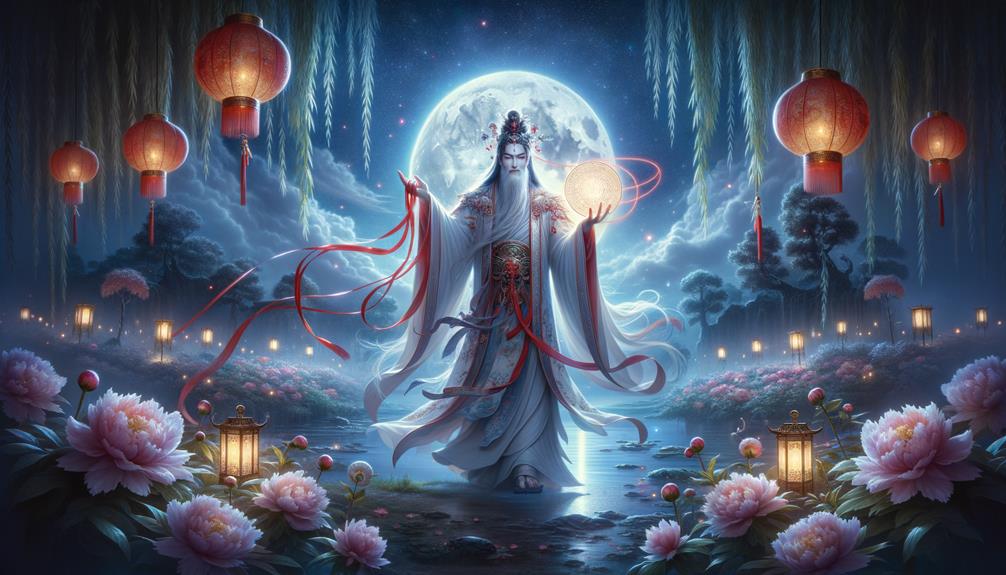
Yue Lao (月老), short for Yuexia Laoren, “the Old Man Under the Moon,” is a Chinese deity who oversees marriage destiny. He is usually imagined as an elderly official carrying a register of future spouses and cords with which he joins people who are fated to marry. Contemporary art often makes those cords bright red, creating the familiar “red thread of fate,” though the early story’s central idea is the binding power of destiny rather than a modern romantic symbol.
The Tang tale of Wei Gu
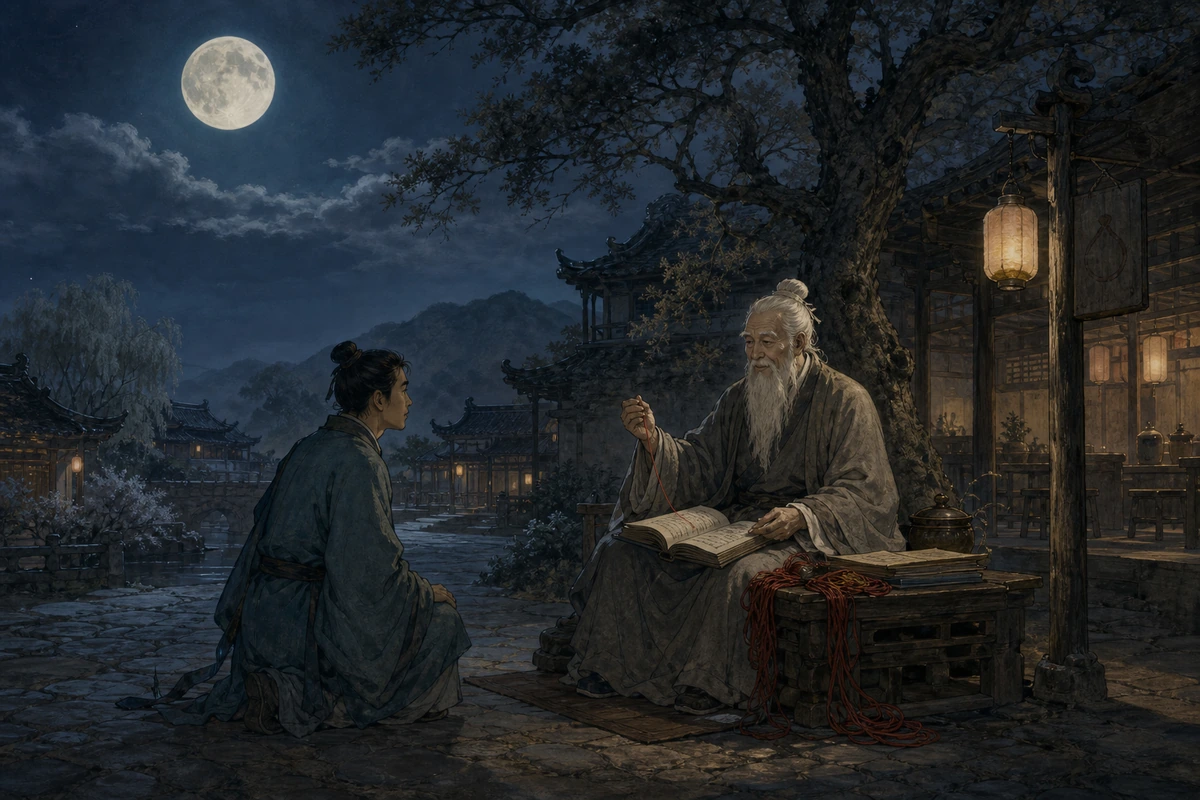
The foundational narrative is set in the Tang dynasty and concerns a traveler named Wei Gu. While staying near Songcheng, Wei Gu sees an old man reading a book by moonlight. The book records marriages, and the man’s bag contains cords used to bind the feet of destined husbands and wives. Once tied, the old man explains, a pair will eventually marry despite distance, hostility, or differences in social position.
The old man identifies a very young girl from a poor family as Wei Gu’s future wife. Wei Gu rejects the prediction and orders a servant to attack her. Years later, he marries the daughter of a provincial official and discovers that she is the same person, still bearing a scar from the assault. The marriage prediction is fulfilled, but the story is not an uncomplicated romance. Wei Gu’s violence is morally disturbing, and responsible retellings should not turn it into a charming courtship episode.
What the marriage register means
Yue Lao’s book and cords reflect a bureaucratic image of the unseen world. Just as earthly administrations kept registers and assigned offices, divine officials could be imagined recording births, deaths, fortunes, and marriages. Yue Lao does not simply inspire attraction. His authority concerns a socially recognized union whose outcome is already entered in a cosmic record.
This makes the common label “Chinese Cupid” convenient but inaccurate. Eros and Cupid emerged from Greek and Roman traditions of desire, divine arrows, and personified love. Yue Lao belongs to a different religious and literary setting, in which destiny, family formation, and celestial record-keeping matter more than sudden passion.
The red thread in later culture
In later storytelling and popular devotion, the marriage cord is commonly described as red and may connect ankles, feet, or little fingers. The thread can stretch or tangle but does not easily break. Couples visit temples associated with Yue Lao to ask for a suitable match, clarity in relationships, or a favorable marriage. Procedures differ among temples: offerings, written petitions, divination, and the handling of red cord should be explained according to the specific sanctuary rather than treated as one universal rite.
The symbol also moved beyond formal worship into novels, television, comics, wedding customs, and everyday speech. In that modern setting, it may signify soulmates broadly, even when no marriage is involved. That is a creative extension of the tradition, not necessarily the exact meaning found in the earliest tale.
Yue Lao and Qixi
Yue Lao is often associated with the romantic atmosphere of Qixi, but the two traditions are not the same story. Qixi centers on the annual meeting of the Weaver Girl and Cowherd and historically includes prayers for skill and dexterity. Yue Lao is the divine registrar and arranger of marriages. Their themes overlap in modern celebrations because both speak to longing, partnership, and fate.