
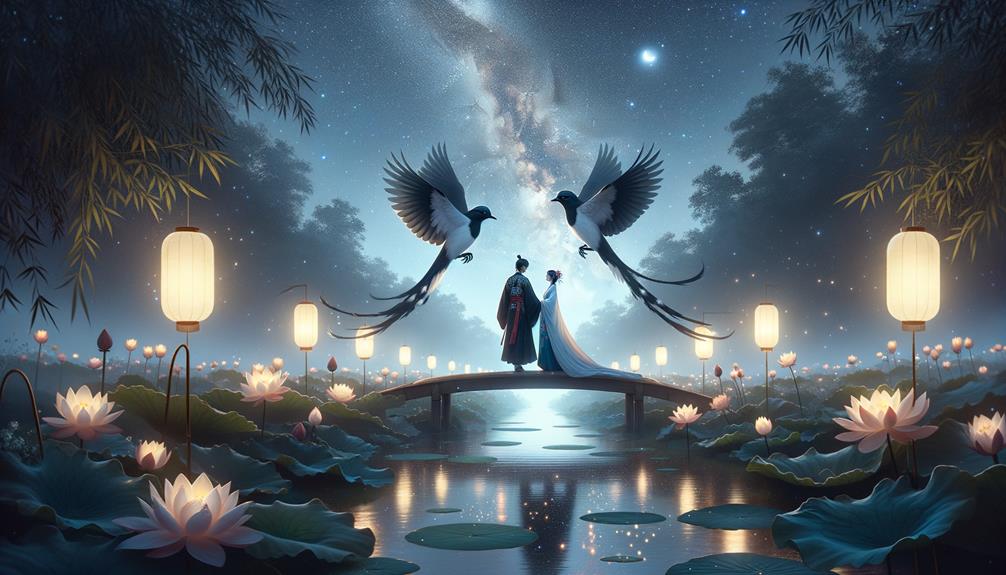
Qixi (七夕), the “Seventh Evening,” is observed on the seventh day of the seventh lunar month. Its best-known story follows the Weaver Girl and the Cowherd, represented by the stars Vega and Altair, who are separated by the Milky Way and allowed to reunite. Modern advertising often calls Qixi “Chinese Valentine’s Day,” but romance is only one layer of a much older festival concerned with celestial patterns, textile work, dexterity, and the hopes of girls and women.
The Weaver Girl and the Cowherd
The Weaver Girl is called Zhinü and the Cowherd Niulang. There is no single, fixed version of their story. In widely told forms, Zhinü is a heavenly weaver whose labor maintains celestial order, while Niulang is a mortal herdsman. They marry, but a divine authority separates them across the River of Heaven—the Milky Way. Once each year, magpies form a bridge so the pair can meet.
Other versions alter their parentage, the reason for punishment, and whether both figures begin as celestial beings. The annual reunion nevertheless remains the emotional center: love survives separation, but only within a painful cosmic limit. Rain on the festival night is sometimes explained as the lovers’ tears. This is poetic folklore, not an astronomical explanation of weather or starlight.
Qiqiao: asking for skill
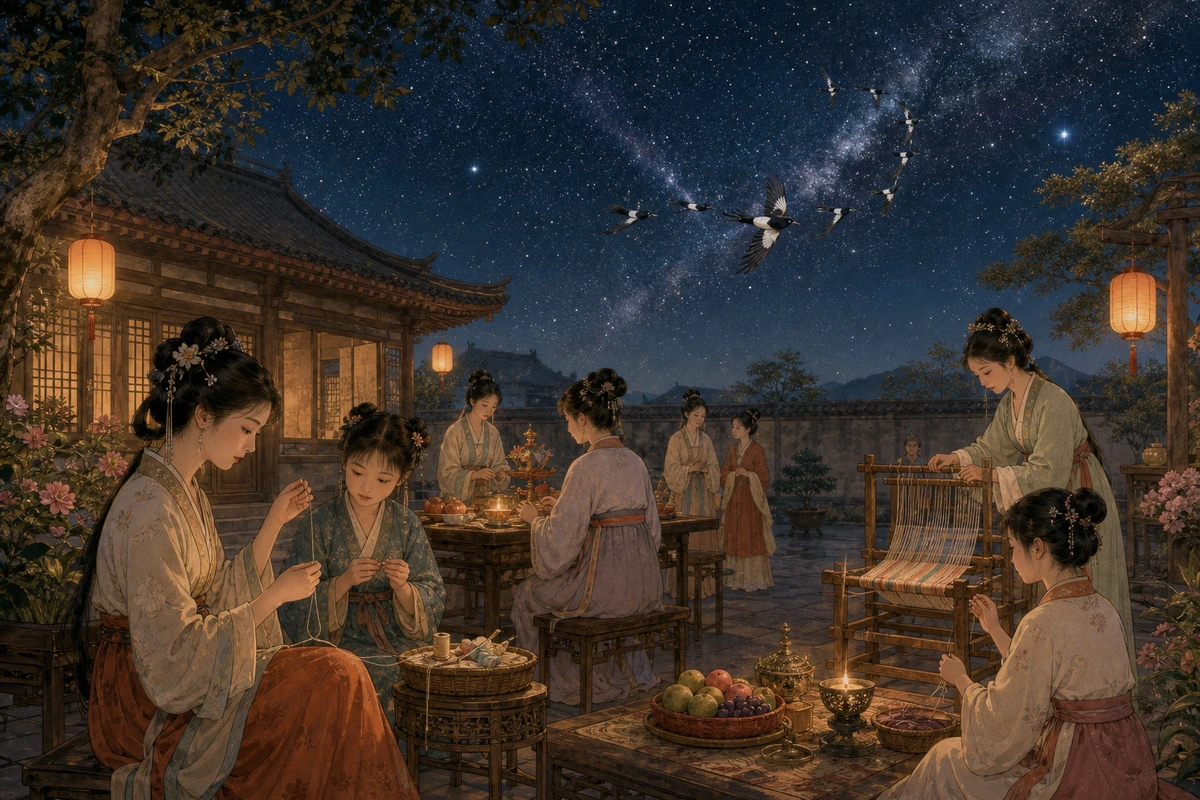
A historical name for the observance is Qiqiao, “pleading for skill” or “begging for cleverness.” Girls and women made offerings to the Weaver Girl and demonstrated abilities associated with textile production and household artistry. Needle-threading tests, displays of embroidery, carved fruit, special pastries, and observations involving spiders or reflected needlework appear in regional accounts. Customs differed by period and place, so no one checklist represents all of China.
These practices illuminate why reducing Qixi to a couples’ holiday loses so much. Weaving was skilled, economically valuable labor. Asking Zhinü for dexterity expressed hopes for competence, recognition, a stable household, and sometimes a good marriage. Contemporary museums and heritage programs continue the qiqiao theme through embroidery, dyeing, weaving, and family craft workshops.
The stars behind the story
Vega, Altair, and nearby Deneb form the prominent Summer Triangle. In East Asian star lore, the bright stars on opposite sides of the Milky Way made the separated lovers visible in the night sky. The narrative did not arise from modern scientific astronomy, yet it preserves close attention to seasonal celestial patterns. Myth and observation work together here without being the same kind of explanation.
Qixi today
Modern Qixi can include restaurant dates, flowers, jewelry, social-media campaigns, temple visits, and heritage events. Commercial romance is therefore a real part of the current festival, not simply a mistake. The problem comes only when it is presented as the whole history. Qixi has changed repeatedly, and contemporary couples share the date with older traditions of women’s artistry, prayer, and storytelling.
Qixi is often linked with Yue Lao, the divine arranger of marriages. Their themes overlap, but Yue Lao’s marriage register and cords come from a separate narrative complex. The Chang’e tradition provides another useful comparison: it too joins a female celestial figure, seasonal observance, and a night-sky body, but it belongs primarily to the Mid-Autumn Festival.