
Hecate is a Greek goddess of thresholds: crossroads, doors, torchlit movement, household protection, and later encounters with magic and the dead. Popular culture often reduces her to an evil witch or calls her an ancient “maiden, mother, and crone.” Neither description fits the range of Greek evidence. Hesiod gives her honors in heaven, on earth, and at sea, while later ritual and art make her a powerful guardian of places where worlds and paths meet.
Hecate in Hesiod’s Theogony
Hesiod names Hecate as the daughter of Asteria and Perses. Although she belongs to the generation before Zeus’s rule, Zeus does not strip away her privileges. He confirms her share in earth, sea, and starry heaven. This unusually long hymn within the Theogony presents her as honored by the Olympians rather than exiled from their order.
Hecate can favor kings in judgment, speakers in assembly, warriors, athletes, horsemen, sailors, fishers, and herders. She grants prosperity or withholds it and is called a nurse of the young. Nothing in this early passage confines her to witchcraft, moonlight, or the underworld. It is one of the clearest examples of how a deity’s profile can narrow in modern summaries even when an important ancient source is broad.
Hecate, Demeter, and Persephone
In the Homeric Hymn to Demeter, Hecate hears Persephone cry out during her abduction but does not see the captor. She approaches Demeter carrying torches and helps direct the search toward Helios, who can reveal what happened. When Persephone eventually returns, Hecate embraces her and becomes her attendant and companion.
The episode connects Hecate with searching, darkness, transition, and movement between the upper world and the underworld. It does not make her queen of the dead; that position belongs to Persephone. Hecate’s role is relational and mobile. She accompanies the one who crosses a boundary.
Crossroads and doorways
Later Greek worship places Hecate at three-way crossroads and before houses, gates, and sanctuaries. Such locations are both useful and uneasy: travelers choose a direction, strangers approach a settlement, refuse leaves the household, and the protected interior meets an uncertain outside. A goddess who can face several directions is well suited to guard them.
Small shrines or images could stand near doors, and the term hekateion is used for her cult image. Hecate’s titles vary by place and function. Forms related to Propylaia emphasize “before the gate,” while Enodia is associated with roads and can overlap with a distinct Thessalian goddess. Ancient religion did not force every local title into one tidy biography.
Hecate’s Deipnon and household ritual
At the end of the lunar month, households could prepare Hecate’s deipnon, or supper. Food and other materials were taken outside, often to a crossroads or shrine. The rite helped mark the month’s end, remove ritual pollution, and maintain the boundary between household order and what lay beyond it.
Ancient references mention foods such as cakes, eggs, fish, garlic, and other offerings in different contexts. Modern lists often present one fixed menu, but practices varied. It is also risky to describe every crossroads meal as a sinister sacrifice. The domestic setting connects purification, protection, obligation, and care for a dangerous boundary.
Why Hecate appears in triple form
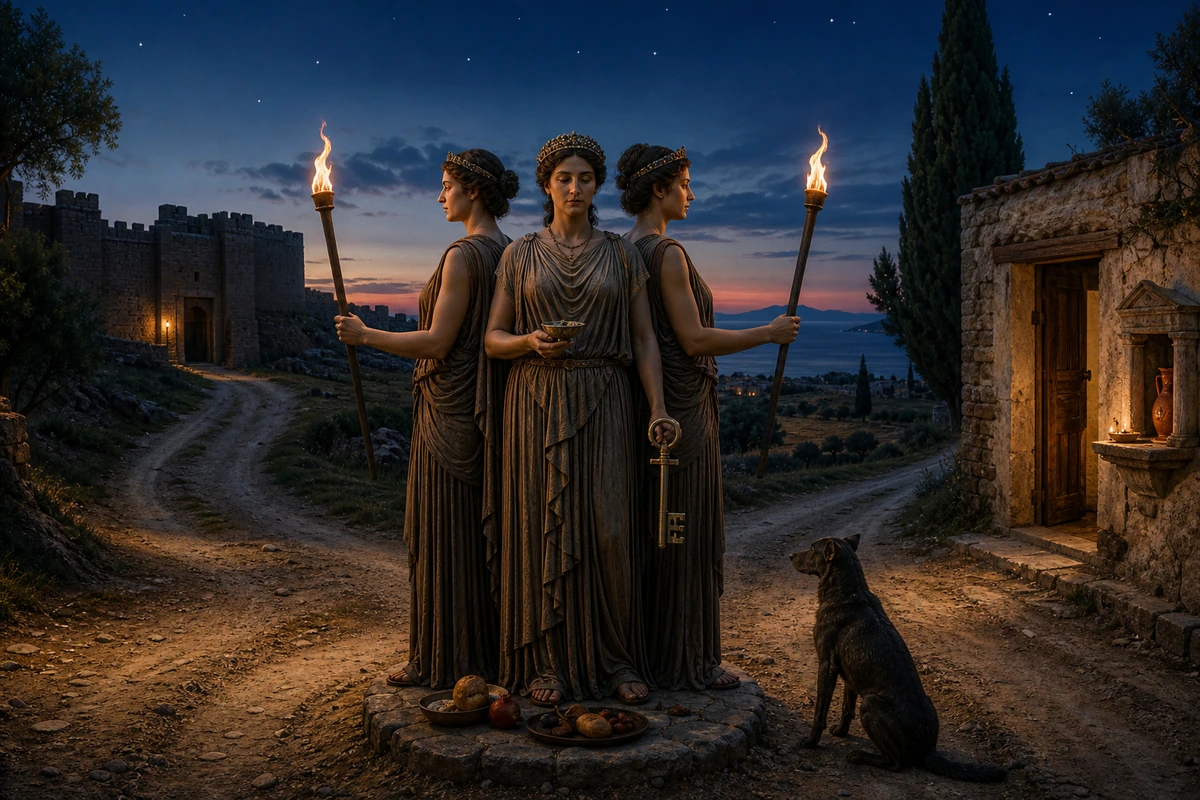
Hecate can be shown as a single woman holding torches or as three bodies joined around a central support. Pausanias credits the sculptor Alcamenes with an early three-formed Hecate at Athens, although artistic development cannot be reduced to one invention. Triple images allow the goddess to look outward in several directions, especially at a three-way junction.
The three bodies are normally similar in age. The widely circulated maiden–mother–crone scheme is a modern spiritual interpretation, not a standard explanation found in ancient Greek texts or surviving hekateia. It can be meaningful within a modern practice, but it should be labeled modern rather than projected backward as the original key to every triple image.
Attributes and what they mean
| Attribute | Ancient association | Common mistake |
|---|---|---|
| Torches | Search, night travel, ritual light, and Persephone’s passage | Proof that Hecate is simply a moon goddess |
| Triple body | Guarding several approaches and a stable cult image | An ancient maiden–mother–crone diagram |
| Dogs | Presence, warning, sacrifice, and the boundary of the household | Only a “familiar” from modern witch fiction |
| Keys | Access, guardianship, and opening or closing thresholds | A single universal “key to the underworld” doctrine |
| Crossroads offerings | Monthly, protective, purificatory, and local ritual practice | Evidence that every offering was a curse |
Magic, ghosts, and later literature
Hecate’s association with magic becomes especially visible in later Greek and Roman literature. She appears in stories of Medea and in poetry involving nocturnal rites, desire magic, ghosts, and the underworld. The Greek magical papyri and curse traditions invoke many gods under specialized names; Hecate can be prominent in this fluid ritual environment.
These sources should not be erased, but they also should not overwrite Hesiod, household worship, or civic cult. “Goddess of witchcraft” describes a real part of Hecate’s reception, especially in later periods. It becomes misleading when treated as her sole ancient identity or when “witchcraft” is given an unchanging modern definition.
Hecate in modern religion and popular culture
Contemporary Pagan, Wiccan, occult, feminist, and devotional communities have made Hecate an important living figure. Practitioners may understand her as a guide through trauma, a guardian of personal boundaries, a patron of magic, or a triple goddess. These are modern religious developments with their own value and history.
Accuracy does not require dismissing them. It requires separating contexts. A modern altar, a Shakespearean witch scene, a Roman magical text, a Classical hekateion, and Hesiod’s honored goddess are related through reception, but they are not interchangeable evidence for one timeless practice.
What Hecate represents
Hecate’s most consistent power is not evil but access. She stands where a person leaves safety, chooses a road, begins a new month, searches in darkness, or accompanies someone between states. Her torches do not abolish the night; they make movement through it possible.
That is why her broad early honors and her later chthonic character can coexist. A deity of thresholds must be able to touch more than one realm. Hecate protects the border precisely because she is not contained by either side.