

Accuracy note: Ancient sources disagree about Atalanta’s father, husband, Argonaut status, and some events. The Calydonian hunt and the footrace may preserve more than one regional tradition that later mythographers combined.
Atalanta is a hunter, runner, wrestler, and one of the most prominent women among Greek heroic figures. Her stories repeatedly place exceptional skill against expectations about gender and marriage, but they do not survive as one seamless biography.
Exposure and the she-bear
In the Library attributed to Apollodorus, Atalanta’s father exposes her because he wanted sons. A she-bear nurses the infant until hunters find and raise her. As an adult she remains in the wilderness, armed and committed to virginity. When the centaurs Rhoecus and Hylaeus attack her, she kills them with her bow.
Her father is Iasus in this account. Other authors call him Schoeneus or Maenalus. This is one reason scholars have suggested that Arcadian and Boeotian Atalanta traditions were joined over time.
The Calydonian boar hunt
Oeneus, king of Calydon, neglects Artemis in a harvest sacrifice, and the goddess sends a destructive boar. Meleager gathers heroes from across Greece. Atalanta is the only woman in the standard company and, in a prominent version, strikes the boar first with an arrow before Meleager kills it.
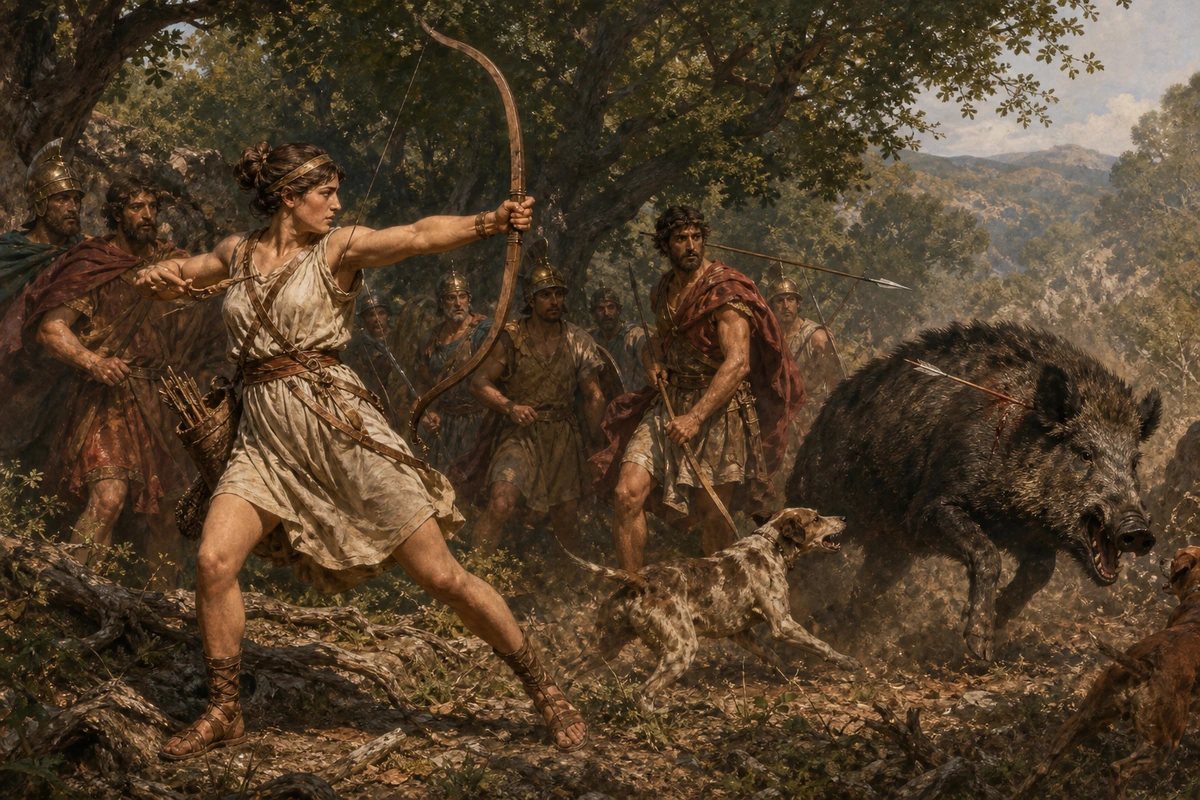
Meleager awards her the hide, but his maternal uncles object that a woman should receive the prize. Meleager kills them, and the family conflict leads to his death. Atalanta’s achievement is therefore not a decorative episode; it exposes the rivalry over who is allowed heroic honor.
Was Atalanta an Argonaut?
Some ancient lists include her among the Argonauts. Apollonius of Rhodes instead says she wished to sail but Jason refused, fearing her presence among an all-male crew would cause conflict. Both traditions existed. An article should name the source rather than declaring either “she was” or “she was not” an Argonaut without qualification.
Wrestling Peleus
Ancient art and literature also associate Atalanta with the funeral games for Pelias, where she wrestles Peleus and wins. The scene reinforces her athletic status independently of the marriage race and hunt.
The footrace and golden apples
When pressured to marry, Atalanta makes suitors race her. In Apollodorus’s version they run ahead while she pursues in armor; being caught means death, while victory means marriage. Melanion wins with golden apples from Aphrodite. He drops them as he runs, and Atalanta loses time collecting them.
Many other texts call the suitor Hippomenes and Atalanta’s father Schoeneus. Ovid gives Hippomenes an important speaking role and makes Venus describe the race. The names are not interchangeable proof of a scribal mistake; they reveal variant traditions.
Did Atalanta choose to lose?
Modern retellings sometimes claim she deliberately slows because she desires the suitor. Ovid gives her conflicting attraction and reluctance, while Apollodorus simply says the apples enable the victory. Her inner motive should therefore be tied to the version being discussed.
Transformation into lions
After the marriage, the couple have sex in a sacred precinct and are transformed into lions. The offended deity and location vary: Apollodorus names a precinct of Zeus, while other traditions connect the punishment with the Mother of the Gods or Cybele. The transformation was intensified by an ancient belief that lions did not mate with one another.
Mother of Parthenopaeus
Atalanta is also named as the mother of Parthenopaeus, one of the Seven against Thebes. His father may be Melanion, Ares, or Meleager depending on the account. This genealogy further shows why a single modern family tree can mislead.
Atalanta’s significance
Atalanta can be admired as an independent woman who succeeds in elite heroic spaces, but the ancient stories also repeatedly channel her toward marriage, maternity, punishment, or family catastrophe. Reading both elements reveals the tension of the tradition more clearly than turning her into either a simple rebel or a cautionary stereotype.