
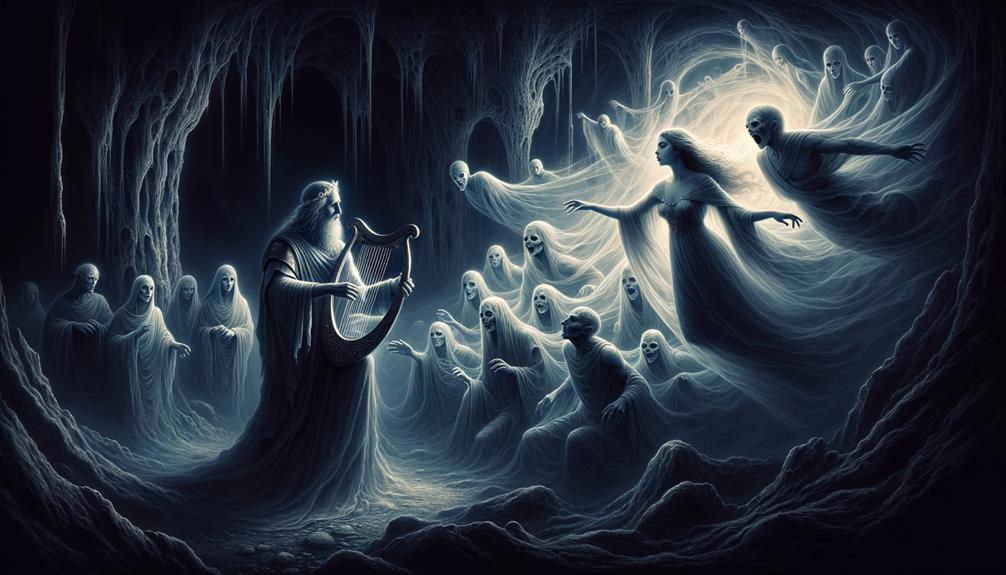
Accuracy note: The best-preserved ancient narratives of Orpheus and Eurydice come from Virgil’s Georgics and Ovid’s Metamorphoses. They agree on the failed return from the underworld but differ in framing, emphasis, and the reason Eurydice first encounters the snake.
Orpheus is the singer whose music crosses the boundary of death. Eurydice is the wife he nearly restores to life. Their story is familiar, but its details come from particular Roman poets rather than one timeless, fixed Greek script.
Virgil’s version: Eurydice flees Aristaeus
In Georgics Book 4, the tale appears inside a story about the beekeeper Aristaeus. Eurydice dies after stepping near a water snake while fleeing his unwanted pursuit. Orpheus mourns and descends through the entrance at Taenarum to the realm of the dead.
His singing moves the shades and the powers below. Eurydice is allowed to follow him upward on the condition that he not look back before reaching the world above. Near the boundary, Orpheus is seized by sudden madness or forgetfulness and turns. Eurydice is lost a second time and speaks a final farewell as she recedes into darkness.
Virgil then has Orpheus mourn for months before Thracian women tear him apart. Aristaeus must make ritual amends, and a new swarm of bees emerges from sacrificed cattle. This agricultural frame is essential to Virgil’s poem and is usually missing from stand-alone retellings.
Ovid’s version: anxiety and the second death
Ovid begins with ominous signs at the wedding and has Eurydice die from a snakebite while walking with Naiads. Orpheus enters the underworld and addresses its rulers in song. He argues that love has brought him there and asks only to borrow Eurydice until she has lived out her proper span.
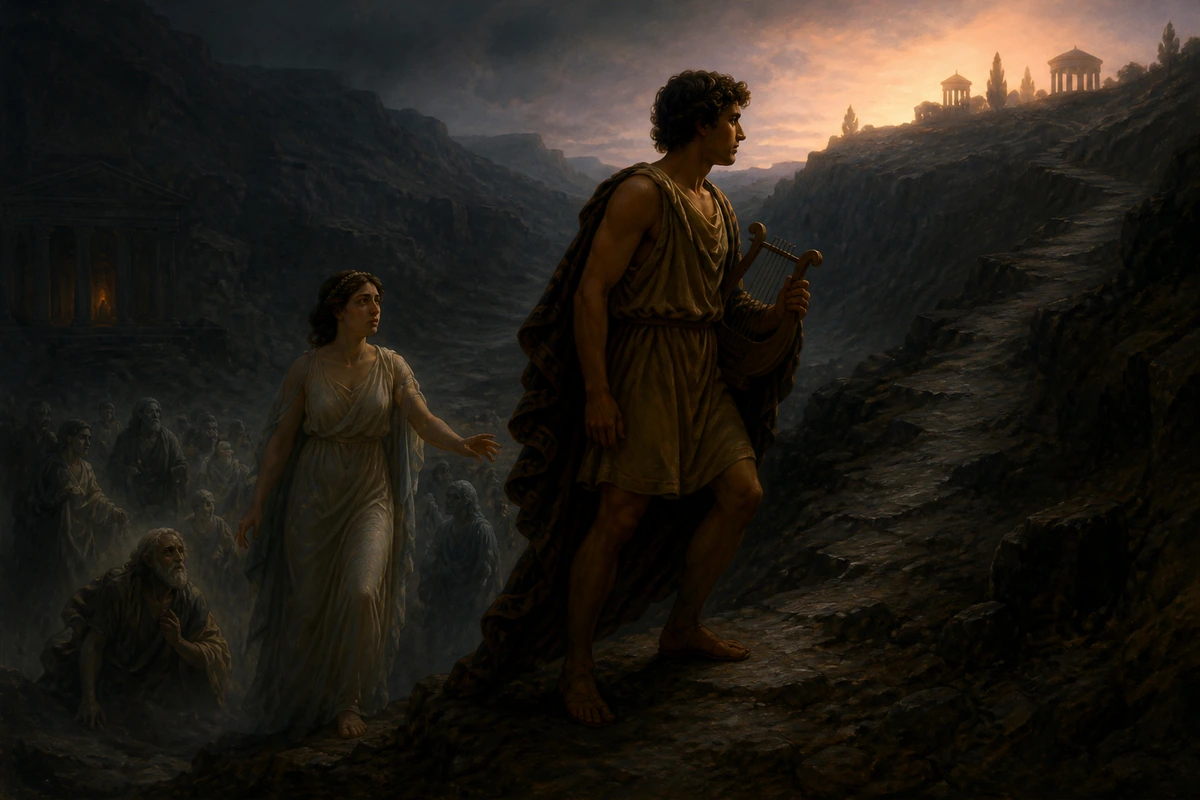
Pluto and Proserpina grant the request with the same condition. Ovid says Orpheus turns because he fears Eurydice may be failing behind him and longs to see her. She slips back, and the poet says she makes no complaint except that she was loved. Charon refuses Orpheus a second crossing.
Why does Orpheus look back?
Ancient texts do not give the modern psychological monologue often supplied in adaptations. Virgil emphasizes a sudden failure under divine law; Ovid emphasizes fear and desire. The glance can be interpreted as doubt, impatience, love, or the impossibility of reversing death, but those are readings of the episode rather than new ancient facts.
Who rules the underworld?
Modern summaries often credit Hades alone. Both Virgil and Ovid present a royal pair: the ruler of the dead and his queen. In Latin they are Dis or Pluto and Proserpina. The condition is not simply a “cruel trick”; it is the extraordinary term on which the normal order of death is temporarily suspended.
Orpheus before Eurydice
Orpheus had an older and wider mythic identity as an extraordinary Thracian singer, an Argonaut, and a figure connected with initiatory poetry and beliefs about the afterlife. The Eurydice episode became his most famous story, but it does not exhaust the evidence about him.
Ancient allusions also suggest that versions of an underworld rescue circulated before Virgil. The precise form and outcome may not always have matched the later canonical failure. It is safer to say Virgil and Ovid shaped the versions that dominate Western art.
Music that interrupts punishment
Ovid lists impossible pauses produced by the song: Ixion’s wheel stops, Sisyphus sits on his stone, Tantalus ceases reaching for water, and the Danaids stop filling leaking vessels. The catalogue defines Orpheus’s power through temporary stillness. Music cannot abolish death, but it can make even the underworld listen.
Eurydice’s limited voice
The story is usually told from Orpheus’s viewpoint. Eurydice speaks only briefly in Virgil and scarcely at all in Ovid. Modern writers have often used that silence as a reason to retell the myth from her perspective. Such works belong to reception history and should not be mistaken for recovered ancient testimony.