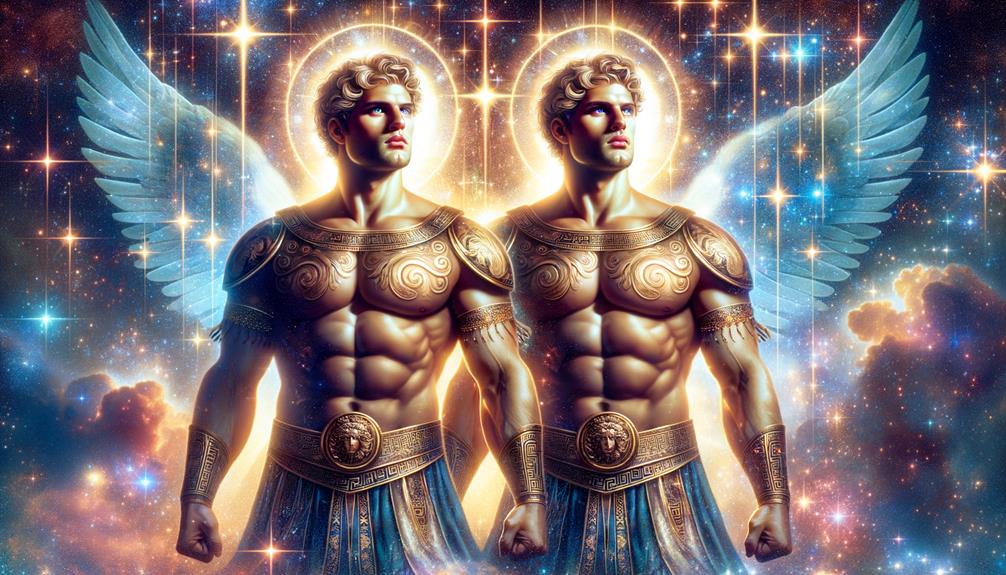
Castor and Polydeuces—Pollux in Latin—are the Dioscuri, the “sons of Zeus.” Greek authors do not agree on whether both twins are Zeus’s sons or only Polydeuces is divine. That disagreement is central to their story, because the best-known version ends with the immortal brother choosing to share his life with the mortal one.
Castor, Polydeuces, and their names
The Greek names are Kastor and Polydeukes, usually anglicized as Castor and Polydeuces. Roman authors call the second brother Pollux. Together they are the Dioskouroi or Dioscuri, “boys of Zeus,” and also the Tyndarids, “sons of Tyndareus.” The two collective names preserve the same uncertainty found in their genealogies.
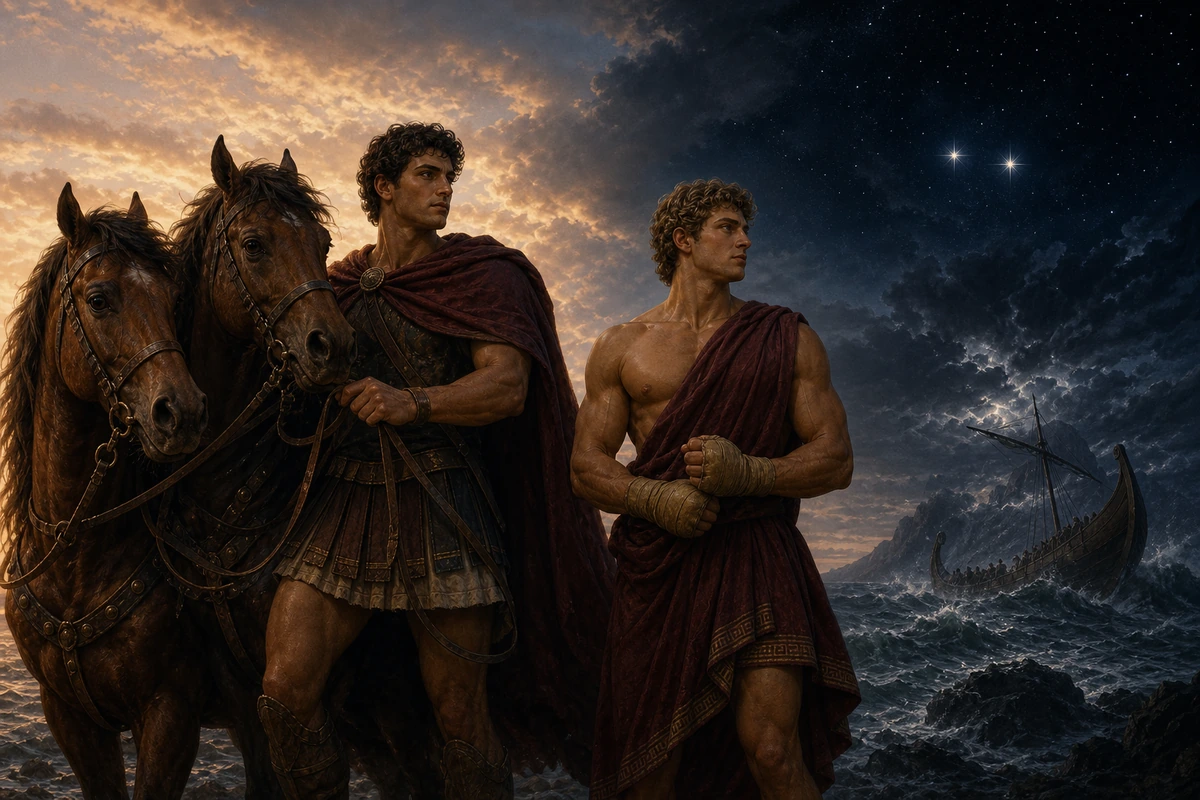
Castor is repeatedly described as a skilled horseman or tamer of horses. Polydeuces is the outstanding boxer. Their identities are complementary rather than interchangeable, even when poetry treats them as an inseparable pair.
Who were their parents?
Homer’s Odyssey calls Leda the wife of Tyndareus and says she bore Castor and Polydeuces to him. The Homeric Hymns instead call both twins sons of Zeus and Leda. Pindar’s Nemean 10 gives the version now most familiar: Polydeuces is Zeus’s immortal son, while Castor carries the mortal seed of Tyndareus.
Stories about Leda’s eggs and the division of four children between Zeus and Tyndareus belong to still other ancient and later combinations. There is no single family tree that resolves every source without contradiction.
Horseman and boxer
The brothers join several heroic adventures. They sail with Jason on the Argo, appear in traditions about the Calydonian boar hunt, and recover their sister Helen after Theseus carries her away. During the Argonautic voyage, Polydeuces defeats the brutal Bebrycian king Amycus in a boxing match.
Conflict with another pair of cousins, Idas and Lynceus, leads to their deaths or transformation. Sources disagree about whether cattle theft, the abduction of the Leucippides, or both stand behind the quarrel. Those variants should not be merged into one confidently sequenced feud.
Death and shared immortality
In Pindar’s version, Idas mortally wounds Castor. Polydeuces returns to find his brother dying and begs Zeus to let him die too. Zeus offers a choice: Polydeuces may live forever on Olympus, or he may share everything with Castor, spending half their time beneath the earth and half in heaven. He immediately chooses the shared life.
Odyssey 11 gives a shorter and different formulation. The earth covers both brothers alive; they receive honour from Zeus and alternate between life and death. Both accounts make alternation the answer, but only Pindar dramatizes Polydeuces’s choice and divided parentage.
Why sailors called on the twins
The Homeric Hymn to the Dioscuri presents the brothers as rescuers of ships. Sailors caught in violent winds pray to them, and the twins appear darting through the air before stilling the storm. Later Greeks and Romans connected their presence with paired lights seen around a ship’s mast, the phenomenon now called St. Elmo’s fire.
It is unnecessary to invent a scene in which Poseidon formally grants them control of the sea. Their protective role is directly attested in hymns and later poetry. The paired lights, horses, travellers’ caps, and stars become visual ways of recognizing them.
Spartan cult and the twin stars
The Dioscuri were especially important at Sparta and nearby Therapne, where traditions located their dwelling or tomb. They were patrons of horsemen, athletes, guests, travellers, and communal order. Pindar also associates them with athletic contests at Sparta.
The constellation Gemini became their most durable celestial image, but ancient accounts of their alternate days are not merely a coded astronomy lesson. Their myth first expresses a bond that refuses the permanent separation of mortal and immortal kin.