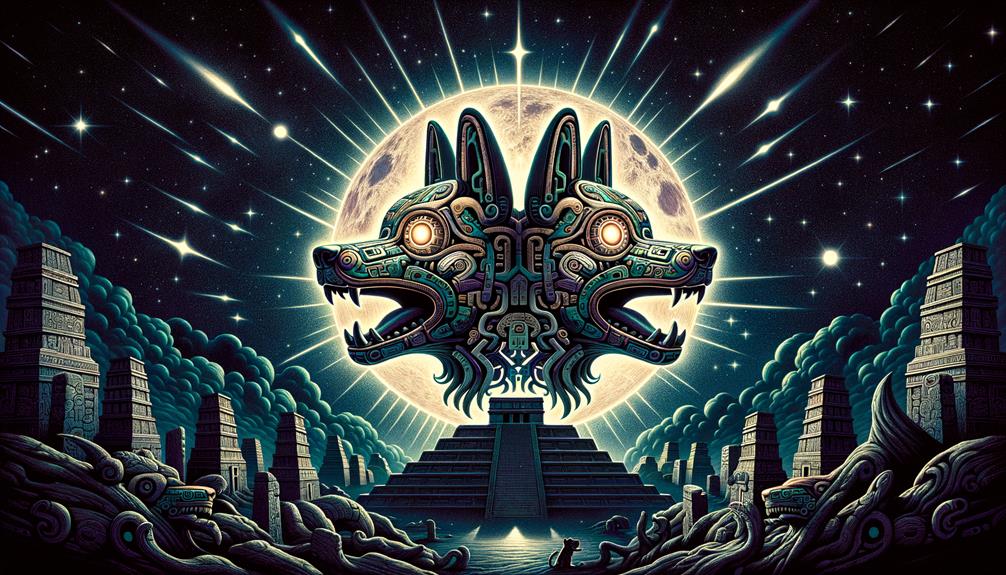
Xolotl is a Nahua deity associated with dogs, twins and bodily difference, lightning or fire, the evening star, and the dangerous boundary between life and death. He is frequently called Quetzalcoatl’s twin or double. Describing him only as an “Aztec Anubis” loses the specifically central Mexican stories that connect sunset, sacrifice, transformation, and funerary dogs.
What does Xolotl mean?
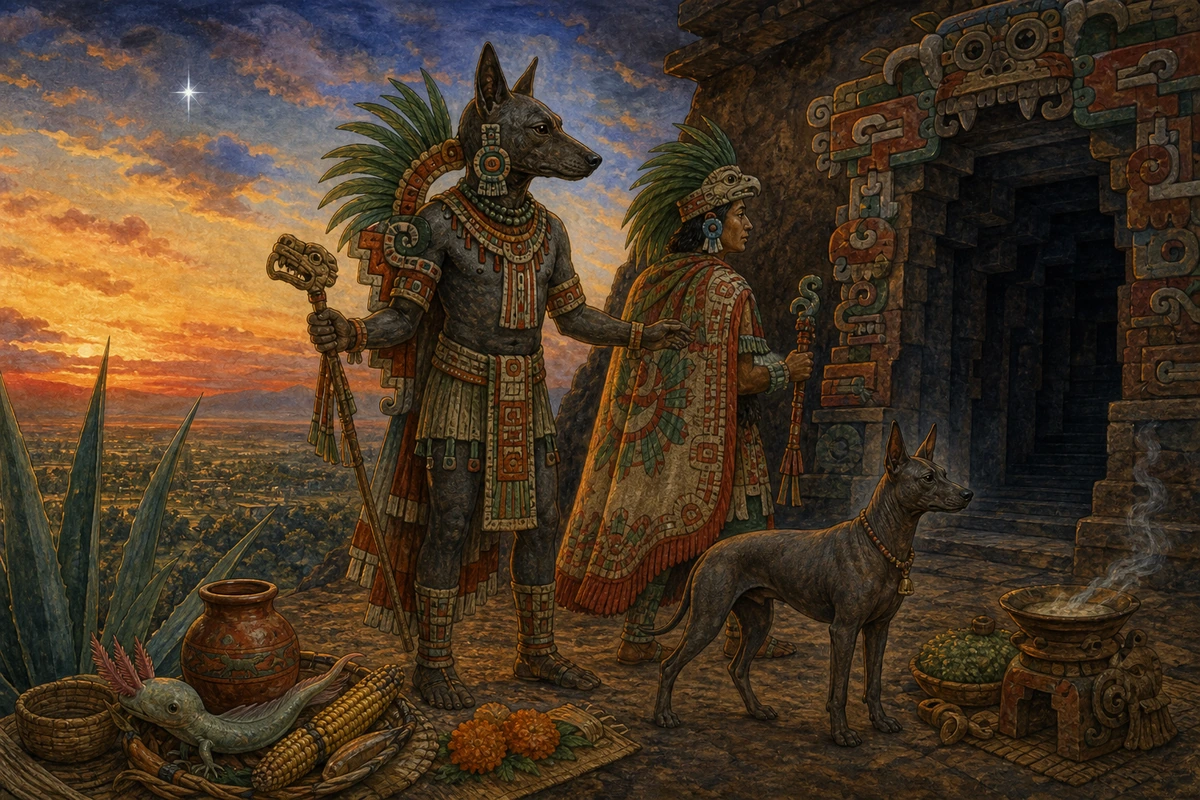
Xōlōtl has a wider field of meaning than “dog.” Colonial dictionaries connect it with a servant, page, double, twin, or being marked as unusual or incomplete. The word also appears in xoloitzcuintli, the Mexican hairless dog, and in axolotl, the aquatic salamander.
The overlapping meanings help explain the deity’s associations without reducing his name to one modern English label. Xolotl is a double and a boundary figure who can take canine form.
Quetzalcoatl’s twin and Venus at dusk
Central Mexican sources pair Xolotl with Quetzalcoatl. Quetzalcoatl can represent the bright morning aspect of Venus, while Xolotl is linked with the evening star descending after the sun. The pair express complementary phases rather than two modern astronomical “gods” mechanically assigned to one planet.
As daylight ends in the west, Xolotl accompanies the sun toward the night world. His dog form suits a guide able to cross between the inhabited surface and Mictlan.
The god who fled sacrifice
In one account of the creation of the Fifth Sun, the gods must die so the sun can move. Ehecatl acts as executioner, but Xolotl weeps and flees. He hides by transforming into a double maize stalk called xolotl, then a doubled maguey called mexolotl, and finally the aquatic axolotl. He is discovered and killed.
The story explains several Nahuatl names through transformation, but it also complicates Xolotl’s divine status. He is not merely death’s fearless master. He is the god who fears sacrifice, changes shape, and is nevertheless drawn into the cosmic payment demanded of the others.
Dogs and the journey after death
Dogs had deep mortuary importance across Mesoamerica long before the Mexica Empire. Archaeological burials and ceramic vessels show canines as companions, offerings, and guides. Nahua accounts say a dog could help the dead cross a dangerous river on the route to Mictlan.
Xolotl’s canine identity belongs in that wider tradition, but not every burial dog is an image of Xolotl. The domestic animal, the divine guide, and the named breed intersect without becoming identical.
The descent for the bones
Quetzalcoatl’s journey to Mictlan to recover the bones of earlier humans is sometimes told with Xolotl as his companion. The Legend of the Suns focuses on Quetzalcoatl’s confrontation with Mictlantecuhtli, the breaking and recovery of the bones, and their eventual animation with divine blood.
When Xolotl is added as guide, the pairing fits his underworld role. It should still be presented as a version or interpretation, not inserted into every surviving text as though the manuscripts were identical.
Difference, doubling, and protection
Xolotl was associated with twins, congenital difference, and bodies considered unusual. Modern descriptions sometimes use the harsh word “monstrous,” reflecting both the range of the Nahuatl term and colonial translation. Difference could be a divine sign rather than merely a stigma.
Sources also connect him with lightning, fire, misfortune, and protection during pregnancy. These domains share the theme of unstable transitions: a flash between sky and earth, a doubled birth, the evening star at sunset, or a traveller moving from life toward the dead.
Why Xolotl is not Anubis
Both Xolotl and the Egyptian Anubis can appear canine and relate to the dead, which makes the comparison tempting. Their myths, ritual systems, visual conventions, and historical settings are separate. Anubis oversees embalming and tomb protection in Egyptian religion; Xolotl belongs to Nahua stories of Venus, divine sacrifice, transformation, and the Mictlan journey.
Xolotl does not need an imported equivalent. His own linked identities—as twin, evening star, reluctant sacrifice, dog, and boundary-crosser—form a coherent and distinct profile.