
Near the end of Egils saga Skalla-Grímssonar, a grave at Mosfell is opened and an unusually large skull is examined. The scene has inspired modern medical speculation about the saga’s formidable poet-warrior, Egill Skallagrímsson. It has not, however, produced a diagnosis. No authenticated remains of Egill have been recovered, and the saga never describes his bones as cursed.
Who was Egill Skallagrímsson?
Egill is the central figure of an Icelandic family saga conventionally dated to the thirteenth century. The narrative places most of his life in the tenth century, several hundred years before its surviving manuscripts. It follows his family’s settlement in Iceland, his feuds and travels, and his career as a poet capable of both violence and intricate verse.
The saga gives Egill a striking body: large, strong, heavy-featured, and difficult even in old age. Such characterization can preserve social memory, literary convention, or both. It is not equivalent to a clinical record written by an observer trained in modern medicine.
What the saga says about the grave
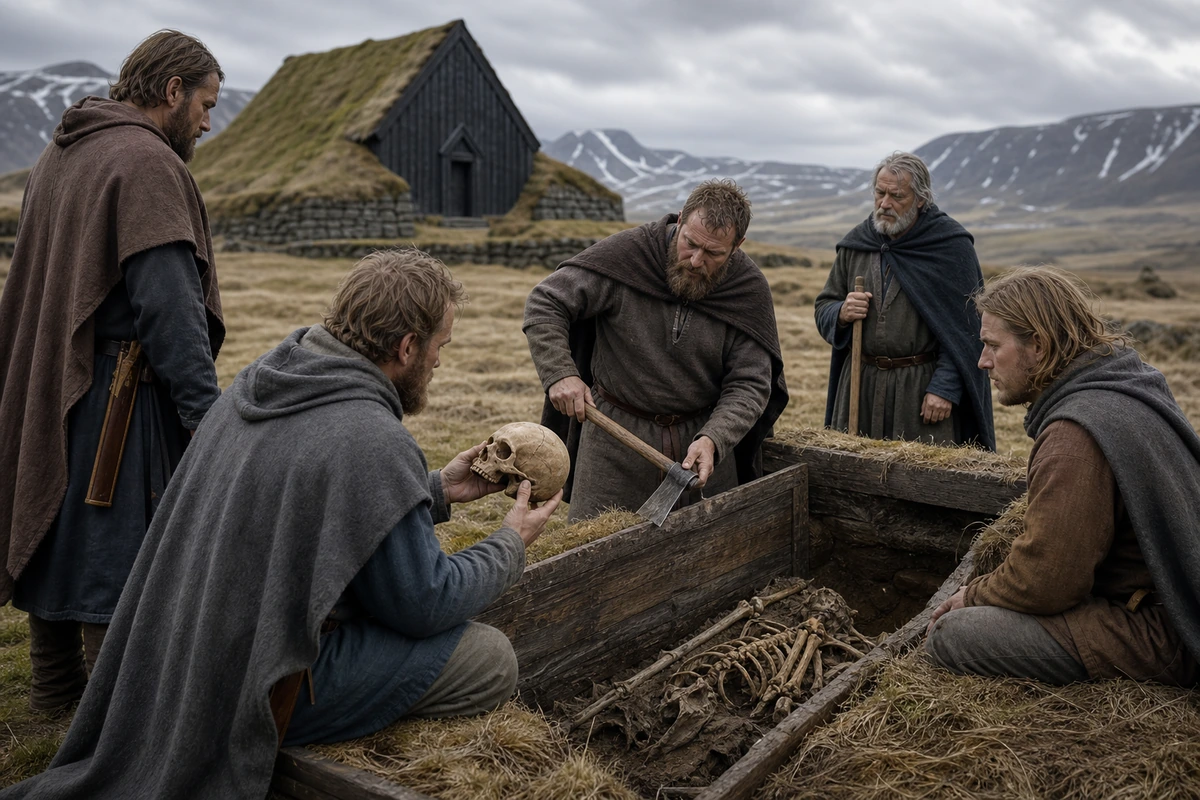
The final chapters move from Egill’s death to the history of his burial place. He is first said to have been buried in a mound at Mosfell. When a church is later built, his bones are moved beneath its altar. Still later, when that church is taken down, the bones are found again and reburied in the outer churchyard.
The saga singles out the skull. It is described as exceptionally large and heavy, with ridged or shell-like markings on its surface. A priest named Skapti Thórarinsson tests its hardness by striking it with the back of an axe. The blow whitens the bone but neither dents nor cracks it. The remains are then buried again.
This is the actual basis of the “mysterious bones” story. There is no curse, spell, haunting, or supernatural warning in the passage.
The Paget disease hypothesis
Modern readers have proposed that Egill’s appearance and the saga’s description of a thick, heavy skull resemble Paget disease of bone. Paget disease can disrupt normal bone renewal and sometimes produces enlarged or thickened bones, including the skull. The comparison is an interesting exercise in retrospective diagnosis, especially because the saga offers several physical details rather than one isolated adjective.
But resemblance is not proof. The diagnosis depends on a literary description recorded centuries after Egill’s presumed lifetime. There are no radiographs, laboratory findings, securely identified skeletal remains, or contemporary medical observations. Even the axe test is a narrated episode whose purpose may be to emphasize the hero’s exceptional hardness after death.
Why other explanations have been proposed
Researchers have also discussed endemic skeletal fluorosis, a condition caused by prolonged exposure to high levels of fluoride, as a possible explanation for dense and altered bone. That suggestion illustrates the central problem: the same brief description can be mapped onto more than one modern condition.
Other possibilities include normal variation, age-related change, an unidentified individual’s remains, exaggeration, or a literary motif. Without the skeleton itself and a secure chain of identification, no method can choose conclusively among them.
Could the grave be found?
Archaeology at Mosfell has studied the conversion-era landscape and the movement of farms, churches, and cemeteries. That work helps researchers understand the social setting in which stories about burial and reburial developed. It does not mean that a skull matching the saga passage has been found and verified as Egill’s.
An identification would require much more than a large skull in the right district. Archaeological context, dating, biological profile, and ideally independent evidence linking the grave to the saga’s family would all matter. DNA could establish relationships only if securely identified comparison material existed.
Reading the episode responsibly
The Mosfell passage is valuable on two levels. As literature, it supplies a final image of Egill’s physical power: even his skull resists an axe. As cultural evidence, it records medieval interest in church relocation, remembered graves, and the treatment of ancestral remains.
Medical interpretation can add a third level, but it must retain the word hypothesis. The careful conclusion is not that Egill certainly had Paget disease, fluorosis, or supernatural bones. It is that a medieval author described an extraordinary skull in terms vivid enough to invite—and limit—modern diagnosis.