
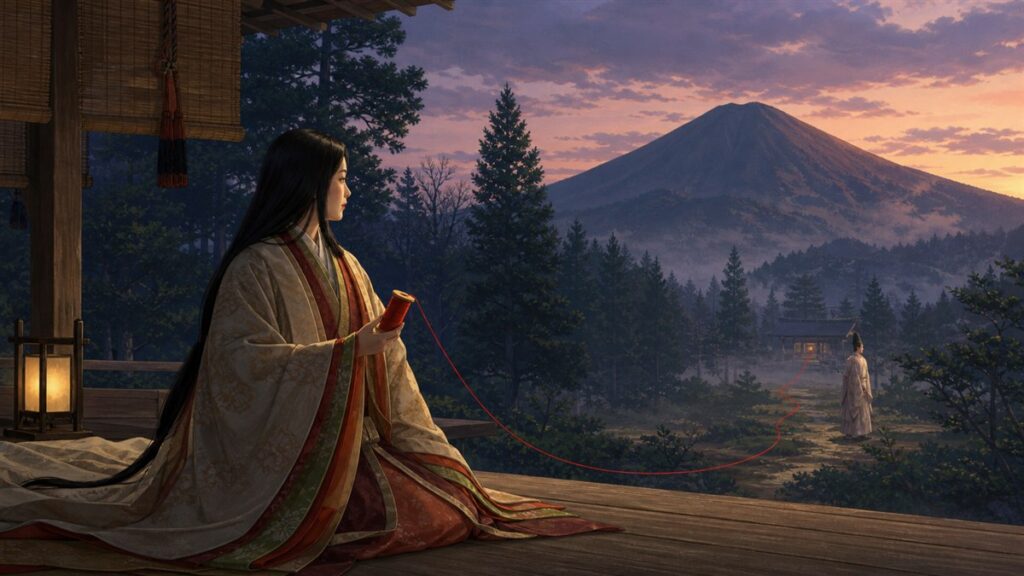
Ikutamayorihime belongs to one of the Kojiki’s most memorable divine-identity tales. She is not a seaweed goddess. She is the woman whose mysterious lover is revealed as Ōmononushi, the deity of Mount Miwa, when a thread leads from her chamber to the mountain. Her pregnancy also anchors the genealogy of Ōtataneko, a priest whose worship ends a devastating epidemic.
Where the story appears
The episode is told in the Kojiki, compiled in 712, during the reign of Emperor Sujin. Japan is suffering from epidemic and disorder. A dream reveals that proper worship of Ōmononushi will restore the realm, but the ritual requires a particular descendant: Ōtataneko. The narrative then explains how that descent began with Ikutamayorihime.
The unknown visitor
Ikutamayorihime is described as exceptionally beautiful. A handsome man visits her at night, and before long she becomes pregnant. She does not know his name or origin. Her parents, astonished because no recognized husband comes to the house, ask how the pregnancy occurred. She tells them about the nightly visitor.
The needle, red earth, and hemp thread
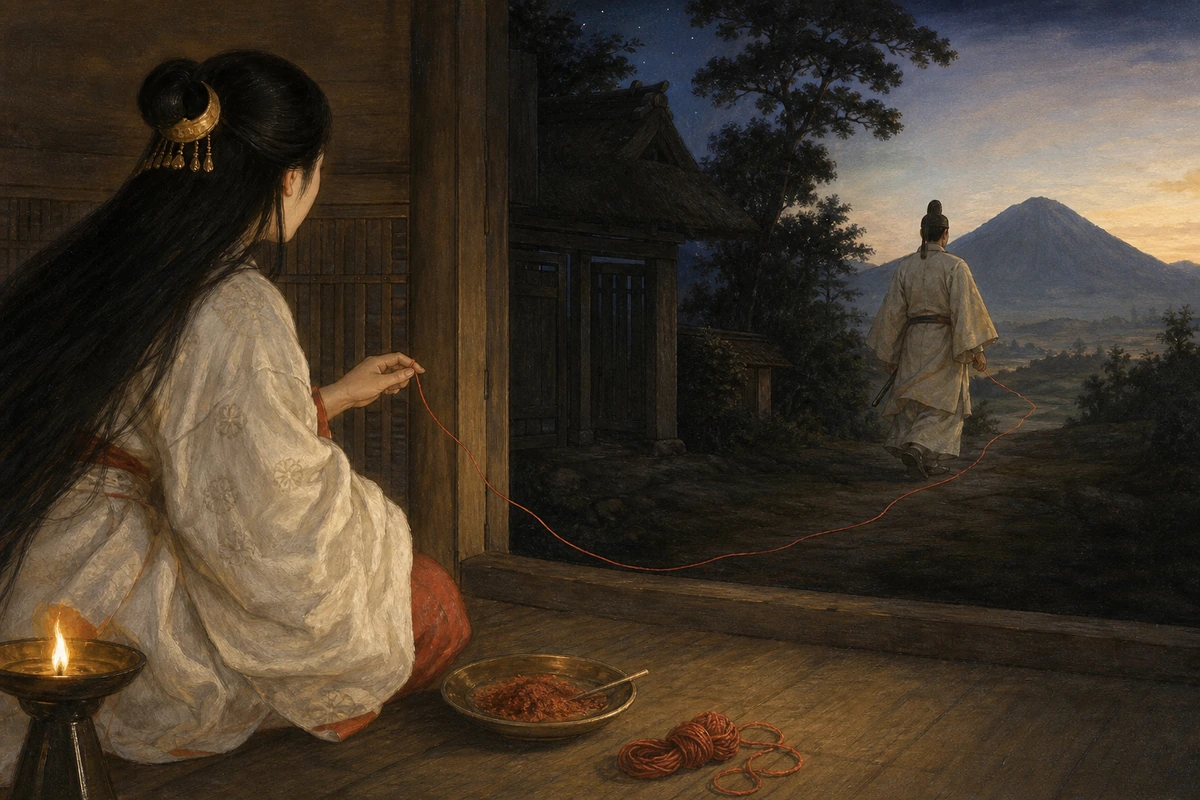
Her parents devise a way to identify him. They instruct her to scatter red earth beside the bed, pass hemp thread through a needle, and fasten the needle to the edge of the visitor’s garment. In the morning, the thread runs out through the door’s keyhole. Only three coils remain inside.
The path to Mount Miwa
Following the thread, the family finds that it reaches Mount Miwa. The visitor is therefore understood to be the mountain’s deity, Ōmononushi. The Kojiki connects the three remaining coils to the name Miwa: an example of ancient wordplay used to make a place-name meaningful within a sacred story.
Why Ōtataneko matters
Ikutamayorihime’s child begins the line from which Ōtataneko descends. When Emperor Sujin locates him and appoints him to worship Ōmononushi, the epidemic subsides and the country returns to order. The love mystery is thus also a political and ritual genealogy. It authorizes a priestly descendant by connecting him directly to the deity he serves.
Mount Miwa as the deity’s body
Ōmiwa Shrine is famous for directing worship toward Mount Miwa itself rather than centring a conventional main sanctuary containing an image of the god. Later shrine history is not identical to the eighth-century text, but it preserves the mountain’s status as the divine presence. The thread’s destination matters because it points to a sacred landscape, not simply a hidden house.
What the story is not
Ikutamayorihime’s name and story are sometimes confused with other women whose names contain tama or hime. She is not Toyotama-hime, Tamayori-hime, or Yamato-totohi-momoso-hime, another woman linked with Ōmononushi in a separate episode. Nor does the story explain the modern East Asian “red string of fate”: the Kojiki thread is hemp, while the red material is earth scattered on the floor.
Why the episode endures
The narrative moves from an intimate question—who visits at night—to the sacred identity of a mountain and the ritual health of the realm. A domestic act of investigation reveals divine geography. Ikutamayorihime is therefore essential to the story’s logic even though the text says little about her life beyond the encounter.
Sources and further reading
- Kojiki, translated by Basil Hall Chamberlain, section on Emperor Sujin and Ōtataneko
- Ōmiwa Shrine, traditional accounts of Ōmononushi and Mount Miwa
- Kojiki, trans. Gustav Heldt, Columbia University Press
- Kojiki, trans. Donald L. Philippi, University of Tokyo Press