

Tantalus is one of Greek myth’s exemplary punished figures. In Homer’s Odyssey, he stands in water he cannot drink beneath fruit he cannot reach—the image that gave English the verb “to tantalize.” Later authors disagree about the crime that produced this fate, and some even reject the most notorious version of his story.
The punishment in Homer
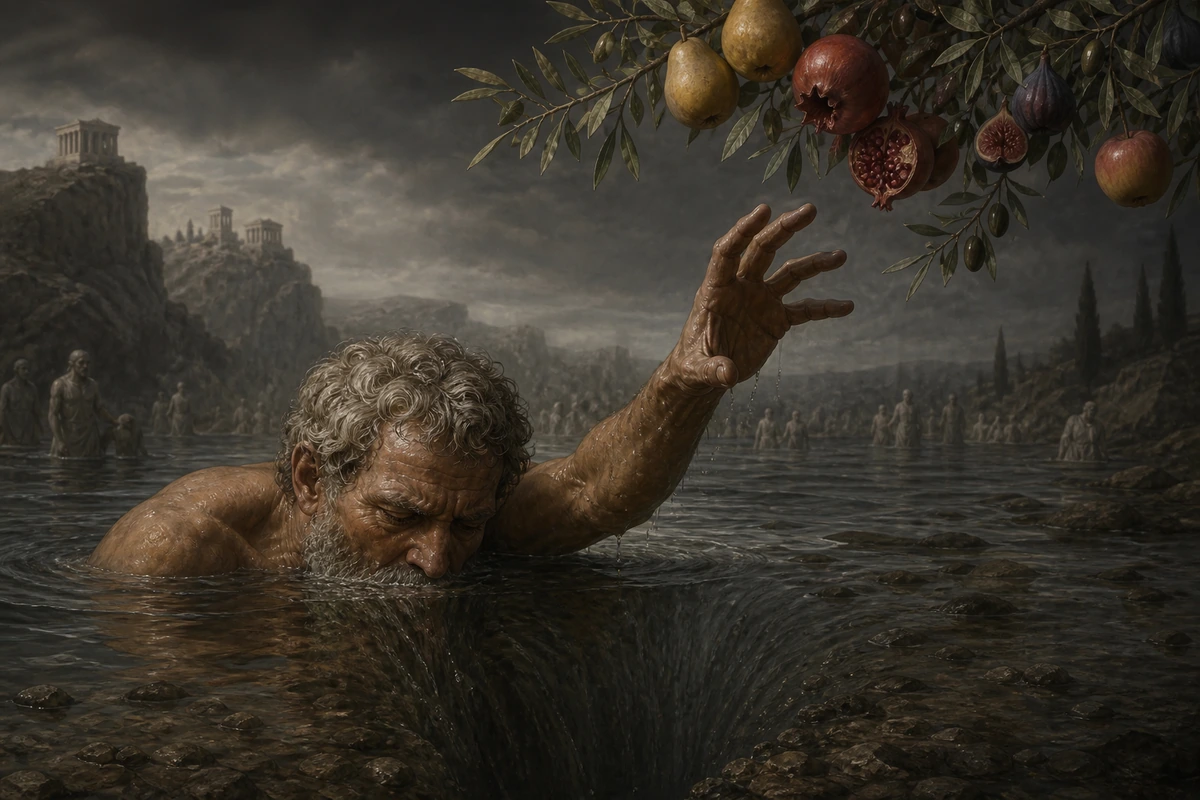
When Odysseus sees Tantalus among the dead, the old king stands in a pool that reaches his chin. Each time he bends to drink, the water vanishes and dry ground appears. Pears, pomegranates, apples, figs, and olives hang overhead, but a wind lifts the branches whenever he reaches for them.
This early surviving passage describes the torment but does not explain Tantalus’s offense. The punishment’s precision is its power: abundance is permanently visible and permanently unavailable.
What did Tantalus do?
Later Greek and Roman sources offer several answers. Tantalus is said to have stolen nectar and ambrosia from the gods, shared divine secrets with mortals, lied about a golden dog, or abused the extraordinary privilege of dining with the immortals. Some traditions say a threatening stone also hangs over him.
The most shocking story claims that he killed his son Pelops, cut him into pieces, and served him at a banquet to test whether the gods would recognize human flesh. The gods restore Pelops; Demeter, distracted by grief, has eaten part of his shoulder, which is replaced with ivory.
Pindar rejects the cannibal feast
In Olympian Ode 1, Pindar explicitly refuses to repeat the claim that the gods ate Pelops. He offers another version: Poseidon takes the beautiful Pelops away, while Tantalus later loses divine favor because he shares nectar and ambrosia with mortal companions. Pelops returns and wins Hippodameia.
Pindar’s correction is valuable evidence that Greek poets did not simply copy a fixed canon. They argued with inherited stories and reshaped them for performance, theology, and audience.
Pelops and the House of Atreus
Tantalus stands at the beginning of a family line marked by recurring violence. Pelops becomes the father of Atreus and Thyestes; their descendants include Agamemnon, Menelaus, Orestes, and Electra. Later literature can treat the family’s disasters as inherited pollution or a curse, but each work configures that inheritance differently.
The banquet story also anticipates the feast of Thyestes, in which Atreus serves a father the flesh of his children. Greek tragedy repeatedly explores how violence within a household reproduces itself across generations.
What the story means
Tantalus is often summarized as a warning against greed, but not every version makes greed the offense. The more consistent theme is violated reciprocity between mortal and divine realms. He receives access to the gods and misuses it; his punishment grants apparent access to food and water but denies consumption forever.
The myth survives so strongly because the image works even when the cause changes. Desire is kept alive by nearness, and fulfillment retreats at precisely the moment it appears possible.