

Accuracy note: Iris is a divine messenger and a personification of the rainbow in Greek poetry. Claims about her marriage or children depend on the source and should not be presented as a universal genealogy.
Origins and Family

Thaumas, the marine deity, and Electra, a cloud nymph, merged their essences, giving birth to Iris. She personified the harmony between sea and sky, carrying the nature of both water and air within her. As an Oceanid, Iris had deep ties to the primordial waters governed by Oceanus the Titan. This bond amplified her connection to the ever-transforming, life-sustaining seas, positioning her within a vast pantheon of divine beings overseeing the world’s waters.
Iris’s tradition interwove further when she formed a romantic bond with Zephyros, the West Wind god. Their union integrated air and water in a cosmic dance. Through their son Pothos, Iris touched the worlds of longing and desire, reflecting the emotional undercurrents beneath her rainbow-hued persona. Her origins and familial links portrayed Iris as a goddess embodying unity amidst the elements.
Role as Divine Messenger

Iris darts through the sky, a dazzling burst of color bridging the worlds of gods and mortals. Her feathered wings flutter with urgency as she carries messages shaping fates, resolving clashes, fulfilling age-old prophecies. In this sacred duty, Iris ensures the Olympian decrees resound across the world, threads weaving a tradition of cosmic harmony.
Swift Celestial Communication
In the cosmic expanse, Iris darts across the heavens with meteoric speed, relaying messages between gods and mortals. The rainbow goddess, her wings glimmering, soars vast distances from Mount Olympus to Earth.
As a divine messenger, Iris maintains celestial and earthly equilibrium. She ensures the gods’ will is swiftly enacted. Her messages bring hope, reveal mysteries, deliver judgments, and sustain cosmic order.
Iris epitomizes speed and reliability, a conduit of divine intent. Her presence shows the gods’ ubiquitous influence, reaching every corner of existence. Her very essence bridges the divine and mortal worlds.
Divine Messages Delivery
With iridescent wings that shimmer like an ethereal tradition, Iris descends from the heavens, ferrying sacred messages from the gods to the mortal world. Moving with the fluid grace of a rainbow, she bridges the divide between Mount Olympus and Earth as the gods’ swift messenger. Her role extends beyond mere message delivery; she maintains divine equilibrium by facilitating communication and order among mortals and deities alike.
Each mission Iris undertakes pulses with important significance. She traverses worlds at unmatched speed, her presence a tangible manifestation of divine decree and celestial authority. Every message she conveys, whether Aphrodite’s whispered words of love or Zeus’s stern commands, weaves threads of destiny and fate. Iris’s importance cannot be overstated; she stands as the lifeline through which the gods impart their desires, edicts, and blessings.
In mythological lore, Iris endures as a symbol of connection, her rainbow pathways intertwining the divine and mortal domains. Through her dedicated service, she exemplifies the vital role of divine message delivery, a steadfast guide amidst a world shaped by the capricious whims of the gods.
Symbolism and Attributes

Iris’s attributes vividly depict her role’s essence. Wings allow her to traverse freely, a herald’s staff delivers messages authoritatively, and a pitcher serves nectar, reaffirming her link to the divine world.
- Wings: Representing boundless travel and the limitless nature of sacred communication.
- Herald’s Staff: Symbolizing truth and the weight carried by her words as a messenger.
- Pitcher of Nectar: Nurturing life and conveying its essence through divine sustenance.
- Rainbow Bridge: An arc of hope, a conduit spanning the human world and the divine.
Iris embodies the sacred act of communication and transition itself. She upholds cosmic balance by ensuring order and conveying crucial messages across worlds in Greek mythology.
Myths and Legends
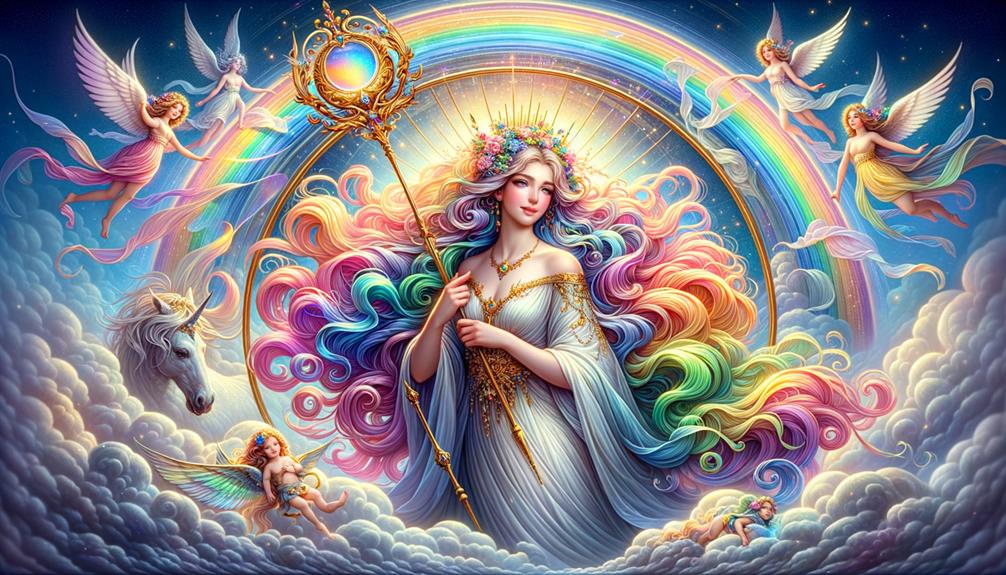
Iris, with her rich wings and dazzling rainbow hues, takes center stage in countless myths and legends as the bridge between gods and mortals. As the daughter of Thaumas and Electra, she personifies the beauty of sea and sky, her very existence symbolizing the hope rainbows represent. Her swift wings carry her across worlds, cementing her role as the divine messenger, ever-ready to deliver the gods’ will to the mortal world.
One story highlights Iris fetching water from the River Styx, that hallowed stream where gods pledge their sacred vows. Through her, divine promises hold weight and truth, maintaining cosmic order.
Iris’s connection to the rainbow extends beyond mere aesthetics; it represents a channel of communication. Her romantic ties to Zephyros and their son Pothos intertwine her with human yearnings, showing even gods experience desire’s pull. Iris stands as a figure of connection, emotion, and divine duty within Greek mythology’s tradition.
Representation in Art

In various artforms, the goddess ascends on rich wings, capturing the essence of celestial connection and divine communication. The rainbow messenger Iris often appears in ancient Greek art, her wings symbolizing swift movement between mortal and godly worlds. She carries a herald’s staff and vase, tools representing her sacred duty to relay divine will and nourish the gods.
These artistic depictions are more than decoration – they vividly portray her essential roles:
- Serving wine to the gods: Bridging the divide between divine and mortal worlds.
- Escorting gods to significant events: Demonstrating her celestial importance.
- Personifying the rainbow: Embodying the link between heaven and earth.
- Heralding messages: Representing clarity and conveying sacred truths.
Through these visual narratives, Iris extends beyond mere goddess status, becoming a living bridge of color and light, guiding both gods and humans. Her symbolic imagery shows the important belief in divine interaction and the crucial nature of communication. Each Iris depiction captures an eternal moment, confirming her unending quest to connect and convey.
Influence and Legacy

In music, the K-pop group Irris represents a modern homage to her story, while in mythology, she stands alongside divine messengers like Angelia and Ninshubur. Ancient texts by Apollodorus, Hesiod, and Ovid, alongside Grimal’s ‘The Dictionary of Classical Mythology,’ immortalize Iris’s significance.
Her symbolic role as the goddess of communication and change continues to inspire interpretations of divine intervention. Iris’s enduring legacy spans art, literature, science, and culture.
Examining Iris’s influence across domains:
| Field | Example | Significance |
|---|---|---|
| Botany | Iris (Plant) | Beauty and hope symbolism |
| Astronomy | Asteroid 7 Iris | Celestial tribute to her radiance |
| Chemistry | Iridium (Element) | Named for iridescent qualities |
| Music | Irris (K-pop group) | Contemporary nod to mythical legacy |
Iris’s legacy exemplifies the lasting power of myths, forever bridging the mortal and divine worlds.
Sources and related reading
- Chaos Creation Primordial Void on MythologyVault
- Tantalus Underworld Eternal Punishment on MythologyVault
- The Metropolitan Museum of Art: Greek gods and religious practices