
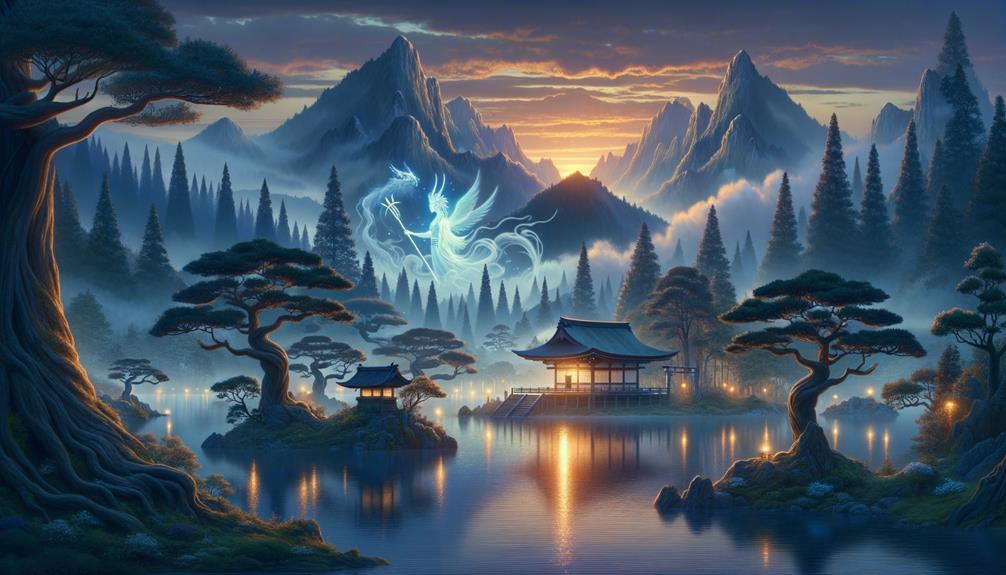
Ōkuninushi is one of the central kami in the myth cycles of the Kojiki, Nihon shoki, and traditions associated with Izumo. His story is not a solitary “creation of Japan.” It links compassion, rivalry, marriage, cooperation, land-making, and the transfer of earthly rule to the heavenly kami. The differences among early sources are part of that history rather than errors to be harmonized away.
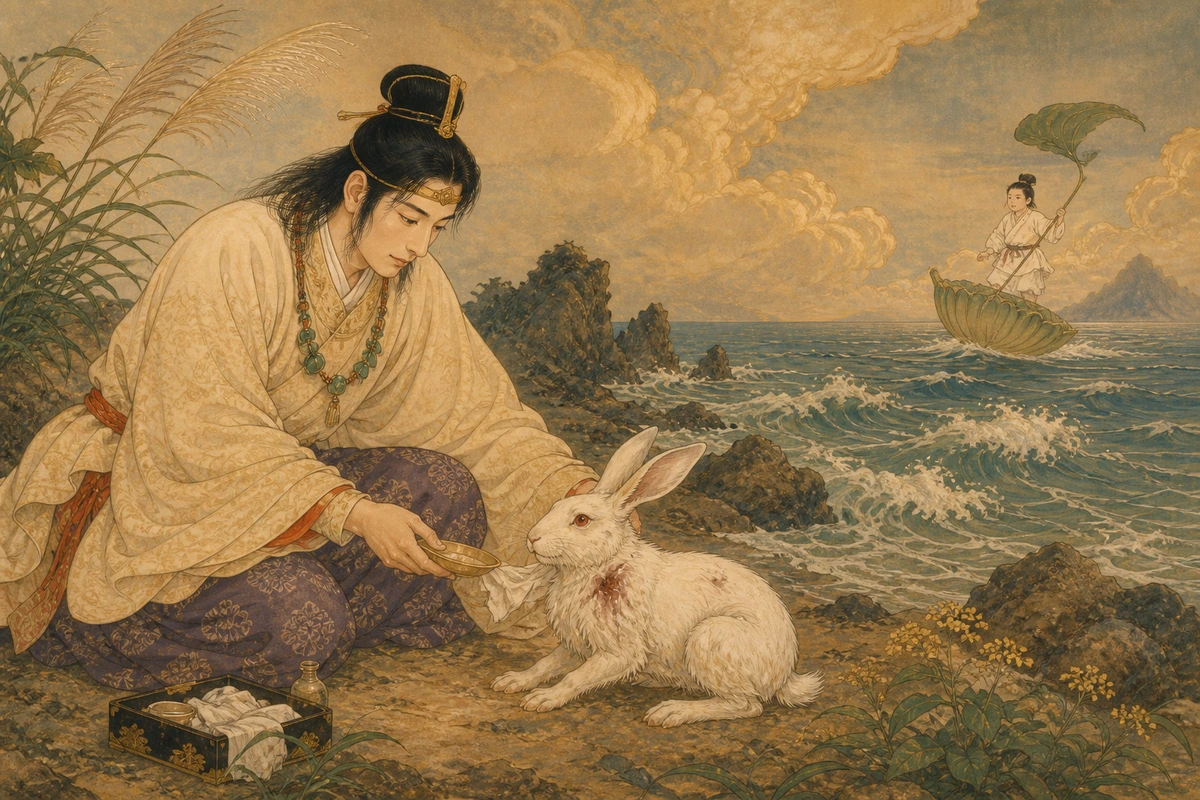
The White Hare of Inaba
In the Kojiki, Ōkuninushi travels with his many brothers, who seek to marry Yakamihime. They encounter a hare stripped of its fur after it tricks a line of sea creatures and is caught in the deception. The brothers maliciously tell it to bathe in salt water and dry in the wind, worsening its pain. Ōkuninushi arrives last because he carries their baggage.
He advises the hare to wash in fresh water and roll in the pollen of cattails. The animal recovers and predicts that Yakamihime will choose him. The episode establishes compassion before kingship: the disregarded brother recognizes suffering that the powerful mock.
Death, pursuit, and the realm of Susanoo
Ōkuninushi’s jealous brothers kill him in more than one episode, and divine intervention restores him. He eventually flees to the distant realm of Susanoo. There he meets Suseribime, but Susanoo subjects him to ordeals involving snakes, insects, fire, and a search for an arrow. Suseribime helps him survive.
Ōkuninushi escapes with Suseribime and sacred objects associated with Susanoo’s authority. The relationship is not a simple mentorship. Hostility, testing, kinship, theft, and reluctant recognition overlap in a myth that gives Ōkuninushi the names and powers of a ruler.
Building and “firming” the land
The tiny kami Sukunabikona arrives from across the sea and becomes Ōkuninushi’s partner. Kokugakuin University’s Encyclopedia of Shinto describes them as cooperating in the work of “firming” or developing the land. Later traditions connect them with medicine, hot springs, agriculture, and knowledge.
When Sukunabikona departs, the work remains incomplete. Another divine presence, identified in the Nihon shoki with Ōnamuchi’s wondrous and fortunate spirit, is enshrined at Mount Miwa. The land-making story is therefore collaborative and ritual, not an image of one god physically manufacturing islands alone.
The transfer of the land
Heavenly envoys eventually demand control of the Central Land of Reed Plains. After failed missions, Takemikazuchi confronts Ōkuninushi. His son Kotoshironushi accepts the transfer, while Takeminakata resists and is defeated. Ōkuninushi consents and withdraws from visible government, with traditions connecting his settlement to a great shrine and the unseen realm.
The episode, called kuniyuzuri, prepares for the descent of the heavenly grandchild and supports the authority claimed by the Yamato court. It combines negotiation, coercion, ritual settlement, and continuing honor for the earthly ruler.
Ōkuninushi after the chronicles
Ōkuninushi is prominently enshrined at Izumo Taisha and worshipped under several names. From the medieval period he was identified with Daikokuten through the shared reading of their names, creating new associations with fortune. Modern claims that reduce him to a generic god of romance, medicine, or nation-building capture only pieces of a complex tradition.