

The aegis belongs to Zeus and Athena in Greek epic, but calling it simply “Athena’s shield” hides how varied the object is. In Homer it is tasselled, terrifying, worn around the shoulders, shaken to rout armies, and associated above all with “aegis-bearing Zeus.” In later art it can look like a goatskin mantle, a scaled breast covering, a collar, or part of a shield. The safest description is therefore a divine protective emblem whose form changes with author, period, and medium.
Source note: This article separates Homer’s descriptions from later artistic and mythographic explanations. Ancient Greeks themselves offered more than one account of the aegis’s material and origin.
What Homer actually describes
The Iliad repeatedly makes the aegis an attribute of Zeus. When the god shakes or displays it, panic spreads across the battlefield. Apollo can carry it on Zeus’s orders, and Athena wears it when she enters battle. This mobility matters: the epic object is not a personal shield forged once for a single goddess, but a sign of authority that Zeus can entrust to other Olympians.
In Iliad 5, Athena casts aside her own robe, puts on Zeus’s tunic, and throws the tasselled aegis around her shoulders. Its surface or field contains personified terrors—Rout, Strife, Strength, and the chilling onset of battle—and the Gorgon’s head appears as a dreadful sign of Zeus. The passage presents an enveloping object charged with divine menace, not a conventional round hoplite shield. In book 15, Apollo holds the aegis before the Trojans; when he shakes it and cries out, the Achaeans lose courage. In book 18, Athena briefly places it around Achilles’s shoulders as she makes him visible and terrifying from the trench.
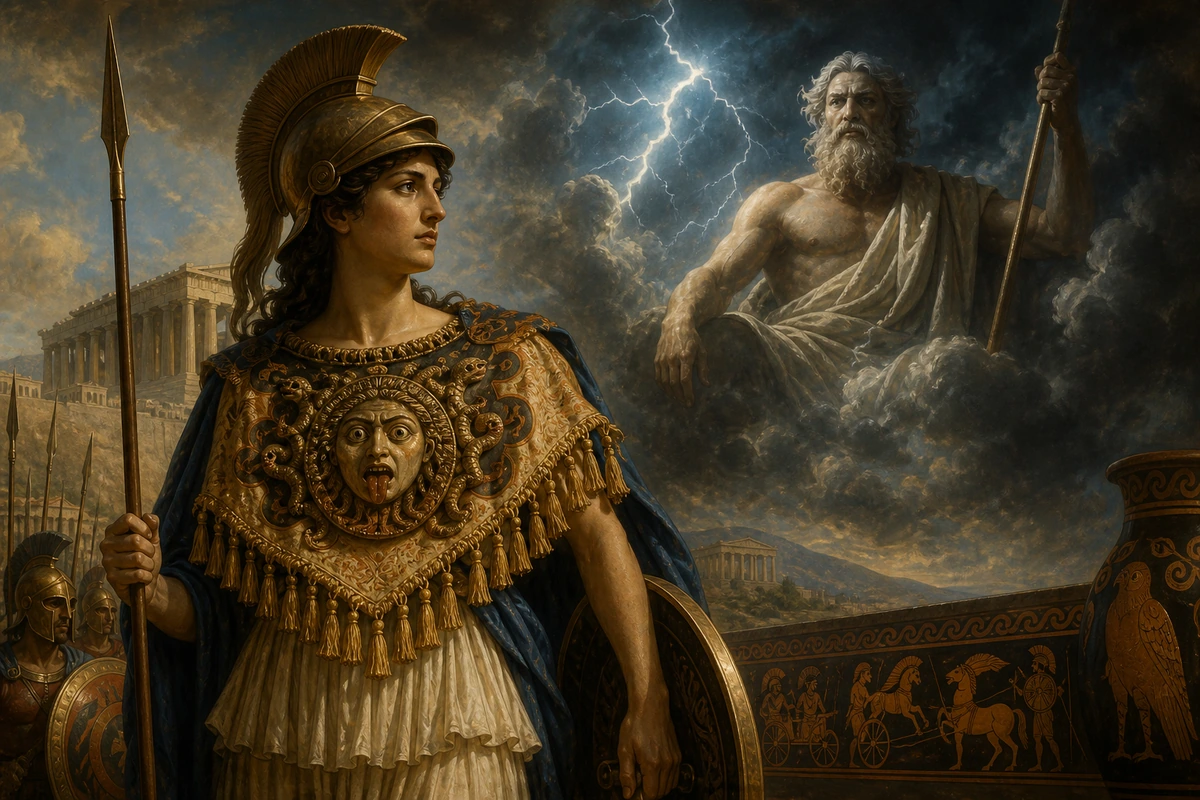
Shield, goatskin, mantle, or breastplate?
The Greek word aigis invited ancient and modern explanations, including an association with a goat (aix). Later writers could describe a goatskin connected with Zeus’s infancy or with a monstrous opponent, while visual artists adapted the aegis to the needs of sculpture and vase painting. On statues of Athena it often lies across the chest or shoulders and may be bordered by snakes. On painted pottery it can be a fringed or scaled garment. Some images combine it with a separate round shield; others compress its features into armor.
This variety is not a defect to be solved by choosing one “correct” model. Mythic objects change as poets, cults, and artists reuse them. “Shield” remains convenient in some translations and later representations, but readers should understand it as one visual possibility. “Protective mantle,” “divine armor,” or simply “the aegis” is often more precise when discussing Homer.
The Gorgoneion and the problem of petrification
The face or head of a Gorgon on the aegis is called a Gorgoneion. In epic it is a terrifying sign. Later myth connects Athena closely with Medusa’s severed head, especially after Perseus’s adventure, and artists frequently place the Gorgoneion at the center of Athena’s aegis. Those traditions help explain the familiar image, but they should not be collapsed into the claim that the aegis always fired a literal petrifying beam. Homer emphasizes fear, rout, and divine power rather than giving the object a fixed game-like ability.
The Gorgoneion also had a wider protective life. Greek armor, architecture, coins, and ritual objects could bear a frontal Gorgon face as an apotropaic image—one intended to repel danger. On Athena’s body, that protective and threatening logic works in both directions: it guards the goddess and confronts anyone who faces her.
Who made the aegis?
No single surviving source establishes one universal manufacturing story. Modern summaries sometimes state that Hephaestus forged the aegis or that Athena invented it, but those claims fuse separate traditions about divine armor, Zeus’s goatskin, Athena’s equipment, and the Gorgon’s head. The Iliad does not pause to narrate the aegis’s manufacture. Its audience meets an already authoritative object belonging to Zeus and borne by Athena or Apollo when the narrative requires it.
| Context | Bearer | Form or action | What can safely be said |
|---|---|---|---|
| Iliad 5 | Athena | Tasselled, worn around the shoulders, marked by battle terrors and the Gorgon | A divine garment-like defense and sign of Zeus |
| Iliad 15 | Apollo for Zeus | Displayed and shaken to break an army’s courage | Its force is terror and divine authority |
| Later Greek art | Especially Athena | Goatskin, scaled collar, breast covering, or shield element | There is no single visual template |
| Later retellings | Usually Athena | Often simplified into a magic shield | Useful shorthand, but not the whole tradition |
Why “under the aegis” still means protection
The ancient emblem survived in political, military, and literary language. English speakers use “under the aegis of” to mean under the protection, sponsorship, or authority of a person or institution. That metaphor preserves the object’s core function better than many fantasy adaptations do: the aegis is protection made visible, backed by overwhelming power.
Modern games, comics, and novels are free to turn it into a shield, spell, energy field, or named weapon. Those versions are creative descendants, not primary evidence for Greek religion. The more interesting ancient picture is also the less tidy one: a tasselled object shared among gods, simultaneously garment and armament, bearing a face that guards by terrifying.
Sources and further reading
- Homer, Iliad 5.711–763, Perseus Digital Library
- Homer, Iliad 21, including Athena’s aegis
- “Aegis,” Dictionary of Greek and Roman Antiquities, Perseus Digital Library