

The Sanskrit cintāmaṇi is a “wish-fulfilling jewel” that appears in Buddhist, Hindu, and Jain narrative and visual traditions. In Buddhist art it can symbolize the fulfillment of wishes through the Buddha’s teaching, the compassionate activity of a bodhisattva, prosperity, or the preciousness of awakening. It is an iconographic and literary object—not a type of gemstone that archaeology or the mineral trade can authenticate.
Accuracy note: Online sellers sometimes apply “cintamani stone” to meteorites, tektites, or crystals and promise healing energy. Those commercial claims are separate from the historical Buddhist symbol and are not supported by the museum or textual evidence discussed here.
What the name means
Cintā relates to thought, intention, or a cherished wish, while maṇi means jewel. English translations therefore include “wish-fulfilling jewel,” “thought-gem,” and “jewel that grants desires.” The image belongs to a wider South Asian family of inexhaustible treasures and royal emblems that provide what beings need.
“Wish fulfillment” does not have one meaning in every Buddhist context. A jewel may promise worldly benefit, express a bodhisattva’s power to respond to suffering, or symbolize the Dharma as a treasure more valuable than material wealth. Text, ritual, deity, region, and artistic period determine the emphasis.
How artists represent the jewel
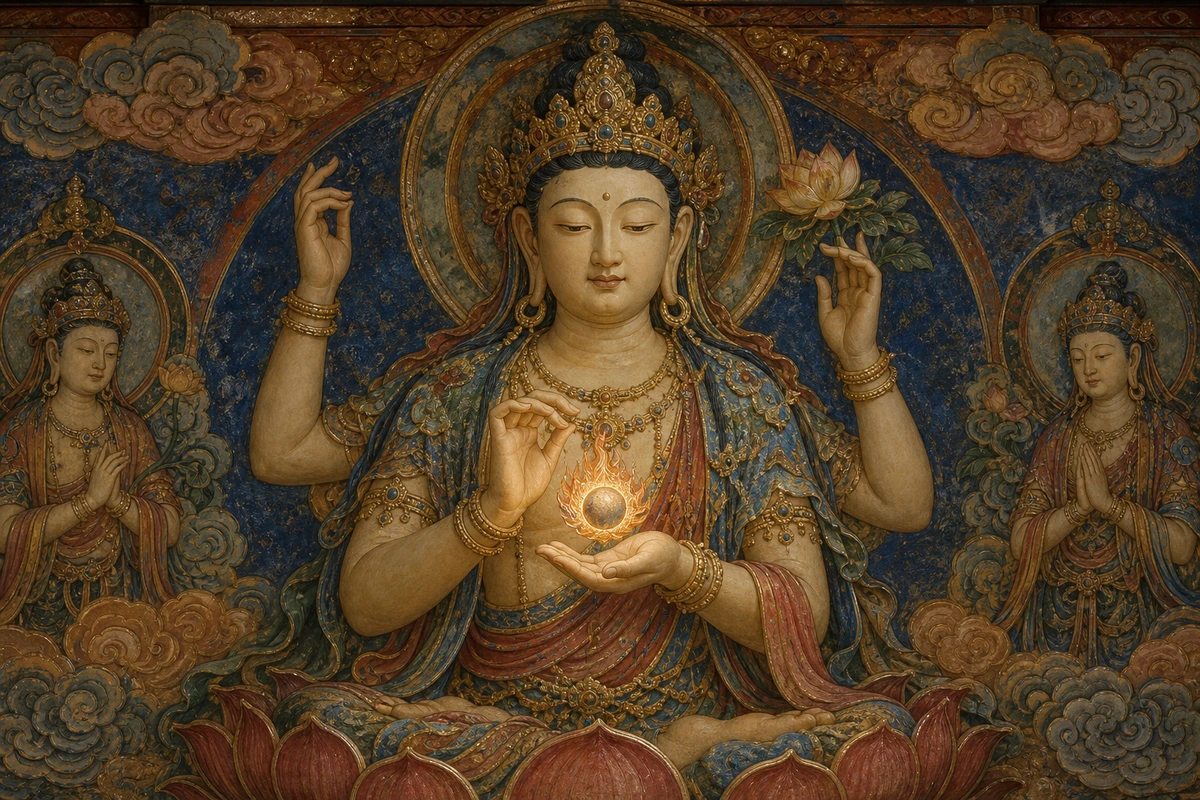
The cintāmaṇi may appear as a single round or teardrop-shaped gem surrounded by flames, as a cluster of elongated orbs, or as a jewel held in a deity’s hand. Flames need not mean that the object literally burns. They form an aureole that signals radiance, sacred power, and preciousness.
In Tibetan, Chinese, Korean, and Japanese art, the image can move among sculpture, painting, textiles, banners, ritual objects, amulets, armor, and decorative arts. A motif’s appearance on a luxurious object does not make that object itself the one legendary jewel. It shows that the symbol could carry wishes for protection, prosperity, religious merit, or salvation into many material settings.
Avalokiteśvara and Cintāmaṇicakra
Several forms of Avalokiteśvara—the bodhisattva associated with compassion—hold a jewel. A particularly important East Asian form is Cintāmaṇicakra Avalokiteśvara, known in Japan as Nyoirin Kannon. The compound joins the wish-fulfilling jewel with the wheel, another major Buddhist symbol. Images may have two, six, or more arms, depending on tradition and iconographic program.
A Metropolitan Museum study identifies a two-armed Cintāmaṇicakra in a Chinese Buddhist mural by the round gem in one hand and a gift-bestowing gesture in the other. Other forms hold lotus, wheel, rosary, or additional implements. This variety makes it unsafe to claim that “Avalokiteśvara always holds the cintāmaṇi” or that every luminous orb in Buddhist art has the same identity.
The jewel in Tibetan visual culture
Tibetan art frequently uses the flaming jewel alone or within grouped auspicious symbols. A British Museum amulet print places a wish-fulfilling gem on an elephant within a complex field of lotus petals, script, mandalas, flames, and the Eight Auspicious Symbols. Its documented use at a doorway relates to protection, but that does not justify assigning the same practice to every Buddhist community.
Likewise, museum discussions of Tibetan decorative arts identify cintāmaṇi motifs as signs of material prosperity and of wishes fulfilled through the Buddha. The distinction is important: the symbol can embrace worldly well-being without collapsing Buddhist goals into “manifest whatever you want.” Buddhist generosity, compassion, merit, and liberation shape the meaning of benefit.
| Representation | Documented setting | Responsible interpretation |
|---|---|---|
| Single flaming orb | Painting, sculpture, ritual and decorative art | Radiant wish-fulfilling jewel; exact meaning depends on context |
| Cluster of jewels | Tibetan and broader Buddhist motifs | Prosperity, fulfilled wishes, or spiritual treasure |
| Jewel held by a bodhisattva | Avalokiteśvara and other iconographic forms | An attribute of compassionate or gift-bestowing activity |
| Commercial “cintamani stone” | Modern crystal and meteorite markets | A modern product label, not proof of a legendary relic |
Not one of “four relics of the Buddha”
The claim that cintāmaṇi stones are one of four physical relics containing the Buddha’s teaching is not a standard account supported by the sources used here. Buddhist traditions do preserve bodily relics, contact relics, sacred texts, and symbolic treasures, but those categories should not be merged into a universal list without a named tradition and text.
Similarly, there is no general evidence that Buddhists use purchased “cintamani crystals” for energy work, aura cleansing, or guaranteed healing. Individual modern practitioners may combine Buddhism with contemporary metaphysical practices, but their choices should not be projected backward or presented as representative of Tibetan Buddhism as a whole.
From Buddhist emblem to Ottoman pattern
A related “chintamani” name is used for the orb-and-wavy-stripe pattern famous in Ottoman textiles and ceramics. Museum catalogues note that this design ultimately draws on Buddhist jewel imagery, though it developed new courtly and decorative associations. The Ottoman motif is therefore part of the symbol’s long visual afterlife, not evidence that the same ritual meaning remained unchanged across Asia.
This transformation illustrates why the cintāmaṇi should be studied as an image moving through cultures. The jewel can be translated, stylized, clustered, paired with other motifs, and adapted to new patrons. Its history is richer than the search for a single lost stone.
How to read the symbol responsibly
Begin with the object in front of you. Who holds the jewel? What gestures and other attributes accompany it? Is the image Buddhist, Jain, Hindu, Tibetan, Chinese, Japanese, Korean, Southeast Asian, or part of a later decorative tradition? Does an inscription or museum record identify the figure? Those questions produce more reliable answers than assuming every flaming pearl means the same thing.
The cintāmaṇi’s enduring appeal comes from a powerful metaphor: wisdom and compassion are treasures able to answer need. Treating it as a guaranteed paranormal mineral shrinks that metaphor. In art and literature, the jewel matters precisely because it can hold material hope and the aspiration for liberation in one radiant form.
Sources and further reading
- British Museum, “cintamani” collection term
- The Metropolitan Museum of Art, multiarmed Avalokiteśvara
- The Met, The Gods of War, discussion of the jewel motif