
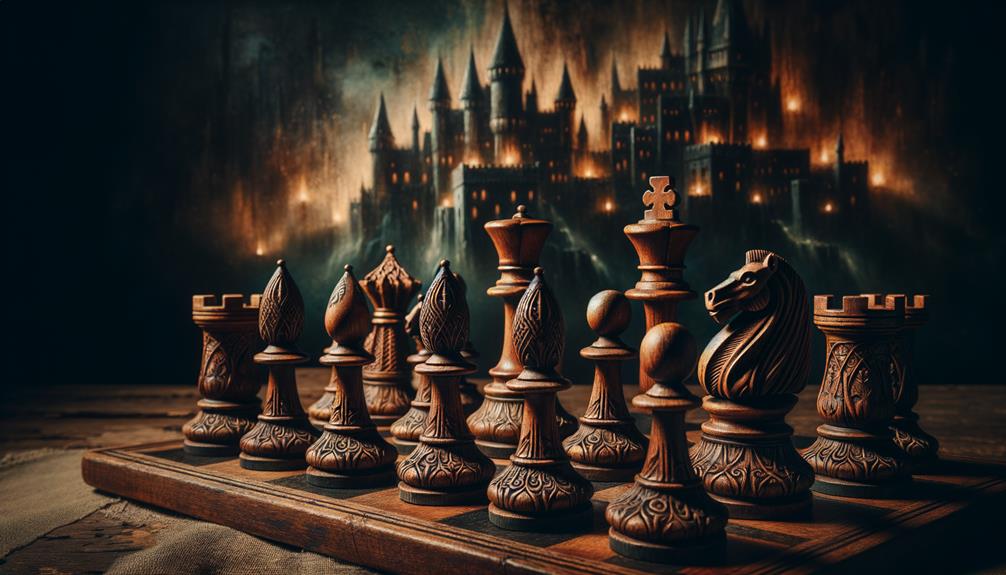
The Lewis Chessmen are among the most recognizable survivors of medieval Europe: kings grip swords, queens rest a hand against one cheek, bishops raise a blessing or hold a crozier, and warriors stare over their shields. Their expressions feel individual, yet the pieces reveal something larger—a North Atlantic world connected by trade, church organization, political rivalry, and the spread of chess.
The hoard was found on the Isle of Lewis in Scotland’s Outer Hebrides and first exhibited in Edinburgh in 1831. It contains 93 surviving objects: 78 chess pieces, 14 round gaming pieces usually identified as draughtsmen, and a belt buckle. Eleven are held by National Museums Scotland; the remainder belong to the British Museum, which has placed six on long-term loan at Museum nan Eilean in Stornoway.

What the hoard contains
The chess pieces represent kings, queens, bishops, knights, warders—the equivalent of modern rooks—and pawns. The surviving group is large enough to represent parts of at least four sets, but it does not make four complete modern chess armies. Differences in dimensions, carving, and material also show that the objects were not created as one perfectly uniform display set.
| Piece type | Medieval form | What it reflects |
|---|---|---|
| King | Enthroned ruler, often holding a sword across the lap | Kingship expressed through regalia and seated authority |
| Queen | Enthroned woman, frequently with hand at cheek | The queen’s established place in the European game |
| Bishop | Mitre, crozier, book, or blessing gesture | Christian transformation of a piece that had different identities in earlier chess |
| Knight | Mounted warrior with shield and weapon | Aristocratic cavalry and military status |
| Warder | Standing shield-bearer; several bite their shields | A warrior piece later represented by the rook or castle |
| Pawn | Simple obelisk-like or geometric form | Lower-value pieces without individualized human figures |
The worried-looking queen is often turned into a modern joke, but a hand to the cheek was a conventional gesture that could communicate thought, concern, or grief. Likewise, shield-biting warders are frequently called berserkers. Medieval literary parallels make that connection plausible, yet the carving does not name them or explain the gesture.
Walrus ivory and whale tooth
Most pieces were carved from walrus tusk ivory, with some made from whale tooth. The distinction matters because both materials belong to northern maritime economies. Walrus ivory traveled through Arctic and North Atlantic exchange networks long before elephant ivory became dominant in later European luxury carving.
Material study can potentially identify the biological and geographic origins of tusks, while tool marks and stylistic clusters can distinguish hands or workshops. A British Museum research project running from 2024 to 2027 is re-examining sourcing and manufacture. Older claims that every piece came from one named workshop or one individual carver therefore deserve caution.
The pieces are usually dated about 1150–1200 and widely associated with Norway. Trondheim has often been proposed as a production center because comparable sculpture and church networks existed there, but a specific workshop has not been proved for the full hoard. At the time, Lewis belonged to the Norse-Gaelic Kingdom of the Isles and sat on sea routes linking Norway, Scotland, Ireland, and the Isle of Man.
How chess changed on its journey west
Chess developed in South Asia and traveled through the Islamic world into Europe. As the game entered new courts, pieces were reinterpreted. The elephant became the bishop in much of western Europe; the chariot or rook acquired new forms; and the vizier evolved into the queen. The Lewis pieces show the European game after Christian clerical and feudal identities had become visibly embedded in it.
The bishops are especially significant. Their presence and mitres reflect the power of the medieval church and help date the set’s cultural context. The pieces do not provide a literal diagram of society, however. A game compresses and rearranges institutions for play; pawns do not document the lives of ordinary Hebrideans.
Why were the pieces buried?
No contemporary record explains who hid the hoard. A traveling merchant could have concealed stock intended for sale, which fits the multiple sets and maritime route. A local ruler, bishop, or wealthy household might instead have owned the pieces. Both remain hypotheses.
The discovery story is also uncertain. Later tales involve a sandbank, cattle, dreams, murder, or a terrified finder who thought the figures supernatural. What can be documented is that the group had surfaced by April 1831, when it was displayed by the Society of Antiquaries of Scotland. Dramatic folklore should not replace the gaps in the early record.
Collection, location, and Lewis
The split between London and Edinburgh is part of the hoard’s modern biography. British Museum collection records cover 82 of the 93 objects, including gaming pieces and the buckle, while National Museums Scotland holds eleven chess pieces. Six British Museum chessmen have been displayed in Stornoway on long-term loan since 2017, returning part of the group to public view on Lewis without changing ownership.
Discussion about where the pieces should be displayed sometimes resembles restitution debates, but the acquisition history is not equivalent to the violent 1897 seizure of the Benin Bronzes. The Lewis question centers on discovery, purchase, national collections, local connection, and access. Different histories require different ethical analysis.
Accuracy note
The count of 93 includes chessmen, gaming pieces, and a buckle; there are 78 actual chess pieces. Norway and the date range 1150–1200 are strong scholarly conclusions, while a particular workshop and the reason for burial remain unproved. The image above is labeled as an editorial visualization rather than a museum photograph.

