The sculptures often called the Elgin Marbles were created as architectural parts of the Parthenon and other buildings on the Athenian Acropolis. The more precise term Parthenon Sculptures keeps the monument—not the British aristocrat who removed many surviving pieces—at the center of their history.
Made in the fifth century BCE from Pentelic marble, the surviving works are now divided mainly between the Acropolis Museum in Athens and the British Museum in London, with fragments in several other European museums. Debate over reunification involves legal title, the conditions of Ottoman authorization, colonial power, conservation, public access, and whether one monument’s surviving decoration should be displayed together.
Three sculptural systems
The Parthenon was built on the Acropolis between 447 and 432 BCE and dedicated to Athena. Its sculptural program worked at several architectural scales. The pediments filled the triangular ends of the roof. Metopes occupied square panels above the outer colonnade. A continuous Ionic frieze ran high around the inner building.
| Group | Original location | Main subject |
|---|---|---|
| East pediment | Roof triangle above the principal east entrance | Birth of Athena in the presence of gods and cosmic figures |
| West pediment | Opposite roof triangle | Contest of Athena and Poseidon for Attica |
| Metopes | Exterior Doric frieze, high above the columns | Mythic conflicts including gods and Giants, Greeks and Amazons, Greeks and Trojans, Lapiths and Centaurs |
| Ionic frieze | Continuous band around the upper wall of the inner building | Procession commonly connected with the Panathenaic festival |
The carvings were not originally bare white. The Acropolis Museum documents color and metal attachments used for bridles, weapons, and other details. Weathering and cleaning removed much of that surface, so modern monochrome galleries can make the ancient temple seem less visually intense than it was.
Damage before Lord Elgin
The Parthenon’s history did not freeze after antiquity. It became a Christian church and later a mosque. Carvings were damaged through deliberate alteration, reuse, weather, and conflict. In 1687, during a Venetian bombardment of Ottoman-held Athens, ammunition stored inside exploded and destroyed the building’s center.
By 1800, many sculptures had already fallen or disappeared. That fact matters, but it does not settle the later removal debate. “Some pieces were damaged” is not the same claim as “any later extraction was legitimate,” just as preservation after removal does not erase the circumstances in which it occurred.
Elgin’s removals, 1801–1805
Thomas Bruce, seventh Earl of Elgin, served as British ambassador to the Ottoman Empire, which then governed Athens. His agents initially documented the Acropolis through drawings and casts. Between 1801 and 1805 they removed sculptures and architectural elements from the Parthenon, Erechtheion, Temple of Athena Nike, and Propylaia. Pieces came from fallen debris and from the standing buildings.
The British Museum states that Ottoman authorities granted a permit, commonly called a firman, and that removal occurred under local oversight. Parliament investigated the acquisition in 1816, purchased Elgin’s collection, and transferred it to the museum. The original Ottoman document has not survived in the form expected for a formal firman; scholarship relies heavily on an Italian translation and other records. The scope and legitimacy of the permission are therefore central points of dispute, not facts resolved by repeating either side’s slogan.
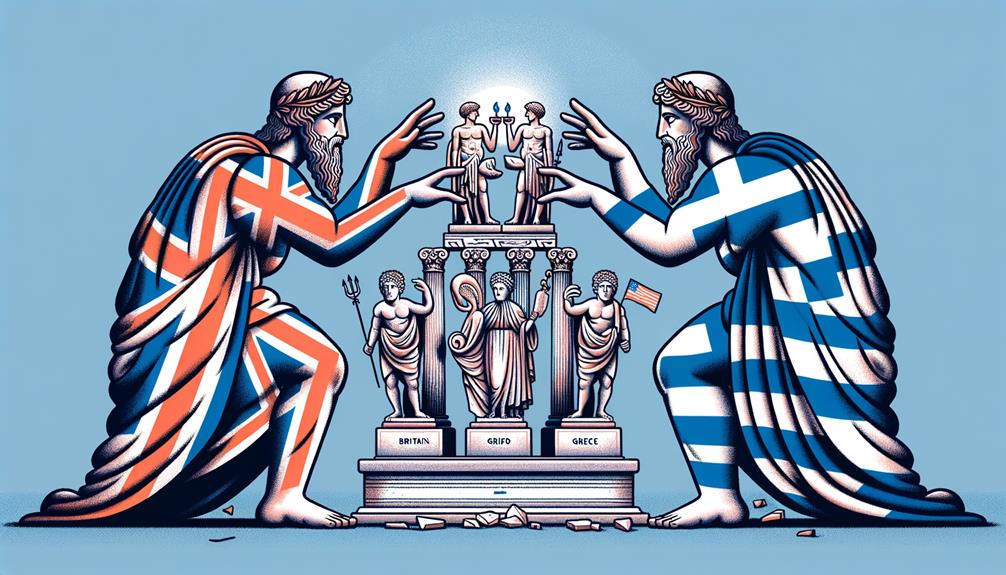
The Acropolis Museum describes major removals as forcible detachment under occupation and incorporates plaster casts where originals are in London. Greece’s position emphasizes the monument’s integrity and seeks permanent reunification in Athens. The British Museum’s trustees assert legal acquisition and argue that London’s display places the works in a comparative world collection.
What survives and where
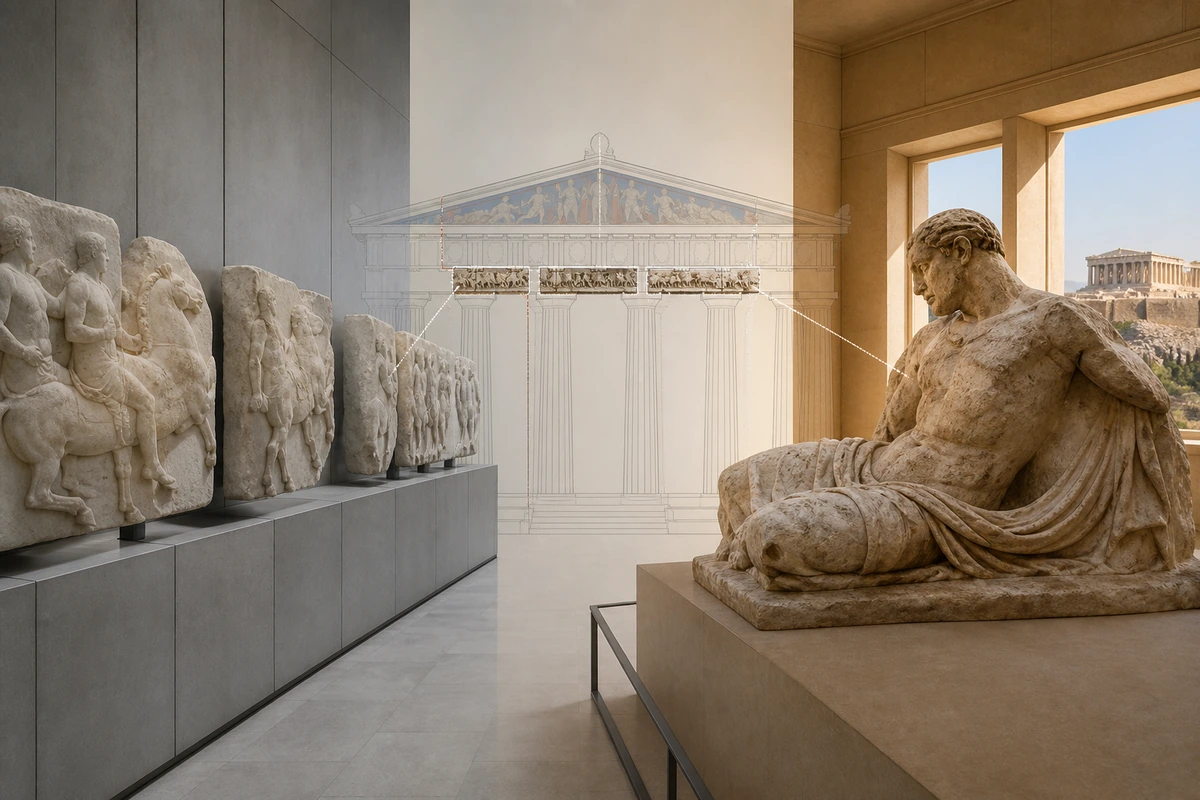
About half of the original sculptural decoration is lost. Of the portion that survives, the largest groups are divided roughly between Athens and London. The British Museum holds 15 metopes, 17 pedimental figures, and about 75 meters of the original frieze. The Acropolis Museum displays sculptures retained or recovered in Greece and uses casts to show missing London and other fragments within the sequence.
Fragments also remain in Paris, Copenhagen, Munich, Vienna, Würzburg, and elsewhere. Several museums have returned small fragments to Athens, sometimes as deposits or transfers. Those precedents demonstrate that movement is possible, but a fragment’s return under one institution’s law does not automatically determine the legal position of the British Museum collection.
The reunification arguments
Supporters of permanent return argue that the sculptures were conceived as one architectural program and can be understood most fully beside the Parthenon. They emphasize asymmetries of imperial power, contested Ottoman authorization, and the Acropolis Museum’s purpose-built gallery. Reunification would not place originals back outdoors on the ruined temple; it would bring surviving pieces together in the Athens museum.
The British Museum trustees argue that legal title is secure, that the division itself forms part of the objects’ history, and that display in a global collection encourages comparisons with Egypt and the Near East. They state willingness to consider loans if ownership is acknowledged, a condition Greek governments have rejected because it conflicts with their claim.
“Shared heritage” can support collaboration, but it does not by itself answer who decides location. Likewise, “they belong in context” requires defining context: the original building, modern Athens, a history of collecting, or an international museum. The dispute persists because ethical, legal, historical, and museological questions do not produce one automatic result.
Conservation and access
Both Athens and London conserve and publicly display their collections. The old claim that Greece lacks a suitable museum became untenable when the Acropolis Museum opened in 2009. The question is not whether Greek professionals can care for the works; the British Museum itself explicitly acknowledges that they can.
Physical reunification would still require agreements about ownership, transport, duration, reciprocal loans, and long-term governance. Digital models and casts help viewers understand missing sequences, but they do not erase the symbolic and material significance of originals.
Accuracy note
This article distinguishes documented events from institutional positions. It neither calls Ottoman permission an undisputed legal title nor assumes that the absence of the original firman proves no authorization existed. Current negotiations can change; the stable issue is the long-running Greek request for permanent reunification and the British Museum trustees’ opposing legal and display position.