
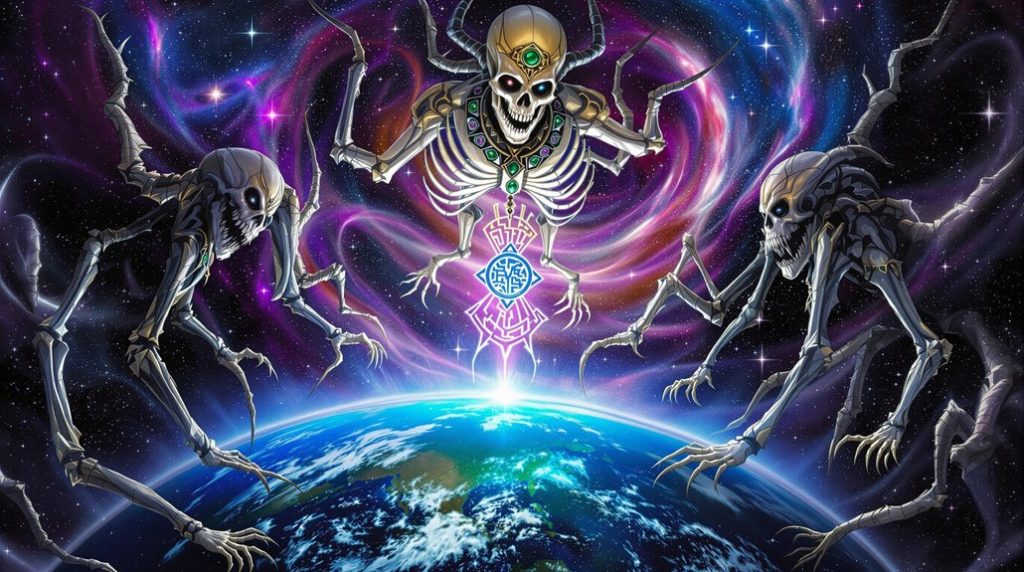
The Tzitzimime belong to the religious traditions of central Mexico, not Greek mythology. Colonial-era Nahua sources describe them as powerful celestial beings associated with stars, skeletal imagery, women, and moments when cosmic order appeared vulnerable. Calling them simply “star demons” captures their danger but can conceal their status as divinities and ancestors.
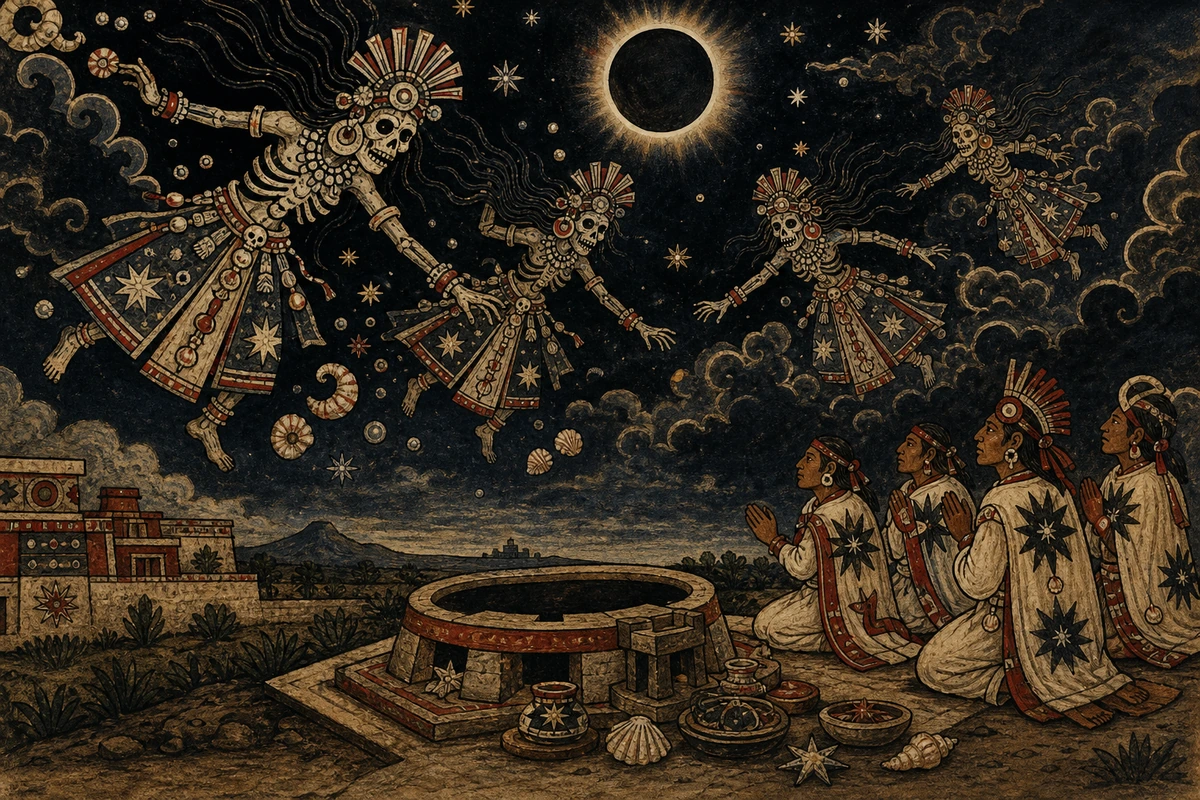
Celestial beings and skeletal imagery
Tzitzimime are frequently represented as female skeletal figures with star signs, shell ornaments, clawed hands, or distinctive skirts. Their exposed bones do not make them zombies in a modern sense. In central Mexican art, skeletal imagery participates in a wider language of death, fertility, sacrifice, and regeneration.
Scholars have connected them with stellar goddesses, defeated female powers, ancestors, and the dangerous forces released during transitions. The evidence is complex, and different manuscripts do not produce one simple family tree.
Eclipses and cosmic uncertainty
Solar eclipses made the normal relationship between sun and sky visibly unstable. Colonial accounts describe fear that celestial beings would descend and devour humanity. The threat was not a nightly war at dusk and dawn, and surviving sources do not support invented powers such as possession or “life-force draining.”
The New Fire ceremony
Every fifty-two years, the 260-day and 365-day calendar counts returned to a shared starting configuration. At the Binding of the Years, household fires were extinguished while priests waited to kindle a new flame. If the ceremony failed, the sun might not return and the Tzitzimime could descend.
The successfully lit fire was carried outward from the ceremonial center, renewing homes and temples. Archaeology shows that New Fire practices were older and more widespread than the Mexica Empire; Tenochtitlan appropriated and monumentalized an established central Mexican tradition.
Danger is not the whole story
Some colonial descriptions associate Tzitzimime with protective or generative female powers as well as catastrophe. Treating them as generic evil monsters imposes a Christian demonology on beings whose pre-Hispanic meanings were more layered.