
The Five Suns are successive world ages in central Mexican cosmology. Each sun brings a particular order of gods, beings, food, and time; each ends in catastrophe before another world is established. The Mexica understood the present age as the Sun of Movement, destined to end as earlier ages had ended. Surviving sources differ, so no single chart should be treated as the universal account.
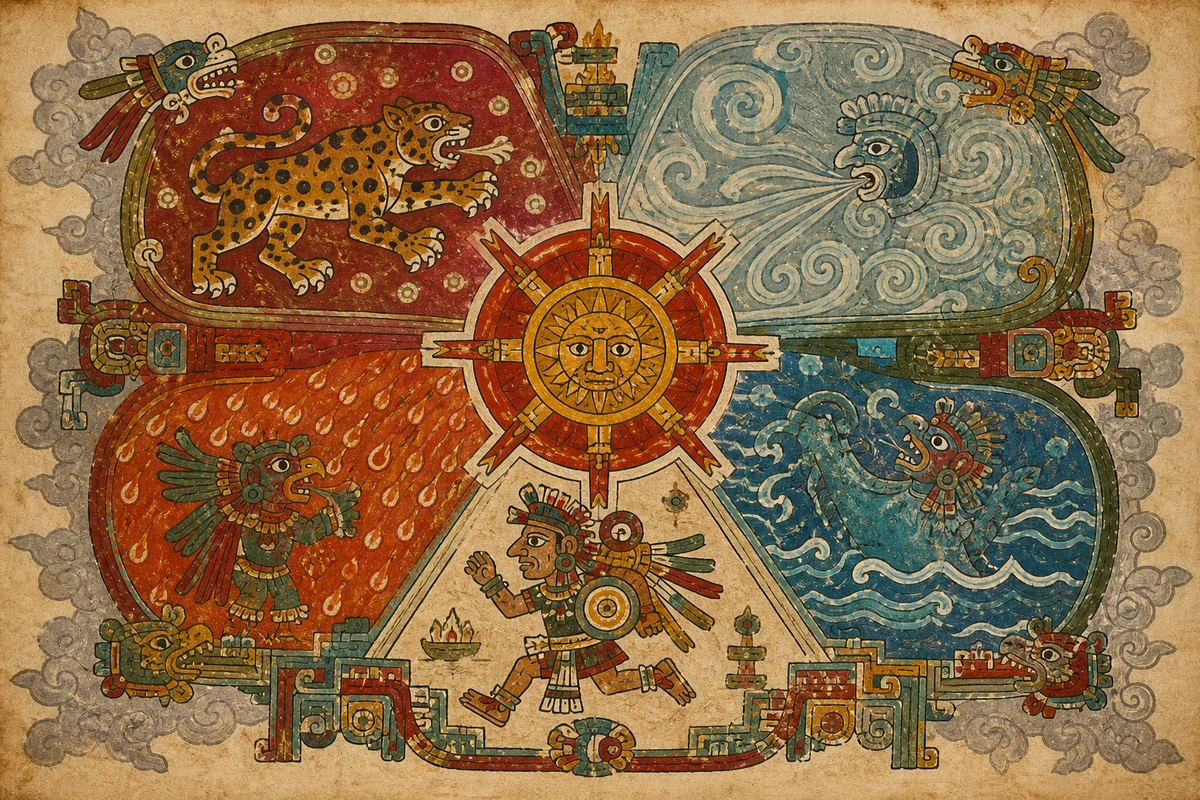
Successive worlds, not five planets
The Nahuatl word translated as “sun” can name an age defined by its sun and the conditions under which life exists. In influential accounts, four earlier ages end through jaguars, violent wind, fiery rain, and flood. Their inhabitants may be destroyed or transformed into animals. The present Fifth Sun is associated with movement and earthquake.
The order, divine rulers, inhabitants, and durations vary among sources such as the Historia de los Mexicanos por sus Pinturas, the Leyenda de los Soles, and colonial pictorial manuscripts. A repeated total of 676 years belongs to particular calculations, not an uncontested cosmic clock.
Teotihuacan and the present sun
One creation story places the birth of the current sun at Teotihuacan. Gods gather in darkness and sacrifice themselves; the humble Nanahuatzin enters the fire and becomes the sun, while Tecuciztecatl becomes the moon. The new sun initially refuses to move until further sacrifice sets cosmic time in motion.
This narrative and the sequence of earlier suns are related, but colonial sources arrange their details differently. The point is not a single modern timeline. It is a universe whose stability depends on divine action, human ritual, and the willingness to pay a cost.
The Sun Stone and a common mistake
The famous Mexica Sun Stone includes signs associated with the earlier suns around its central image, but it is not merely an “Aztec calendar” in the modern wall-calendar sense. Its imagery joins calendrical signs, solar power, rulership, sacrifice, and cosmic history.
Living with an unfinished age
The Fifth Sun was not “final” because the Mexica knew a fixed apocalypse date. It was present and therefore vulnerable. The Five Suns made change fundamental: no world order, even one sustained by the gods, was guaranteed forever.