Minos is the legendary king of Crete who stands at the center of several Greek story cycles: Europa’s divine family, the Cretan bull, the Minotaur and labyrinth, Theseus and Ariadne, Daedalus’s escape, and judgment among the dead. Those stories were not written as one consistent biography. Ancient authors disagree, duplicate figures, and emphasize different aspects of the king. Archaeology confirms a sophisticated Bronze Age civilization on Crete, but it cannot turn every episode about Minos into history.
Accuracy note: “Minoan” is a modern archaeological label coined after the legendary Minos. It does not prove that a historical king named Minos built a literal labyrinth at Knossos.
Minos in the oldest surviving Greek poetry
Homer already connects Minos with Zeus, Knossos, Crete, and royal judgment. In Odyssey 19, the disguised Odysseus describes Crete as a rich island of many peoples and cities, naming great Knossos and Minos, who “held converse” with Zeus. The phrase helped later authors imagine Minos as a divinely instructed lawgiver. In Odyssey 11, Odysseus sees Minos in Hades with a golden sceptre, giving judgments while the dead gather around him.
That Underworld scene is older than the familiar later arrangement of three judges—Minos, Rhadamanthys, and Aeacus. It shows that judgment is not an afterthought to the Minos tradition. Yet Homer does not narrate the Minotaur’s birth or Theseus’s full labyrinth adventure in the form known from later mythography and drama. Readers should resist treating the whole cycle as if it came from one source.
Europa, Zeus, and the Cretan royal family
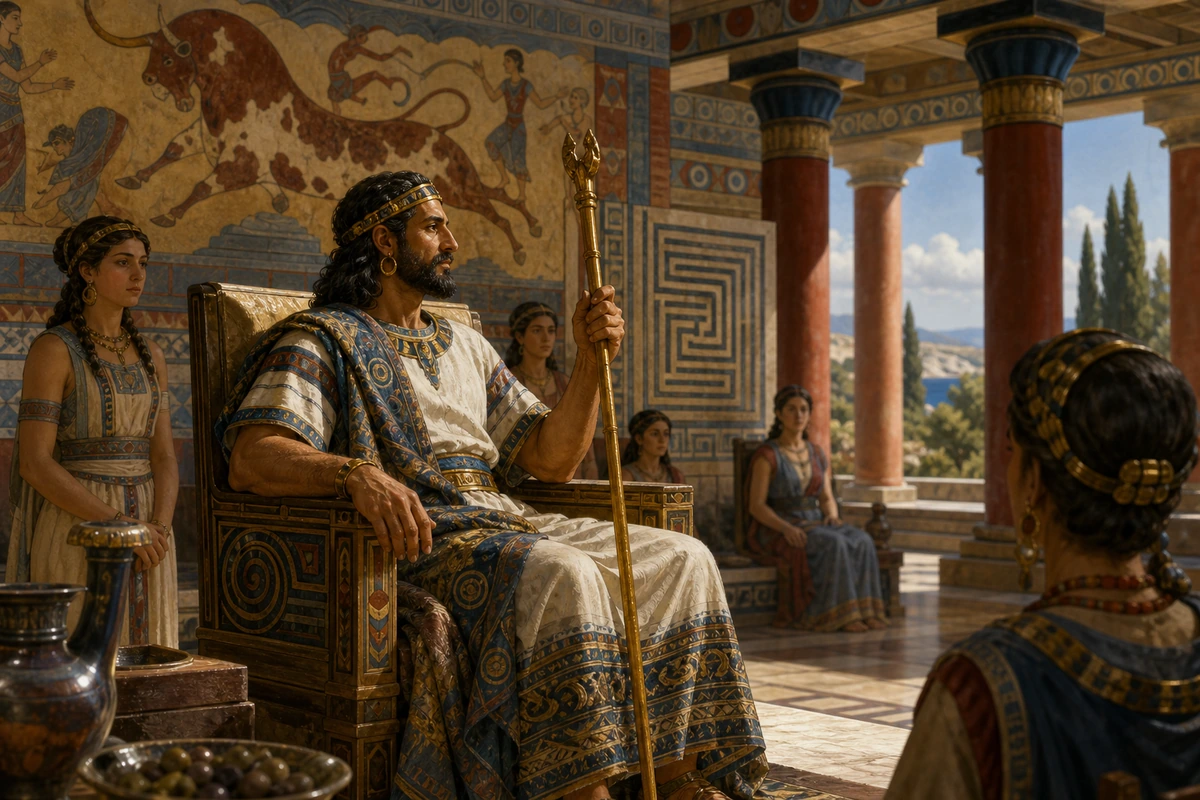
Many genealogies make Minos a son of Zeus and Europa and a brother of Rhadamanthys and Sarpedon. Europa is carried to Crete by Zeus in the form of a bull, linking cattle symbolism to the family before the later Minotaur episode begins. Minos’s wife is usually Pasiphae, a daughter of Helios, and their children include Ariadne, Phaedra, Androgeos, and others whose lists vary by author.
Even antiquity recognized complications. Some writers distinguished an earlier, just Minos from a later ruler of the same name who behaved more harshly. Others treated the stories as one king’s career. This helps explain how Minos can appear both as a wise lawgiver close to Zeus and as the enemy who compels Athens to send young people to Crete.
The bull, Pasiphae, and the labyrinth
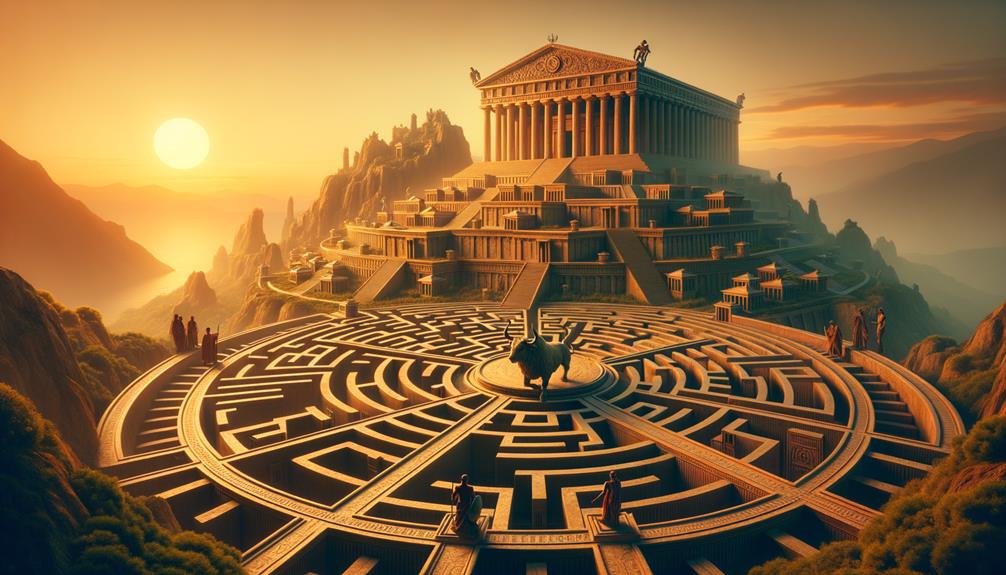
In the standard later sequence, Minos asks Poseidon for a sign that will confirm his right to rule. A magnificent bull rises from the sea, but Minos fails to sacrifice it as promised. Poseidon’s retaliation leads Pasiphae to desire the bull, and she gives birth to the Minotaur. Daedalus constructs the labyrinth to contain the dangerous hybrid.
The Athenian tribute follows the death of Minos’s son Androgeos, though ancient accounts differ about how Androgeos died, why Athens was punished, how often the tribute sailed, and how many youths were sent. Theseus volunteers or is chosen, reaches Crete, and survives the labyrinth with Ariadne’s help. The thread, sword, and abandoned princess became some of the cycle’s most enduring elements, but their details also change across sources.
Daedalus, Sicily, and Minos’s death
After Daedalus escapes Crete, Minos tracks him by carrying a spiral shell and challenging rulers to thread it. Daedalus solves the puzzle for King Cocalus of Sicily by attaching a thread to an ant. The clever answer reveals his hiding place. Minos then dies in a bath through a scheme associated with Cocalus’s daughters. This episode completes a reversal: the ruler who controlled a labyrinth is defeated by another puzzle and by the inventor he tried to confine.
| Layer of evidence | What it establishes | What it does not establish |
|---|---|---|
| Homeric epic | Minos is linked with Zeus, Knossos, kingship, and judging the dead | A complete Minotaur biography |
| Later Greek and Roman literature | Multiple versions of the bull, labyrinth, tribute, Theseus, and Daedalus | One perfectly consistent canon |
| Bronze Age archaeology | Palatial centers, art, writing systems, and complex societies on Crete | Proof that the mythical Minos existed as described |
| Arthur Evans’s terminology | “Minoan” became the standard modern name for Bronze Age Crete | Identification of Knossos as a literal mythic labyrinth |
Minos and “Minoan” archaeology
When Arthur Evans excavated at Knossos in the early twentieth century, he named the Bronze Age culture “Minoan” after Minos. The label remains useful, just as archaeologists use other conventional names, but it reflects a modern act of classification. The palace’s complicated plan, bull imagery, and later restoration encouraged comparisons with the labyrinth story. They are evocative connections, not direct confirmation of a Minotaur prison.
Archaeological evidence should be allowed to tell its own story: Crete had major palatial centers, extensive trade, skilled fresco painting, administrative scripts, and changing political structures across many centuries. The legendary Minos belongs to Greek cultural memory about Crete. Putting myth and archaeology beside each other is valuable when the boundary between them remains visible.
How to read Minos
Minos works less like a modern character with one psychology than like a title-bearing figure through whom Greeks thought about kingship, law, sea power, tribute, foreign luxury, and the limits of authority. In Athens he could be the harsh Cretan opponent of Theseus; in philosophical and genealogical traditions he could be a lawgiver taught by Zeus; in the Underworld he could continue to judge.
That range is the point. The most accurate Minos is not a single reconstructed “real king,” but a legendary ruler reshaped whenever Greek authors asked what legitimate power looked like—and what happened when a ruler broke the terms imposed by a god.
Sources and further reading
- Homer, Odyssey 11.567–600, Minos judging the dead
- Homer, Odyssey 19, Minos and Knossos
- The Metropolitan Museum of Art, “Minoan Crete”