
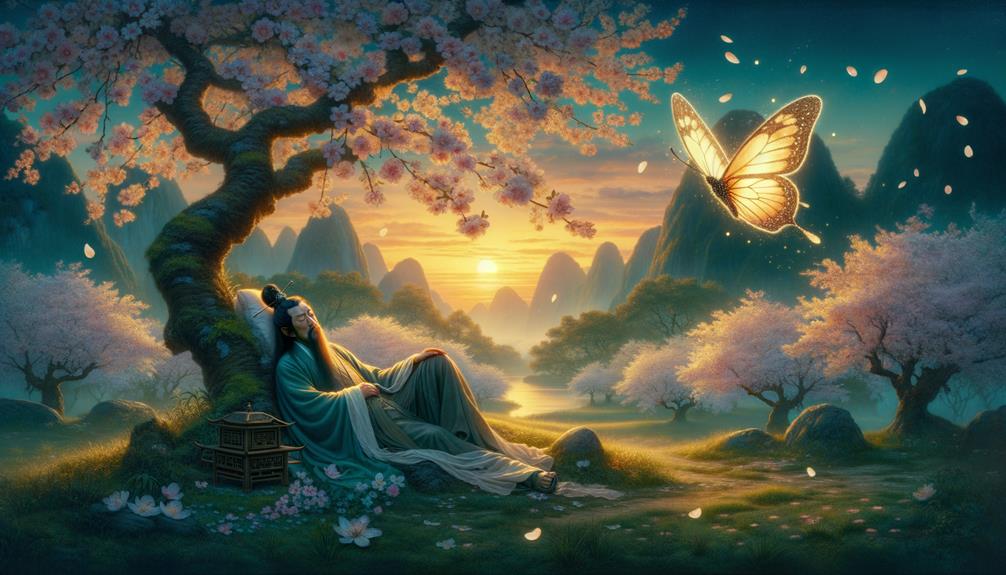
The butterfly dream is among the most famous passages in the Zhuangzi, a foundational work of early Daoist philosophy. In only a few lines, Zhuang Zhou dreams that he is a butterfly, wakes as himself, and wonders how confidently either state can define the other. The story is not merely a slogan that “reality is an illusion.” It is a compact meditation on perspective, identity, knowledge, and the continual transformation of things.
The passage in the Inner Chapters
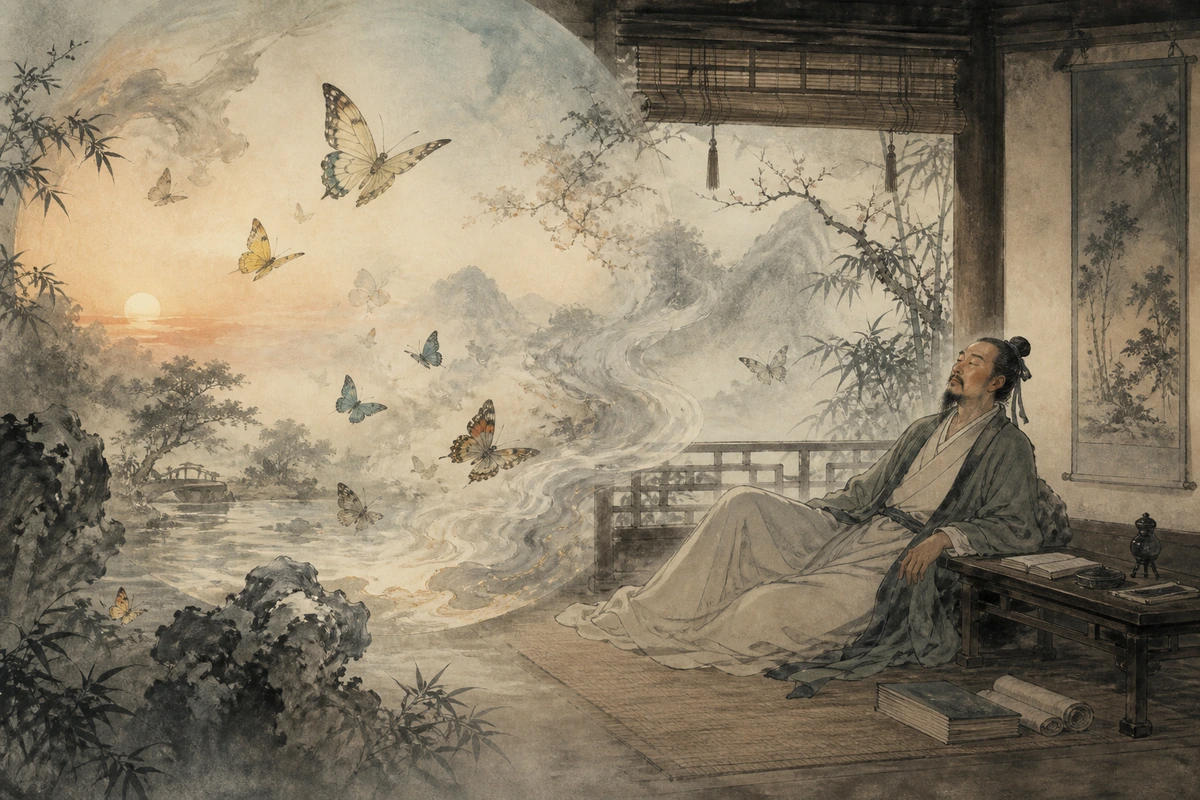
The episode closes chapter two, often translated as “The Equality of Things” or “Discussion on Making All Things Equal.” Zhuang Zhou dreams that he is a butterfly moving freely and happily, with no awareness of being Zhou. When he wakes, he is unmistakably himself. He then asks whether Zhou dreamed of the butterfly or the butterfly is now dreaming of Zhou.
The passage immediately adds an important qualification: between Zhou and the butterfly there must be a distinction. It calls this the “transformation of things.” The dream therefore holds difference and transformation together. Zhou and butterfly are not simply identical, yet neither perspective can claim an uncomplicated view from outside all change.
What the dream does—and does not—say
Popular summaries often turn the story into radical skepticism: perhaps nothing is real, or perhaps life is only a dream. Those readings capture part of its unsettling force, but they can flatten the text. The chapter repeatedly challenges rigid distinctions and the confidence that one limited viewpoint can exhaust reality. The butterfly dream participates in that larger argument by showing how complete a perspective can feel while one inhabits it.
At the same time, waking does not erase the butterfly, and the butterfly does not permanently erase Zhou. The story invites humility about identity and knowledge rather than demanding a single dogmatic conclusion. Its brevity is part of its power: the reader is left inside the question.
Zhuangzi as author and text
Zhuang Zhou was likely a thinker of the fourth century BCE, but the received Zhuangzi is a layered collection compiled from more than one voice and period. The seven “Inner Chapters” are traditionally associated most closely with Zhuang Zhou, while later sections reflect related schools and conversations. Recognizing that history matters because the book is not a conventional treatise. It uses dialogue, paradox, humor, fantasy, and deliberately unstable speakers to change how readers approach a problem.
Transformation beyond the dream
Throughout the Zhuangzi, bodies, values, social roles, and points of view refuse to remain fixed. Transformation is not presented only as loss; it can also free a person from narrow judgments and anxious attachment to one temporary standpoint. The butterfly’s effortless movement gives the idea a memorable form.
Later painters, poets, playwrights, and philosophers repeatedly returned to the scene. Detached from its chapter, it became an emblem of dream and reality. Restored to the chapter, it is richer: a reminder that every confident distinction is made from somewhere, by a being already changing.