
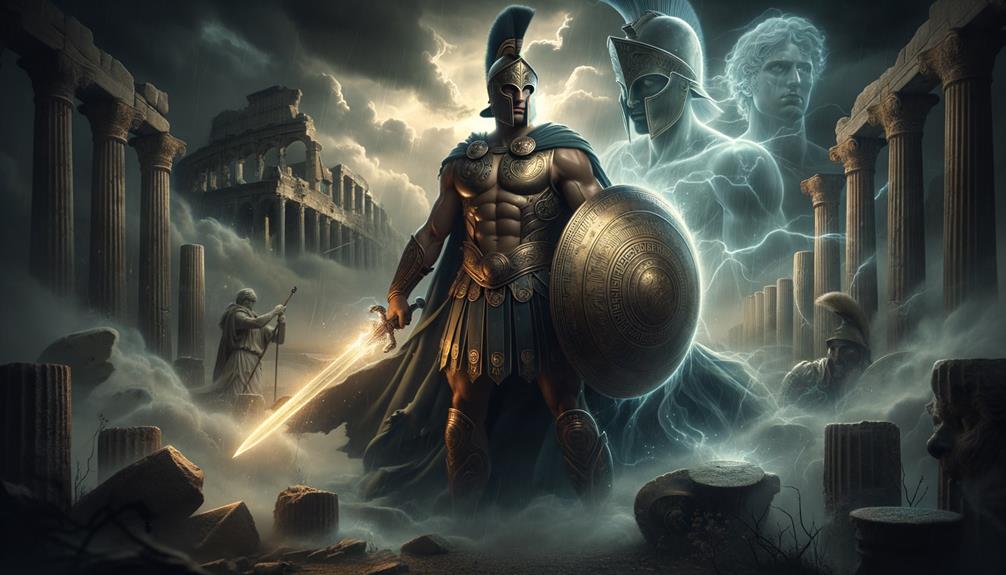
Accuracy note: Aeneas belongs to both Greek and Roman literary tradition. Greek epic presents him as a Trojan warrior; Virgil’s Aeneid turns his survival and migration into an origin story for Rome. These are mythic and literary traditions, not a biography that archaeology can verify.
Aeneas is one of the rare Trojan heroes whose story grows larger after Troy falls. In Homer’s Iliad, he is the son of the mortal Anchises and the goddess Aphrodite, a respected Dardanian commander repeatedly preserved by divine intervention. Centuries later, Virgil made him the central figure of Rome’s national epic: a refugee who carries Troy’s gods and obligations westward, suffers severe losses, and fights to establish a future in Italy.
Aeneas before Rome: the Greek tradition
Aeneas was not invented by Virgil. Homer calls him a son of Anchises and Aphrodite and places him among the leaders of the Dardanians, a people allied with Troy. In Iliad 5, Aphrodite attempts to rescue him after Diomedes wounds him, and Apollo completes the rescue. In Book 20, Poseidon saves Aeneas from Achilles because fate still has a future for Aeneas and his descendants.
The Homeric Hymn to Aphrodite supplies a fuller account of his parentage. Aphrodite disguises herself before meeting Anchises on Mount Ida, later reveals her divinity, and announces the child Aeneas. The poem’s explanation of his name is ancient wordplay, not modern etymology. These Greek sources establish the hero’s divine mother and expected survival without yet telling Virgil’s Roman migration epic.
The escape from Troy
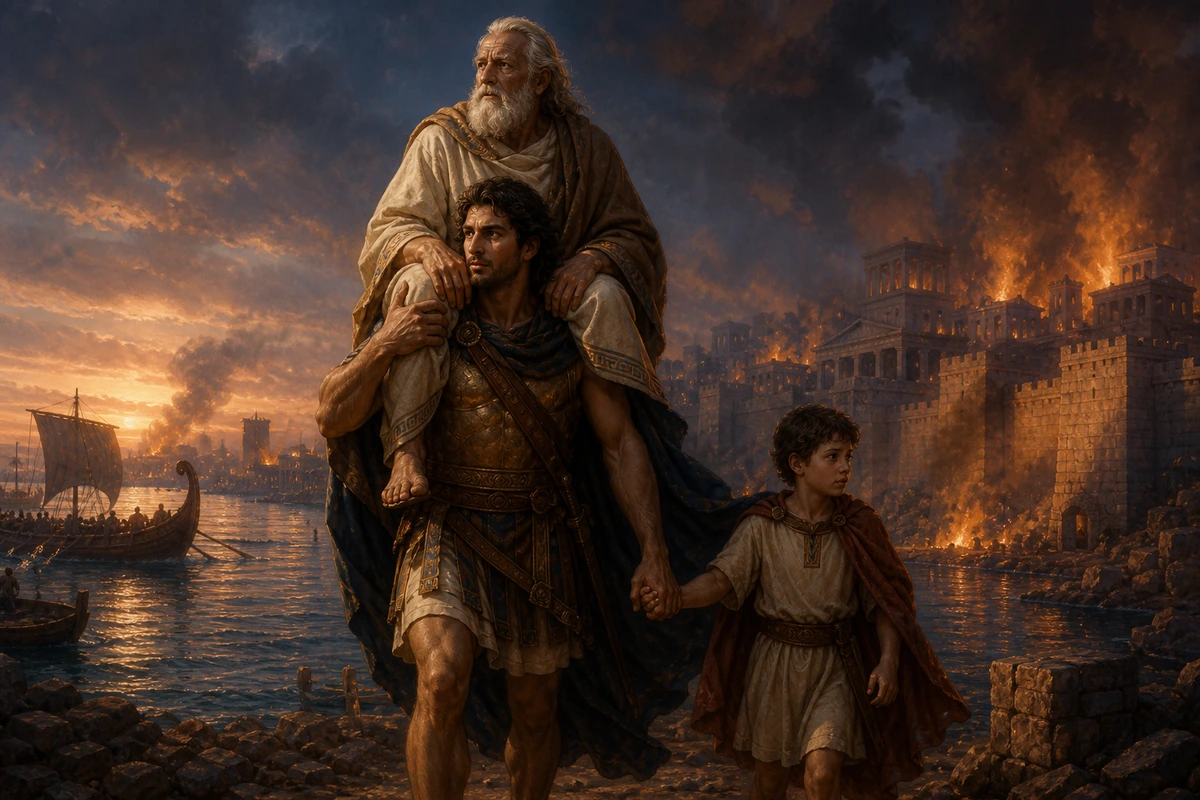
Virgil’s most influential image of Aeneas comes in Aeneid 2. As Troy burns, he carries his elderly father Anchises, leads his young son Ascanius, and asks his wife Creusa to follow. Creusa is lost during the escape. Her shade tells Aeneas that a new land and royal marriage await him in the west.
The scene concentrates the Roman virtue usually called pietas: responsible devotion to gods, family, and community. Aeneas does not simply flee for himself. He preserves a household across three generations and carries Troy’s sacred objects toward an uncertain future. That sense of duty often conflicts with his private wishes throughout the poem.
Wandering, Dido, and the underworld
The Trojans’ route is not a straight voyage from Troy to Italy. They encounter failed settlements, prophecies, storms, the Harpies, and the Cyclopes’ coast. In Carthage, Queen Dido welcomes Aeneas and falls in love with him. When Jupiter’s message recalls him to his assigned future, Aeneas departs; Dido dies by suicide and curses the Trojans. Virgil makes the episode emotionally complex, not a simple victory of duty over temptation.
After Anchises dies in Sicily, Aeneas reaches Cumae. Guided by the Sibyl, he enters the underworld in Book 6, meets the shade of his father, and receives a vision of future Roman figures. The sequence makes Rome’s future part of the poem’s design while reminding readers that this future is being narrated through Augustan-era poetry.
War in Italy and the poem’s difficult ending
Arrival in Latium does not complete the mission. King Latinus is prepared to give his daughter Lavinia to the foreign hero, but Turnus, leader of the Rutulians, resists. Aeneas allies with Evander and the Etruscans, while the conflict produces losses on both sides. The young warriors Pallas and Lausus make the cost of the supposedly destined war especially visible.
The Aeneid ends abruptly after Aeneas defeats Turnus in single combat. He initially hesitates, then sees the belt Turnus took from Pallas and kills him. Virgil does not narrate a peaceful wedding, the founding of Lavinium, or Aeneas’s death. Those events belong to the wider Roman tradition, including Livy and other authors.
From Lavinium to Rome
| Figure or place | Role in Roman foundation tradition |
|---|---|
| Aeneas | Trojan survivor who reaches Latium and is associated with Lavinium |
| Ascanius or Iulus | Aeneas’s son and the traditional founder of Alba Longa |
| Alba Longa | Royal city linking the Trojan line to later Roman founders |
| Romulus and Remus | Twins born many generations later in the foundation legend of Rome |
Roman genealogies did not make Aeneas the direct founder of the city of Rome. Instead, he stood at the beginning of a long sequence: Lavinium, Alba Longa, and eventually Romulus and Remus. The name Iulus also allowed the Julian family, including Julius Caesar and Augustus, to claim descent from Aeneas’s son and therefore from Venus.
What Aeneas represents
Aeneas is often reduced to a model of obedient Roman duty, but Virgil’s characterization is less tidy. He grieves, doubts, becomes angry, and makes choices that hurt others. The poem can celebrate Rome’s destiny while exposing the human cost of empire and civil conflict. That tension is a major reason the Aeneid continues to generate different readings.
Primary sources and related reading
- Homer, Iliad 5: Aphrodite and Apollo rescue Aeneas
- Homeric Hymn to Aphrodite: Anchises and the birth of Aeneas
- Virgil, Aeneid 2: the fall of Troy and escape
- Faunus in Roman tradition on Mythology Vault