
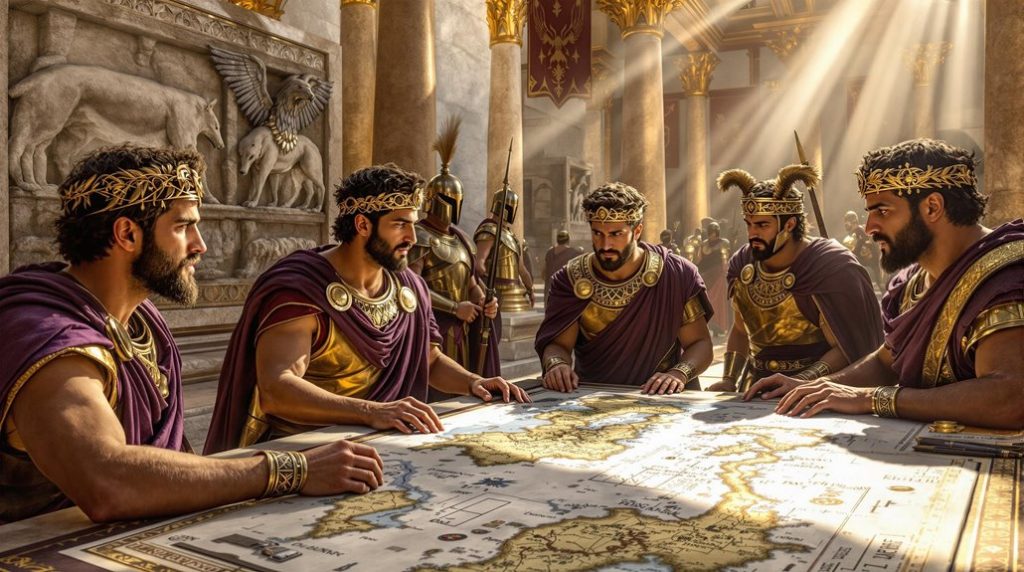
Roman tradition placed six kings between the disappearance of Romulus and the founding of the Republic: Numa Pompilius, Tullus Hostilius, Ancus Marcius, Lucius Tarquinius Priscus, Servius Tullius, and Lucius Tarquinius Superbus. Their stories present early Rome as a city assembled one institution at a time. They are not, however, biographies preserved in contemporary royal archives.
How historical are Rome’s kings?
The conventional chronology runs from Rome’s foundation in 753 BCE to the expulsion of the last king in 509 BCE. Livy wrote Book 1 of his history in the late first century BCE, more than four centuries after the traditional end of the monarchy. Dionysius of Halicarnassus and Plutarch were later still. Their narratives drew on earlier Roman authors, family traditions, monuments, ritual explanations, and storytelling.
Archaeology confirms that settlements around Rome grew into a more urban and politically organized center during the eighth through sixth centuries BCE. It cannot verify every speech, battle, family relationship, or founding act assigned to a named king. The safest language is therefore “Roman tradition credited” rather than “the king certainly created.”
Numa Pompilius: a sacred order
After the warlike Romulus, the Romans choose Numa, a Sabine known for justice and religious wisdom. Livy makes the contrast deliberate: a people shaped by arms must now be shaped by law, calendars, priesthoods, and ritual discipline.
Numa is credited with organizing flamines, Vestal Virgins, Salii, and the pontifex; regulating sacrifices; and closing the doors of Janus during peace. These attributions turn a complex body of Roman religion into the coherent achievement of one exemplary king. The story matters even where the institutions developed gradually.
Tullus Hostilius: Alba and military expansion
Tullus reverses Numa’s peaceful character. His reign centers on war with Alba Longa, Rome’s legendary mother city. The conflict is first decided by the combat of two sets of triplets, the Roman Horatii and Alban Curiatii. After Alba’s leader Mettius Fufetius betrays Rome, Tullus destroys the city and transfers its population and aristocratic families to Rome.
Livy ends the reign with a caution: Tullus turns anxiously to religion during a plague but performs a rite incorrectly and is killed when lightning strikes his house. The episode is a moral sequence, not a meteorological record.
Ancus Marcius: river, port, and boundaries
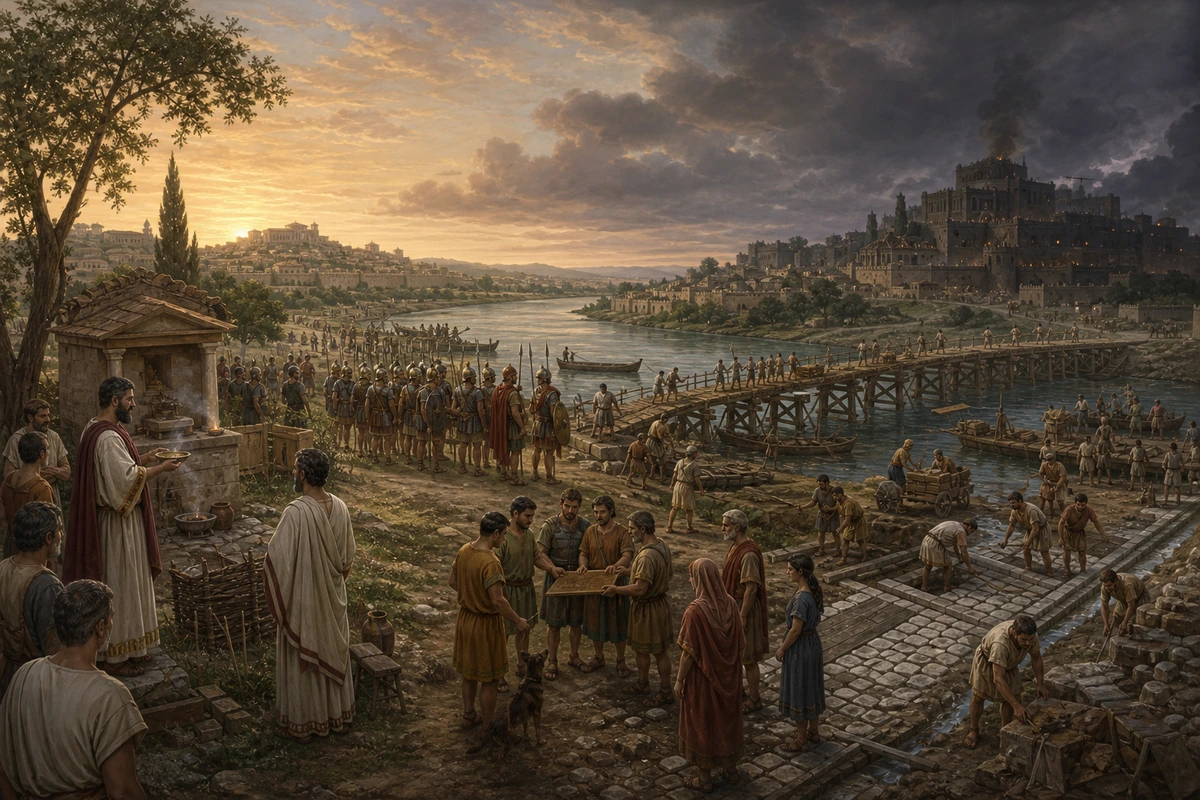
Ancus, described as Numa’s grandson, combines religious observance with military action. Tradition credits him with settling conquered Latin communities on the Aventine, fortifying the Janiculum, building Rome’s first bridge across the Tiber, and founding Ostia at the river mouth.
Archaeologists debate the date and scale of early activity at Ostia, and the great seaport visible today belongs mostly to later centuries. Ancus’s story nevertheless captures Rome’s growing dependence on the Tiber corridor, salt routes, and access to the sea.
Tarquinius Priscus: Etruscan connections and public works
Lucumo, the son of a Greek exile and an Etruscan mother, migrates from Tarquinii to Rome and takes the name Lucius Tarquinius Priscus. With the support of his ambitious wife Tanaquil, he wins royal power. His outsider success gives Roman tradition a way to acknowledge the city’s strong Etruscan connections.
Livy associates his reign with an enlarged senate, cavalry units, games, drainage of low ground, and the beginnings of major works around the Forum and Capitoline. Archaeology supports major urban transformation in sixth-century Rome, but assigning each drain or building phase to one reign exceeds the evidence.
Servius Tullius: census and civic classes
Servius has competing origin stories. Livy makes him the son of an enslaved woman raised in the royal household after a mysterious flame appears around his head. Other traditions connect him with the Etruscan figure Mastarna. His unusual birth prepares a reign defined by reordering status.
Roman authors credit Servius with the census, property classes, centuries used for military and political organization, expansion of the city, and a wall around Rome. Parts of the surviving “Servian Wall” date to the fourth century BCE, long after his traditional reign, although earlier defenses may have existed. The name is traditional, not a secure construction label.
Tarquinius Superbus and the end of monarchy
Servius is murdered in a palace conspiracy involving his daughter Tullia and her husband, Tarquinius Superbus, “Tarquin the Proud.” The last king rules without proper consent, executes opponents, uses forced labour, and presses Rome’s wars and monumental building.
The final crisis begins when the king’s son Sextus assaults Lucretia. After she tells her family and dies by suicide, Lucius Junius Brutus leads an uprising that expels the Tarquins. Roman tradition dates the Republic from this break in 509 BCE. The Lucretia narrative became a foundational story about tyranny and liberty; it should not be reported as though it were preserved in a contemporary court file.
A city built through remembered reigns
Taken together, the six successors form a deliberate progression: Numa gives religion, Tullus military dominance, Ancus territorial and commercial reach, Priscus monumental ambition, Servius civic organization, and Superbus the negative example that makes republican government necessary.
That pattern is one reason to read the sequence critically. It explains institutions by attaching them to memorable founders and turns constitutional change into family drama. The archaeological city did become larger, wealthier, and more connected during the regal centuries. Livy’s kings are the literary framework through which Romans remembered that transformation.