The Norns are powers who shape lives and allot destiny in Old Norse tradition. The best-known three are Urðr, Verðandi, and Skuld, named in Völuspá beside the world tree Yggdrasil. Yet medieval sources also speak of many norns who come to children at birth, and they do not consistently describe three sisters spinning a single thread for every life. That familiar image owes much to comparisons with the Greek and Roman Fates and to later art.
Accuracy note: Urðr, Verðandi, and Skuld are real Old Norse names, but treating them as a tidy “past, present, future” trio is an interpretive simplification. “Weaving fate” is a useful modern metaphor, not the main action assigned to them in Völuspá.
Urðr, Verðandi, and Skuld in Völuspá
In the poem Völuspá, three powerful maidens come from a hall beneath the tree. They are called Urðr, Verðandi, and Skuld. The poem says they establish laws, choose lives, and speak or mark the fates of human beings. The language is compact and has been translated in several ways, including “carve on slips of wood” or “cut runes,” because the Old Norse wording evokes inscribed lots and the formal setting of destiny.
The names are grammatically related to becoming and obligation. Urðr is tied to what has happened or become; Verðandi is a present participle, “becoming” or “happening”; Skuld is related to what “shall” or “must” be and can also mean debt or obligation. Mapping those nuances onto the English labels Past, Present, and Future is memorable, but it makes the trio more symmetrical than the language requires.

Many norns, not only three
Snorri’s Gylfaginning names the three maidens by Urðr’s well but immediately expands the category. Other norns visit every child born and shape that person’s life. Some are of the gods, some of the elves, and some of the dwarfs. Snorri uses this diversity to explain why lives differ: beneficent norns give good fortune, while harmful ones account for misfortune.
Heroic poems and sagas likewise use “norn” more broadly. Norns may arrive at a birth, determine the length or course of a life, or be blamed for a hero’s death. The word can refer to a class of fate-shaping female beings rather than always to one fixed triad. Urðr, Verðandi, and Skuld are preeminent, but they do not exhaust the tradition.
The well and the care of Yggdrasil
Snorri locates a holy well, Urðarbrunnr, beneath one of Yggdrasil’s roots and says the gods hold their court nearby. The norns who dwell there take water from the well and mix or gather it with the clay around the spring, sprinkling the ash so its branches will not wither or decay. The substance makes whatever enters the water gleaming or pale, compared in one translation to the membrane inside an eggshell.
This daily care is more securely sourced than claims that the Norns “maintain cosmic balance between all nine realms.” The world tree links mythic spaces, and tending it plainly has cosmic importance, but the sources do not give the trio a modern job description as guardians of equilibrium. Nor do they say that all norns practice seiðr or that every strike of a dwarf’s hammer preserves their wisdom.
Do the Norns weave fate?
Old Norse poetry certainly uses textile imagery for battle and destiny. The starkest example is Darraðarljóð, where supernatural women weave on a grisly loom before the Battle of Clontarf. Valkyries and norns can overlap in poetic imagination, and Skuld herself appears among valkyries in Snorri’s lists. Even so, that does not make the three named norns exact copies of the Greek Moirai spinning, measuring, and cutting one life-thread.
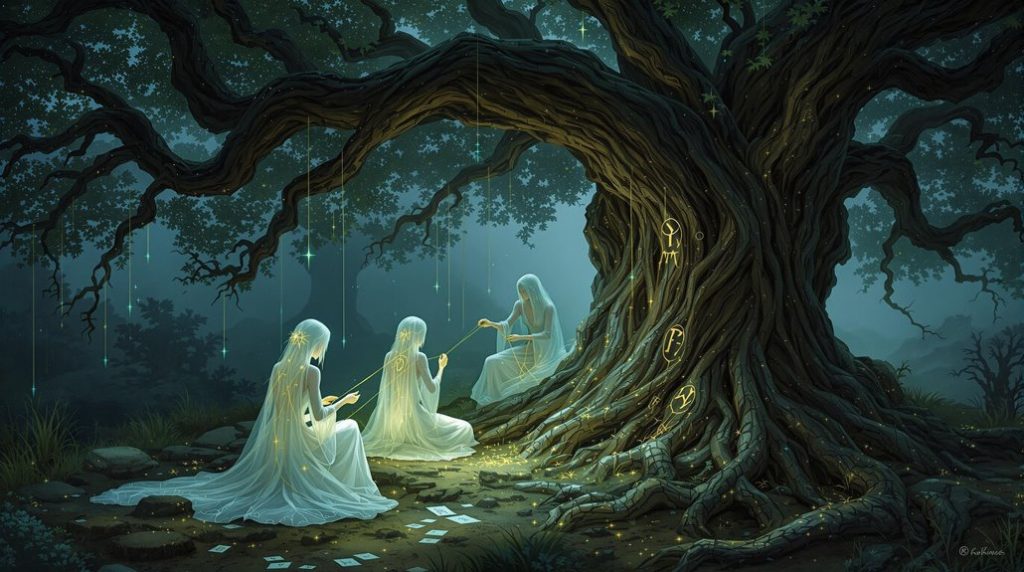
Völuspá emphasizes law-setting, choosing lives, speaking destiny, and possibly carving wooden lots. Gylfaginning emphasizes birth, allotted fortune, and care for Yggdrasil. Artists may visualize fate as cloth, but an accurate caption should identify weaving as interpretation unless a specific textile passage is being illustrated.
| Common claim | What the sources support | Better wording |
|---|---|---|
| There are only three Norns | Three are named at Yggdrasil, while many others shape individual lives | The best-known Norns are Urðr, Verðandi, and Skuld |
| They are literally Past, Present, Future | The names relate asymmetrically to becoming and obligation | The time-triad reading is influential but simplified |
| They spin and cut everyone’s thread | The principal passages mention choosing, speaking, carving, and allotting | They shape or determine fate |
| They are three biological sisters | The texts call them maidens but do not provide a shared parentage | A named triad, not a documented family |
| They alone guard cosmic balance | They tend Yggdrasil with water and clay from the well | Their care helps keep the world tree from decaying |
Skuld, valkyries, and overlapping categories
Skuld is both one of the named norns and a name included among valkyries who ride to choose the slain and decide battles. Medieval mythic categories are often porous: a female supernatural figure may be described by function in one passage and by a more specific name in another. That overlap does not mean all norns are valkyries or that all valkyries are norns.
Urðr can also mean fate or the result of past action beyond the personal name, which is why translations sometimes render Urðarbrunnr as the Well of Fate. “Well of Urðr” is more literal and preserves the productive ambiguity between a named being and the wider power of destiny.
Fate without a single doctrine
Old Norse literature does not offer one systematic theology of free will. Heroes know that death may be fixed yet still care intensely about courage, reputation, kinship, and the manner in which they meet it. Norns can represent forces outside human control, but stories continue to judge choices. Fate sets limits; it does not make conduct meaningless.
The Norns are therefore most compelling when their strangeness is preserved. They are not merely Norse versions of three classical goddesses, nor a decorative maiden-mother-crone trio. They belong by a well under an immense living tree, establish what must be, mark lives, arrive at births, and tend the structure that holds worlds together.
Sources and further reading
- Völuspá, Henry Adams Bellows translation
- Viking Society for Northern Research, The Uppsala Edda, norns and Yggdrasil
- Snorri Sturluson, Gylfaginning, Arthur Gilchrist Brodeur translation