
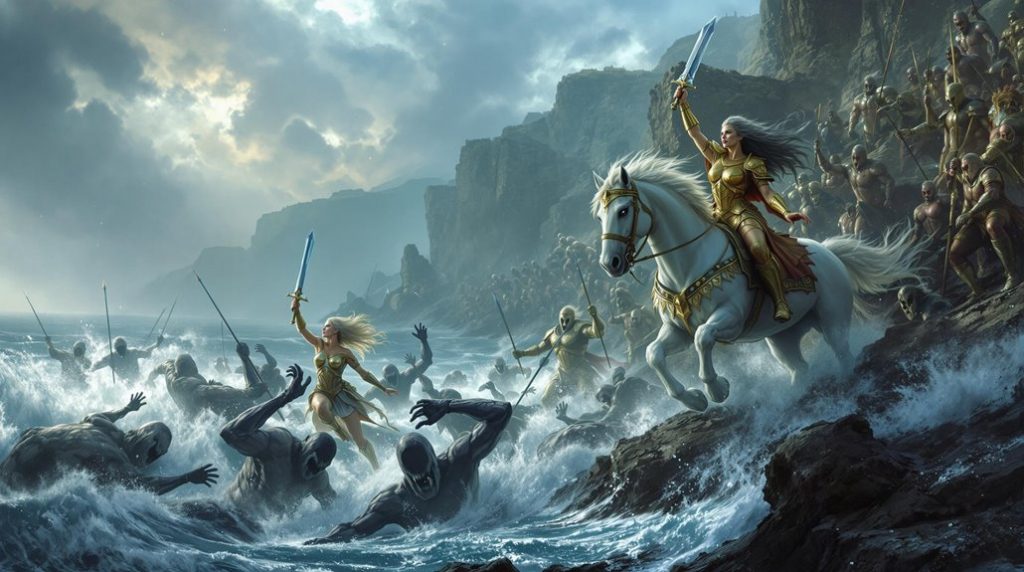
Accuracy note: The Second Battle of Mag Tuired survives in a late medieval Irish manuscript containing older and later layers. It is a mythic literary narrative, not a historical report of a war between archaeologically identifiable peoples.
The victory of the Túatha Dé over the Fomoire is not the story of one champion defeating a simple race of monsters. Cath Maige Tuired builds its battle around oppressive tribute, contested kingship, kinship across enemy lines, and the coordinated skills of rulers, smiths, healers, poets, druids, and warriors. Lug is central because he can organize many arts, not because everyone else becomes irrelevant.
Who are the Túatha Dé?
Túatha Dé Danann is conventionally translated “peoples of the goddess Danu,” although the name Danu is reconstructed from the genitive Danann and remains difficult. In Cath Maige Tuired, they learn supernatural arts in four northern cities and bring four famous treasures to Ireland: the Stone of Fál, Lug’s spear, Nuada’s sword, and the Dagda’s cauldron.
They first fight the Fir Bolg. King Nuada loses a hand in that battle and becomes ineligible for kingship because he is no longer physically whole. Bres, whose father is Fomorian and whose mother belongs to the Túatha Dé, becomes king. His mixed ancestry immediately complicates any attempt to divide the story into two biologically separate species.
Bres’s failed kingship
Bres proves ungenerous and allows Fomorian rulers to impose labor and tribute. The tale measures a king partly through hospitality and distribution. When the poet Cairbre receives a miserably poor welcome, he composes a satire that damages Bres’s standing. Nuada, meanwhile, receives a silver hand from the physician Dían Cécht and later a restored flesh-and-blood hand through Miach.
Bres is removed, but he gathers Fomorian support. The resulting conflict is therefore a rebellion against exploitation and failed sovereignty as much as a supernatural invasion story.
Lug at the gate of Tara
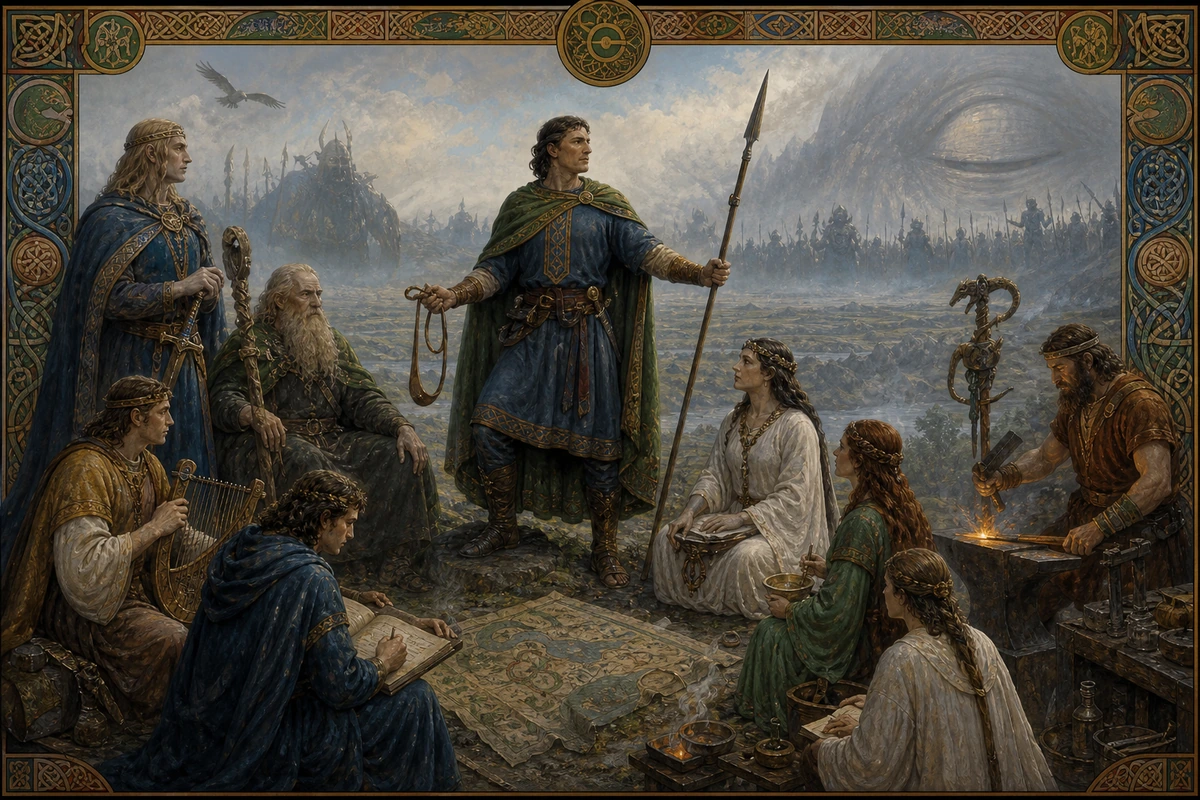
Lug arrives at Tara while Nuada is holding court. The doorkeeper asks what skill he possesses. Lug successively offers the abilities of a builder, smith, champion, harpist, poet, historian, sorcerer, physician, cupbearer, and metalworker; each time the doorkeeper says the court already has one. Lug finally asks whether it has anyone who possesses all those skills together.
Admitted as the samildánach, the many-skilled one, Lug defeats Nuada at a board game and proves his strategic value. Before battle he asks each specialist what service they can supply. The episode makes leadership a work of integration.
The battle as coordinated labor
| Figure or group | Contribution in the tale |
|---|---|
| Lug | Questions the specialists, encourages the host, and confronts Balor |
| Goibniu, Credne, and Luchta | Produce and repair weapons with extraordinary speed |
| Dían Cécht and healers | Restore wounded fighters at the healing well, within the story’s magic |
| Dagda | Promises destructive strength and undertakes a dangerous mission |
| Morrígan, poets, and druids | Supply prophecy, enchantment, satire, and battle magic |
The narrative repeatedly contrasts the Túatha Dé’s renewable equipment and healed fighters with Fomorian losses. These are marvels within a mythic economy of skilled craft, not evidence for secret ancient technology.
Lug and Balor
Balor’s destructive eye must be lifted open by attendants. The text explains its power through fumes from a magical brew that entered the eye when Balor looked into his father’s druids’ work. During the battle, Lug launches a sling stone that drives the eye back through Balor’s head so its force strikes the Fomorian host.
Modern art often turns this into a sword duel or a tale about a giant laser eye. The medieval episode is more specific: a sling, a heavy eyelid, poisonous magical power, and a reversal that makes Balor’s weapon harm his own side.
What happens after victory?
Nuada and Macha die in the battle, so the triumph is not cost-free. The Morrígan announces the victory and a prophetic voice describes both abundance and future disorder. Bres is captured. In exchange for his life, he offers knowledge connected with agriculture, including when to plough, sow, and reap. The ending converts the defeated ruler’s knowledge into terms useful to the land.
Irish tradition later places the Túatha Dé beneath the earth in the síd after the arrival of the Milesians. That later displacement belongs to a broader mythological history; it should not be used to make every character at Mag Tuired a generic fairy.
Fomoire are not simply “evil gods”
The Fomoire include oppressors and terrifying battle leaders, but the text also gives them family bonds, negotiation, and political relationships with the Túatha Dé. Lug himself is Balor’s grandson. Elatha treats Bres differently from the harsh rulers who exploit Ireland. “Chaos versus civilization” can be a useful theme, but it becomes misleading when it erases those internal distinctions.
Primary sources and related reading
- Cath Maige Tuired: The Second Battle of Mag Tuired, translated by Elizabeth A. Gray
- CELT witness and edition record: manuscript and editorial context
- The Morrígan in medieval Irish literature on Mythology Vault