
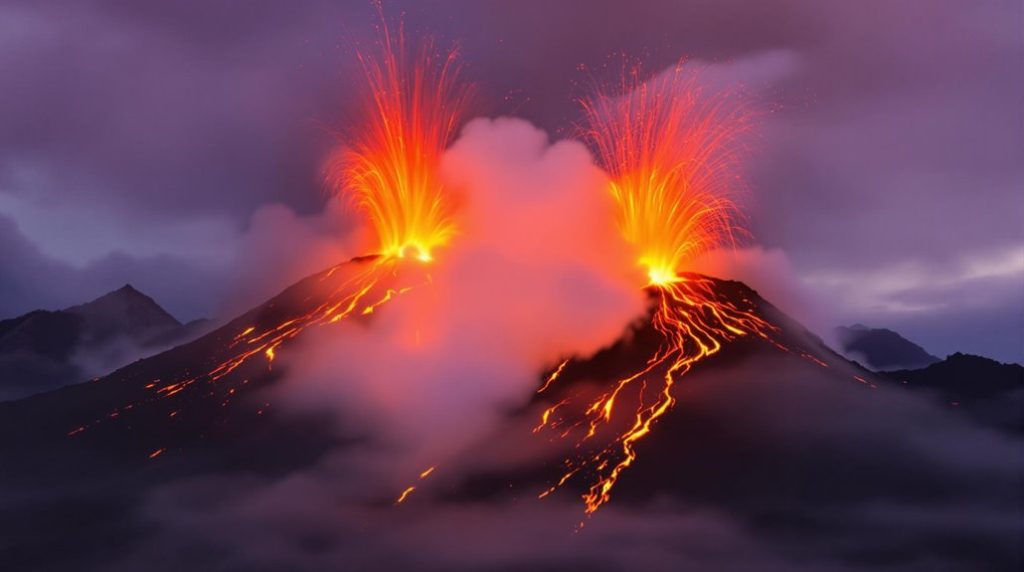
Accuracy note: Pelehonuamea belongs to living Hawaiian traditions preserved in mele, moʻolelo, genealogy, place names, performance, newspapers, and community practice. Her genealogy, migration, and conflicts vary by source; no single retelling should be treated as the only “original myth.”
Pele is intimately connected with volcanic fire, new land, Kīlauea, migration, and a large divine family. She is not only a personification used by premodern Hawaiians to explain eruptions. Hawaiian-language traditions present her as a powerful ancestor and presence whose actions organize relationships among islands, waters, winds, plants, people, and kin.
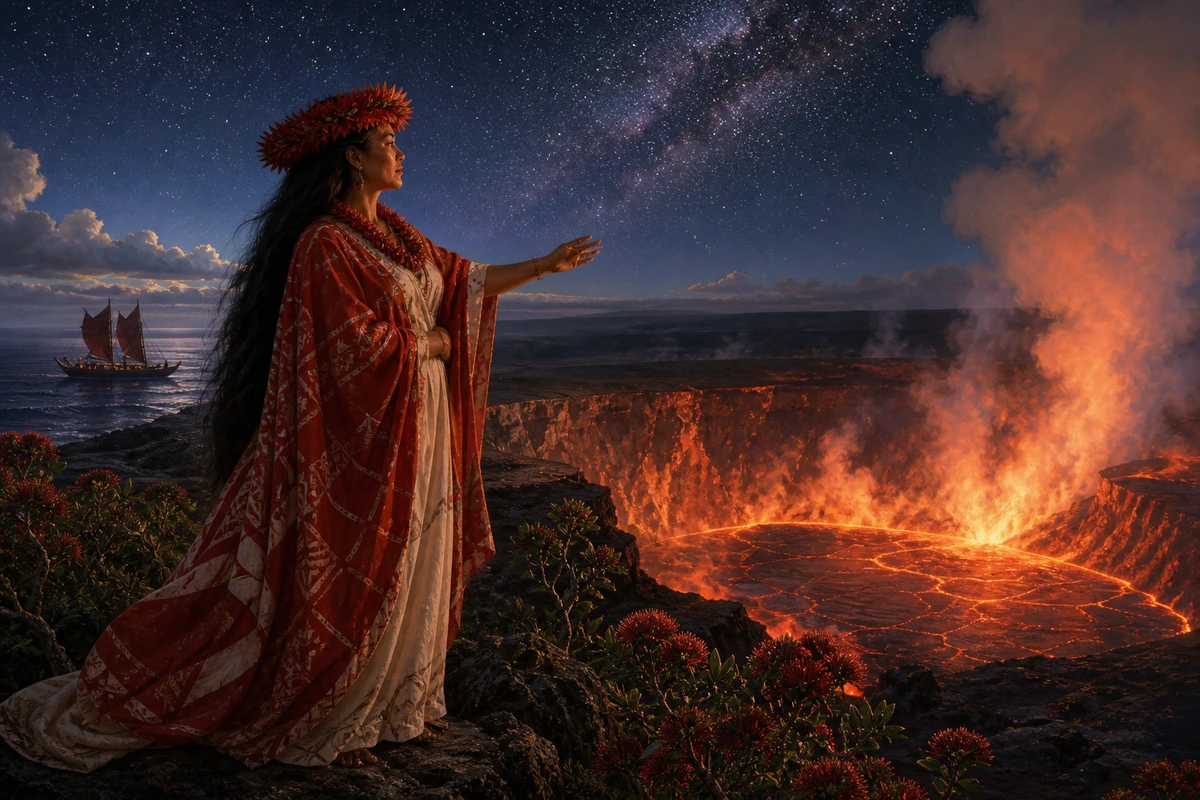
Pele’s names and genealogies
Pelehonuamea is a major name, often connected with red earth. Hawaiian sources also use epithets such as “the earth-eating woman,” “the woman of the pit,” “the foreign woman,” and “the woman of the white garment.” Each name draws attention to a different relationship or manifestation.
The University of Hawaiʻi’s Kahoʻiwai knowledge base records several genealogies: Pele can be a child of Papa and Wākea, of Haumea and Kūwahaʻilo, or of Kahinaliʻi and Kānehoalani. Her siblings include Nāmakaokahaʻi, Hiʻiakaikapoliopele and other Hiʻiaka sisters, the shark-associated Kamohoaliʻi, and Lonomakua. Variation is part of the record, not evidence that one version is corrupt.
Migration from Kahiki
Many moʻolelo say Pele comes from Kahiki, a term that can refer to ancestral lands beyond Hawaiʻi. The reasons for departure differ. Conflict with her sea-associated sister Nāmakaokahaʻi is common, but the cause may involve Pele’s fire, romantic rivalry, family tension, or a larger migration of divine relatives.
Pele searches through the island chain for a suitable home, digging or testing volcanic craters. Nāmakaokahaʻi’s waters may extinguish the fires and continue the pursuit. Pele eventually establishes her residence at Halemaʻumaʻu within Kīlauea on Hawaiʻi Island. The journey creates a map of remembered places rather than a generic fight between elemental sisters.
Nāmakaokahaʻi: water and fire
Popular summaries call Nāmakaokahaʻi merely “Pele’s jealous sister.” Hawaiian traditions give her her own power and relationships. Their opposition connects ocean water with volcanic fire, but it also concerns seniority, kinship obligations, and contested conduct.
Some versions narrate Pele’s bodily defeat while her spirit or divine presence continues. Others emphasize repeated pursuit and settlement. Treating every eruption-water encounter as one episode from a fixed biography flattens a distributed body of island-specific stories.
Pele and Hiʻiaka
The epic of Hiʻiakaikapoliopele is one of the richest Hawaiian narrative cycles. Pele dreams of or encounters the Kauaʻi chief Lohiʻau and sends her youngest sister Hiʻiaka to fetch him. Hiʻiaka agrees after securing promises concerning her friend Hōpoe and her beloved ʻōhiʻa lehua grove.
The journey takes Hiʻiaka across the islands through battles, healing, chants, and encounters with local beings. Delay and misunderstanding provoke Pele’s anger. In major published versions, Pele destroys what she promised to protect, and the sisters’ conflict becomes devastating. The epic is not simply a side story proving Pele’s temper; it gives Hiʻiaka her own growth, skills, loyalties, and moral claims.
Poliʻahu and other rivals
Moʻolelo also bring Pele into conflict with Poliʻahu, associated with snow and Mauna Kea, and with other female powers of wind, water, and high places. Episodes include contests, journeys, courtship disputes, and territorial struggle. The participants’ kin relationships and even whether a scene is located on Hawaiʻi or another island can change by version.
Reducing all these women to “Pele’s sisters” or “ice versus fire” removes names, places, and motives. The specific source should lead the summary.
Symbols and places
| Place or form | Connection in Hawaiian tradition |
|---|---|
| Kīlauea and Halemaʻumaʻu | Pele’s best-known residence on Hawaiʻi Island |
| Lava and volcanic steam | Kinolau or embodied forms and signs connected with Pele |
| ʻŌhiʻa lehua | Plant deeply tied to volcanic landscapes and the Hiʻiaka cycle |
| ʻŌhelo | Berry associated with offerings in recorded practice |
| Migration places across the islands | A sacred geography formed through Pele’s travels and family conflicts |
Living tradition and volcanic science
Geology explains magma, lava chemistry, eruption history, and land formation. Moʻolelo, mele, and genealogy address relationships, identity, ethics, and place. They do not need to compete. Native Hawaiian scholars and practitioners may engage both scientific and ancestral knowledge without translating Pele into a failed geological hypothesis.
Visitors should not imitate offerings from a web article or remove lava rock in the name of a modern “Pele’s curse” story. Respect begins with following current park rules, learning Hawaiian place names, and listening to Hawaiian cultural authorities. The traditions remain alive and are not public-domain props for tourism.
Hawaiian sources and research
- University of Hawaiʻi Kahoʻiwai: Pelehonuamea: names, genealogies, places, and source bibliography
- “Ka Moʻolelo No Pele” in the University of Hawaiʻi Hawaiian-language newspaper database: Hawaiian text and translation
- Hawaiian-language Hiʻiakaikapoliopele serial, chapter 1