
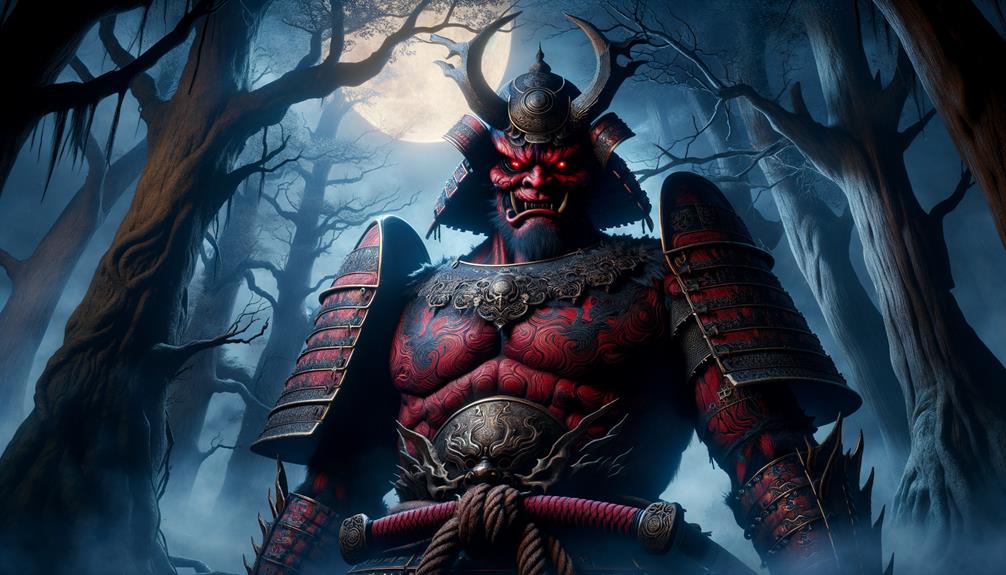
Shuten-dōji, the “drunken acolyte” or “drunken boy,” is one of Japan’s most famous oni. In the best-known legend he rules a mountain stronghold, abducts people from the capital, and is destroyed by Minamoto no Yorimitsu—usually called Raikō—and four retainers. The tale survives in multiple medieval and early modern texts and picture scrolls, so its location, backstory, and details vary.
The standard romanization is Shuten-dōji, not “Shoten Doji.” He is a legendary oni leader, not securely the child of the serpent Yamata no Orochi, and Raikō’s retainers are the heroes opposing him—not members of his gang.
The Mount Ōe expedition
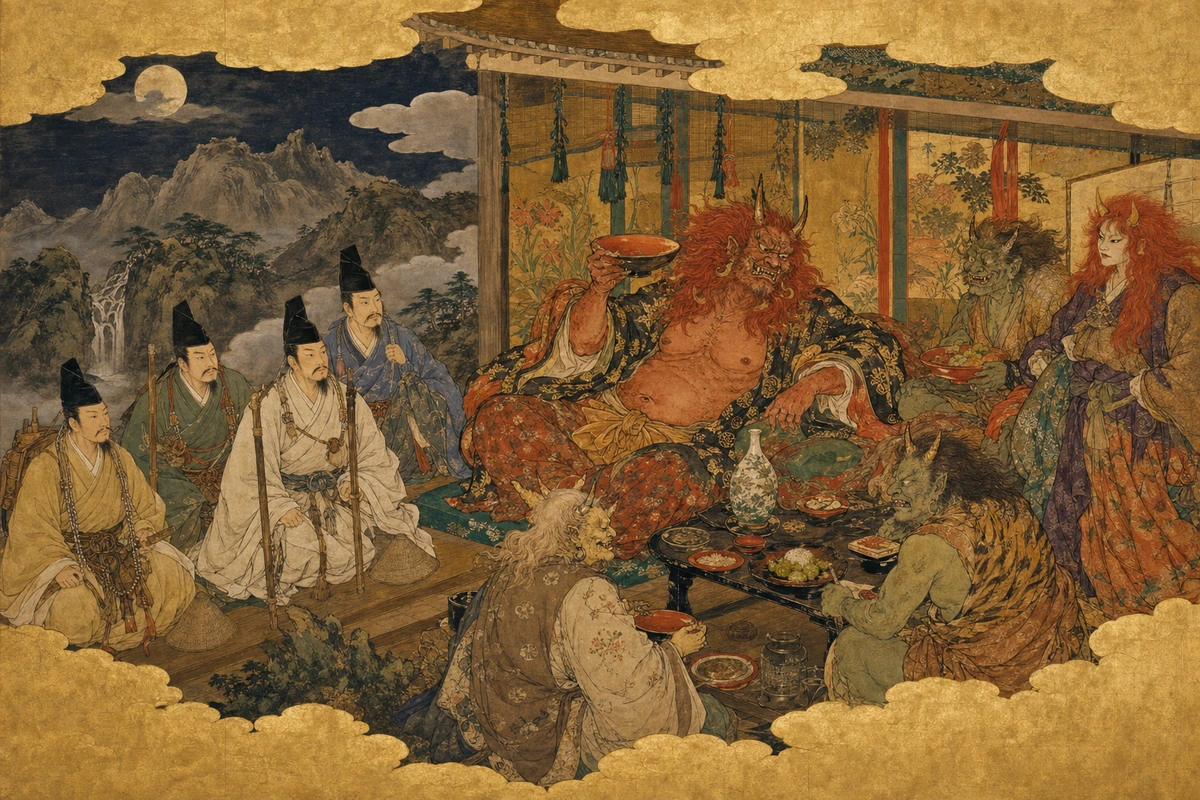
In the familiar version, disappearances from Kyoto lead the court to send Raikō and his companions to Mount Ōe. The warriors disguise themselves as mountain ascetics so that they can enter the oni stronghold. Divine protectors encountered along the road provide help, including special sake and armor or a helmet that will matter during the attack.
The banquet and enchanted sake
Shuten-dōji welcomes the supposed pilgrims and drinks with them. The heroes give him divinely assisted sake that incapacitates the oni while leaving themselves unharmed. Captive women reveal the layout of the residence, and the warriors arm themselves. Their victory depends on disguise, divine aid, information from captives, and intoxication—not a straightforward duel between equal armies.
When Raikō beheads Shuten-dōji, the severed head continues to attack. The protective helmet saves the hero. This final danger makes the oni’s power visible even after bodily defeat and turns the gift received on the journey into the condition of survival.
Raikō’s four retainers
The companions are commonly known as the Four Heavenly Kings of Raikō: Watanabe no Tsuna, Sakata no Kintoki, Usui Sadamitsu, and Urabe no Suetake. The Buddhist title compares their protective service to divine guardians. They should not be placed inside Shuten-dōji’s organization. Ibaraki-dōji is the oni most often associated with Shuten-dōji and also appears in a separate cycle involving Tsuna.
Variant origins and locations
Some traditions locate the stronghold at Mount Ōe, others at Mount Ibuki, and later works develop childhood stories under the name Ibuki-dōji. Parentage and transformation accounts differ. Treating one late genealogy—especially the claim that Yamata no Orochi fathered him—as the universal origin of Shuten-dōji erases the tale’s textual history.
What the legend is doing
The story maps danger onto the mountain boundary beyond the capital. Shuten-dōji’s court mirrors aristocratic banqueting while reversing its values: hospitality hides predation, luxury accompanies captivity, and excessive drinking enables collapse. Raikō’s party also uses deception and violence, so picture scrolls can emphasize spectacle, tension, or moral ambiguity rather than a simple children’s lesson.
Evidence check
| Element | Supported core | Caution |
|---|---|---|
| Name | Shuten-dōji, “drunken acolyte/boy” | Spellings vary in romanization |
| Enemy | Minamoto no Yorimitsu or Raikō and four retainers | The historical warrior and legendary hero are not identical biographies |
| Stronghold | Frequently Mount Ōe | Mount Ibuki and other settings occur |
| Defeat | Disguise, enchanted sake, beheading, attacking head | Scene order and divine helpers vary by version |
| Orochi parentage | Appears in some later origin traditions | Not the stable foundation of all versions |
Shuten-dōji in art
The legend became a major subject for illustrated handscrolls, screens, prints, theater, and modern media. A seventeenth-century British Museum handscroll preserves a long narrative sequence: the disguised departure, mountain crossing, oni banquet, preparation of sake, attack, rescue, and triumphant return. Such artworks are not mere decoration; they show how audiences encountered the story as an unfolding visual performance.
Accuracy note and further reading
This revision removes invented gang ranks, reverses the mistaken placement of Raikō’s retainers among the oni, and presents origin stories as variants.