
The philosopher’s stone was an alchemical ideal: a prepared substance believed capable of perfecting imperfect metals, especially by transmuting them into silver or gold. Some traditions also connected it with medicine, bodily renewal, or an elixir of life. No verified stone with those powers has ever been found, but the search belongs to the serious history of experiment, natural philosophy, metallurgy, and pharmacy.
Alchemy was never one uniform system. Greek-Egyptian, Arabic-language, and Latin European authors used different theories, materials, names, and religious frameworks. “The stone” is therefore best understood as a family of related goals rather than a single recipe transmitted unchanged from antiquity.
From elixir to stone
Ancient Greek-Egyptian alchemists investigated the coloring and transformation of metals. Arabic-language scholarship greatly expanded laboratory practice, apparatus, classification, and elixir theory; Latin translations later carried this material into Europe. In medieval and early modern Latin alchemy, the perfected agent was commonly imagined as a tincture, powder, medicine, or stone capable of projecting its perfection into another substance.
What alchemists meant by transmutation
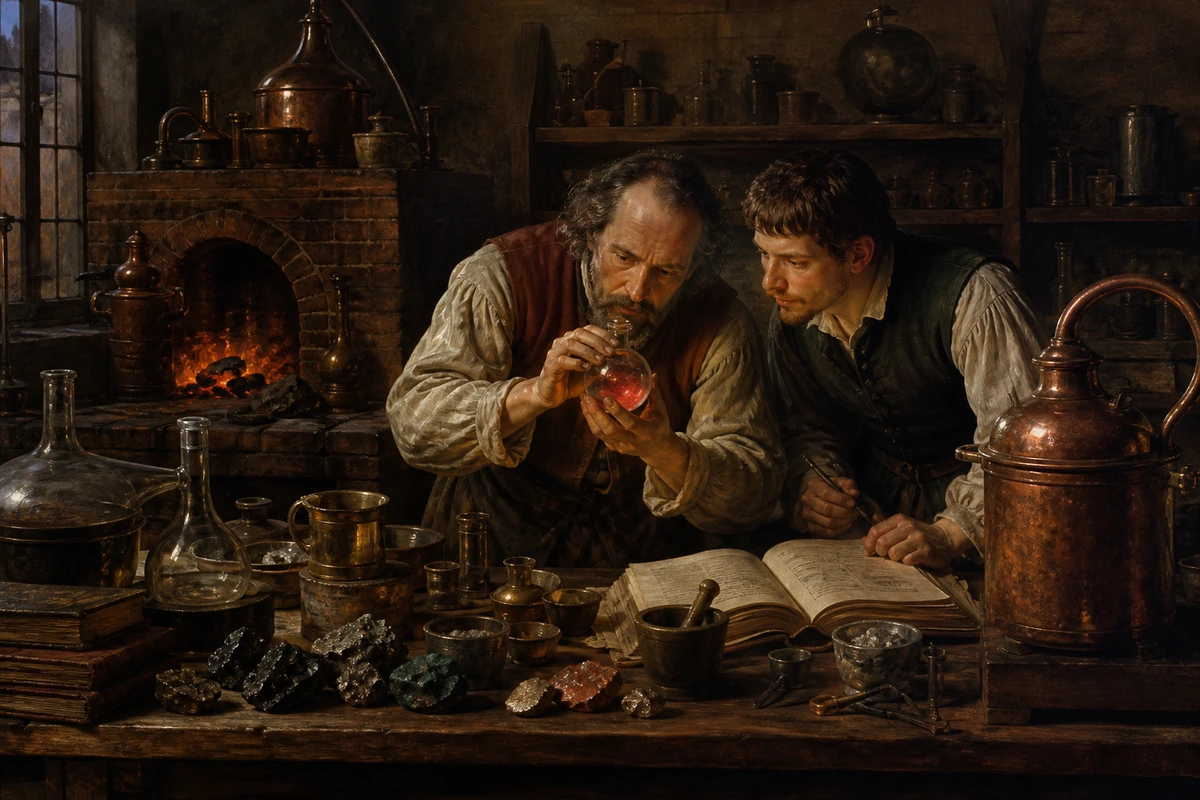
Transmutation seemed plausible within historical theories of matter. Metals were often thought to grow or mature beneath the earth and to share underlying principles in different proportions or states of purity. If art could accelerate nature, a properly prepared agent might complete an imperfect metal’s development. This reasoning was mistaken by modern chemistry, but it was not simply a fairy tale to its practitioners.
Laboratory work involved real operations: heating, distillation, sublimation, calcination, dissolution, crystallization, and the handling of salts, metals, acids, and mercury compounds. Secrecy, metaphor, and deliberate pseudonyms make recipes difficult to interpret, while toxic substances made some experiments dangerous.
The stone, medicine, and long life
Metallic transmutation and medicine overlapped because both were described as restoring balance or perfection. Some writers distinguished a stone for metals from medicinal elixirs; others presented a universal medicine able to heal the human body and prolong life. “Immortality” is often modern shorthand. Historical claims range from curing disease to extending life and should not be flattened into one promise.
Flamel, Paracelsus, Boyle, and Newton
Nicolas Flamel was a historical Parisian scribe, but the story that he discovered the stone grew after his death and is not supported by contemporary evidence. Paracelsian medicine made chemical remedies central to healing, though not every work circulated under Paracelsus’s name is authentic. Robert Boyle and Isaac Newton both took transmutational literature seriously. Newton copied and analyzed alchemical recipes, demonstrating that alchemy and early modern science were not cleanly separated in his lifetime.
It is inaccurate to say that alchemists “accidentally invented chemistry” through one failed quest. Alchemy contained technical knowledge, commercial practice, theology, fraud, experiment, and speculation. Modern chemistry emerged through gradual changes in evidence, instruments, language, institutions, and theories of matter.
Claim check
| Claim | Assessment | Why |
|---|---|---|
| The stone turned lead into gold | Historical claim, not verified fact | Alchemy contains many recipes and testimonies, but no reproducible supernatural agent |
| It always granted immortality | Overstatement | Life extension and universal medicine appear in some, not all, traditions |
| Flamel possessed it | Later legend | The alchemical reputation developed after the historical Flamel’s death |
| Newton studied alchemy | Well documented | Surviving manuscripts record extensive reading and experimentation |
| Alchemy was only spiritual symbolism | Misleading | Many practitioners sought material transformations while also using religious meanings |
Why the symbol endured
The stone compresses a large aspiration into one image: corrupt matter can be purified, divided things can be reconciled, and patient work can uncover nature’s hidden order. Later esoteric and psychological readings turned that process inward, treating the Great Work as a model of personal transformation. Those interpretations are influential reception history, not a universal key to every laboratory text.
Accuracy note and further reading
This article treats the philosopher’s stone as a historically variable alchemical concept and distinguishes documented practice from legendary success claims.