
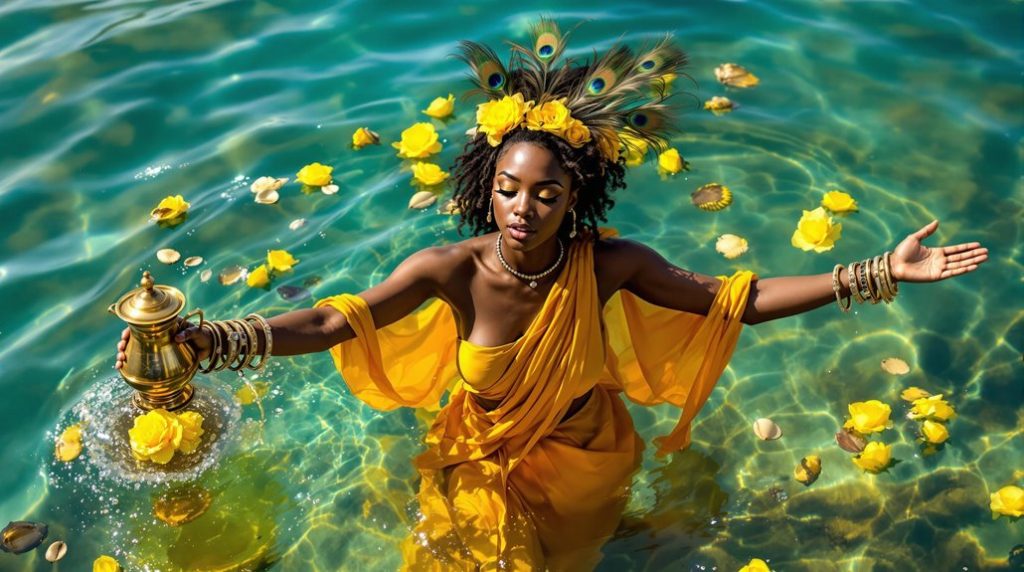
Oshun—often written Osun in Nigeria and Ochún in Cuba—is a Yoruba orisha associated especially with the Osun River, fertility, beauty, diplomacy, prosperity, and healing. She is part of living Yoruba and African diaspora religions, not a character belonging only to a closed body of ancient myths. Accounts, songs, ritual colors, and relationships vary across communities in Nigeria, the Americas, and the Caribbean.
River and orisha
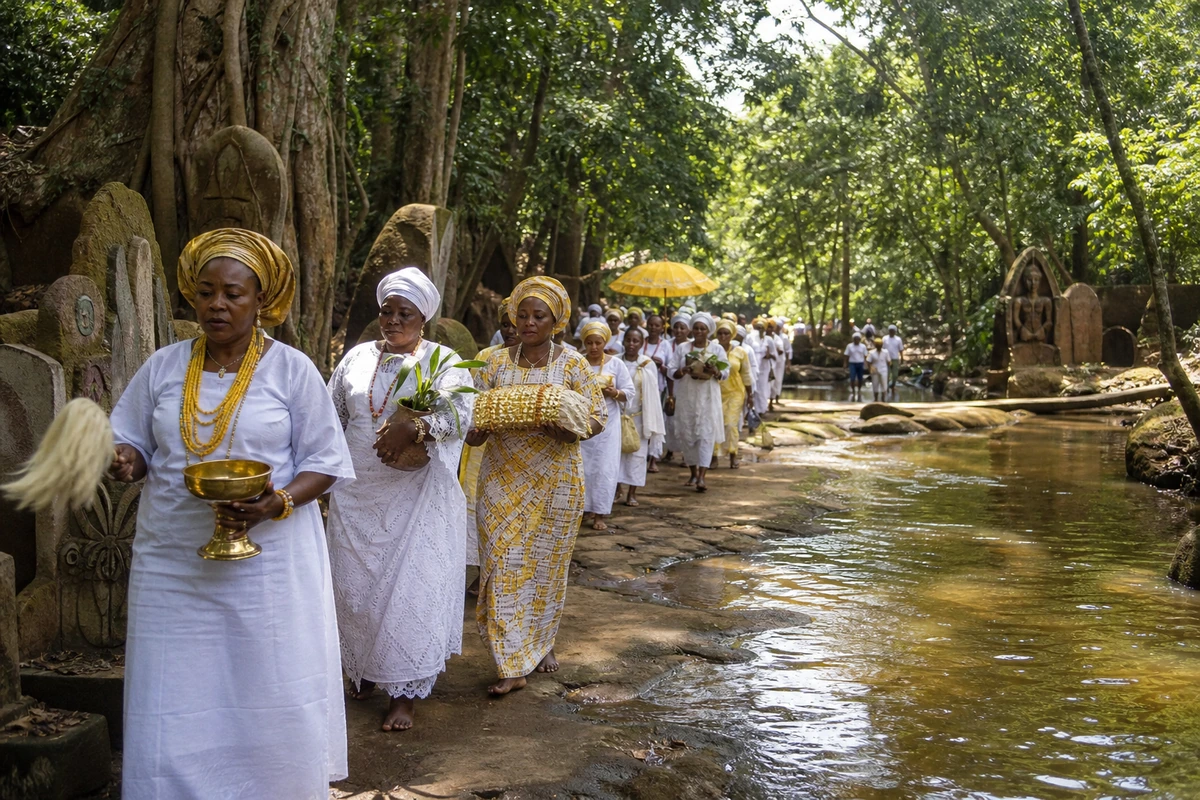
At Osogbo in southwestern Nigeria, the Osun River passes through a sacred grove understood as the orisha’s abode. Shrines, ritual paths, artworks, and worship sites make the grove a living cultural landscape rather than an archaeological ruin. UNESCO inscribed it as a World Heritage Site in 2005.
Osun’s water sustains, cools, heals, and enables fertility. That does not make her merely a poetic personification of “the feminine.” In Yoruba religious practice, orisha have histories, praise names, ritual relationships, priesthoods, and local forms that cannot be replaced by a universal archetype.
Osun and the founding of Osogbo
Local tradition connects the grove with a pact between Osun and Larooye, the founder of Osogbo. The community would honor her sacred place, and she would provide protection and prosperity. The annual Osun-Osogbo festival renews relationships among the orisha, the river, the ruler, the town, devotees, and visitors.
The grove also shows change within continuity. In the twentieth century, artists associated with Susanne Wenger and the New Sacred Art movement created monumental sculptures and renewed shrines in collaboration with local religious authorities. These works are modern contributions to an active sacred landscape, not untouched survivals from a remote past.
Power through persuasion
One well-known Ifa narrative tells that the male orisha attempted to organize the world while excluding Osun. Their work failed until they recognized her power and invited her participation. The lesson is not simply that she represents romantic love. Osun’s àṣẹ—the capacity to make things happen—operates through fertility, intelligence, diplomacy, and social balance.
Honey, brass, fans, mirrors, river water, and yellow or gold are widely associated with her, especially in diaspora traditions. Their meanings and ritual use are community-specific. A source describing Cuban Ochún should not automatically be treated as a complete guide to worship at Osogbo, or vice versa.
Across the Atlantic
The transatlantic slave trade carried Yoruba religious knowledge to the Americas under conditions of extreme violence. Oshun/Ochún became prominent in traditions including Cuban Regla de Ocha (Santería), Brazilian Candomblé, and other African-derived religions. Devotees formed new ritual lineages and, in some places, related orisha to Catholic saints.
These were creative acts of survival, not evidence that every tradition is identical. Spellings, songs, offerings, iconography, and theological emphasis differ. It is better to name a particular community than to speak of one undifferentiated “Oshun myth.”
Beyond “goddess of love”
Calling Oshun a “love goddess” can offer a quick comparison, but it narrows her. River water, fertility, wealth, political mediation, divination narratives, healing, artistry, and community protection all belong to her religious presence. Her sweetness is a form of efficacy, not weakness; stories can also portray anger when reciprocity is ignored.
Most importantly, Oshun is worshipped now. Respectful discussion treats practitioners and sacred sites as contemporary realities rather than remnants of a vanished mythology.