
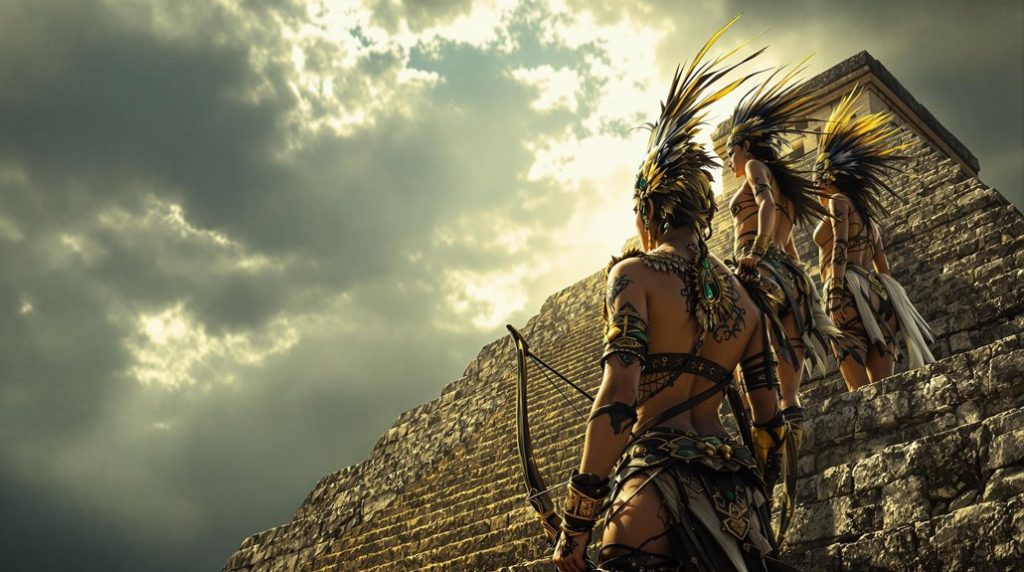
Women exercised political, ritual, economic, and sometimes militarized authority in Mesoamerican societies, but the evidence does not support one trans-Mesoamerican class of “warrior women.” Classic Maya queens, Mexica birth-warrior symbolism, female deities, and colonial accounts belong to different times and cultures. Each claim must be tied to its own inscription, image, burial, or text.
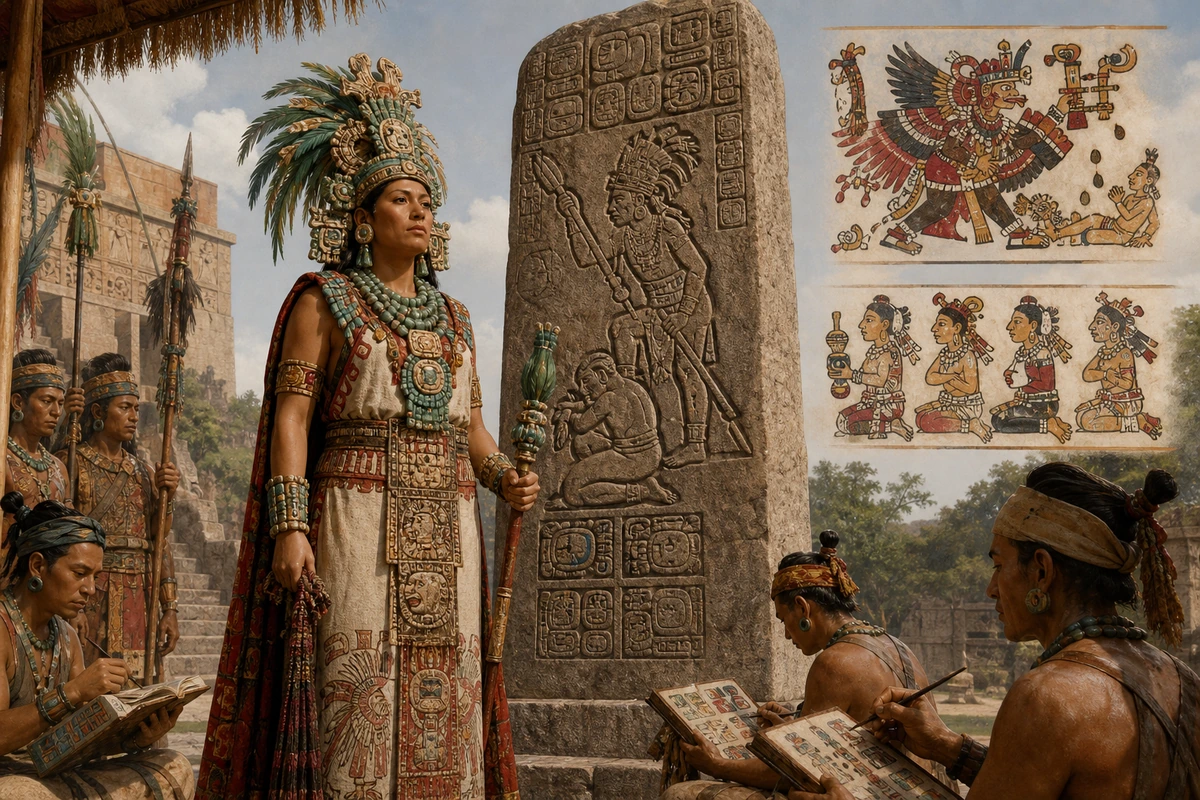
Mesoamerica is not one society
Mesoamerica includes Maya, Mexica, Zapotec, Mixtec, Teotihuacan, and many other communities across more than two millennia. Gender systems and warfare changed by region and period. A Maya monument from the eighth century cannot automatically explain a Mexica ceremony recorded after the Spanish invasion.
Lady K’abel and the title Ix Kaloomte’
Lady K’abel ruled at El Perú-Waka’ in the Late Classic Maya period and bore the elevated title Ix Kaloomte’, often translated “Lady Supreme Warrior” or “Lady Warlord.” Archaeology and inscriptions show her exceptional dynastic authority within the Kaanul political sphere. Whether she personally fought in battle is harder to prove than her political and militarized status.
Lady Six Sky at Naranjo
Wak Chanil Ajaw, conventionally called Lady Six Sky, arrived at Naranjo in 682 and re-established its dynasty. Monuments associate her era with military victories and show her adopting visual roles usually occupied by male kings, including standing above a captive. She likely served as regent for her young son, but her precise formal title and direct battlefield role remain debated.
What royal images can and cannot prove
A ruler shown with weapons, captives, or war costume participates in an ideology of conquest. The image may commemorate command, lineage, divine sanction, or an event. It does not function as a photograph of the person fighting, and it cannot demonstrate that ordinary women routinely served in armies. Iconography and inscriptions need archaeological context.
Mexica women and childbirth as war
Mexica sources compare childbirth with battle. A woman who died giving birth could become a cihuateteo, and her remains were believed to hold dangerous power desired by warriors. This symbolism granted the dead a warrior-like cosmic role; it does not mean all mothers were battlefield combatants.
Itzpapalotl is a deity, not a military unit
Itzpapalotl, the “Obsidian Butterfly,” is a formidable central Mexican deity associated with sacrifice, fire, ancestral or celestial powers, and the paradise of Tamoanchan in colonial sources. Her claws and weapons contribute to martial imagery. A supernatural female figure is evidence for concepts of divine power, not for a historical regiment of women.
Women’s power beyond battle
Elite women forged marriage alliances, transmitted titles, sponsored monuments, served as regents, conducted bloodletting and other rites, managed estates, and appeared in diplomatic histories. Non-elite women produced textiles, traded in markets, farmed, brewed, healed, and maintained households. Defining power only as weapon use reproduces the narrow framework the article is trying to challenge.
Colonial accounts and the danger of spectacle
Spanish and Indigenous colonial writers recorded sieges, migrations, and exceptional women, but they wrote amid conquest and political negotiation. European “Amazon” expectations could shape descriptions. Accounts should be compared with Nahuatl, Maya, Mixtec, or archaeological evidence rather than quoted as transparent eyewitness proof.
A better way to state the conclusion
The evidence demonstrates that some Mesoamerican women held sovereign and militarized authority and that female divinity could embody warfare. It does not justify mass-army claims or a universal ban that a few heroines “defied.” The strongest history names the woman, polity, date, source, title, and degree of uncertainty.