

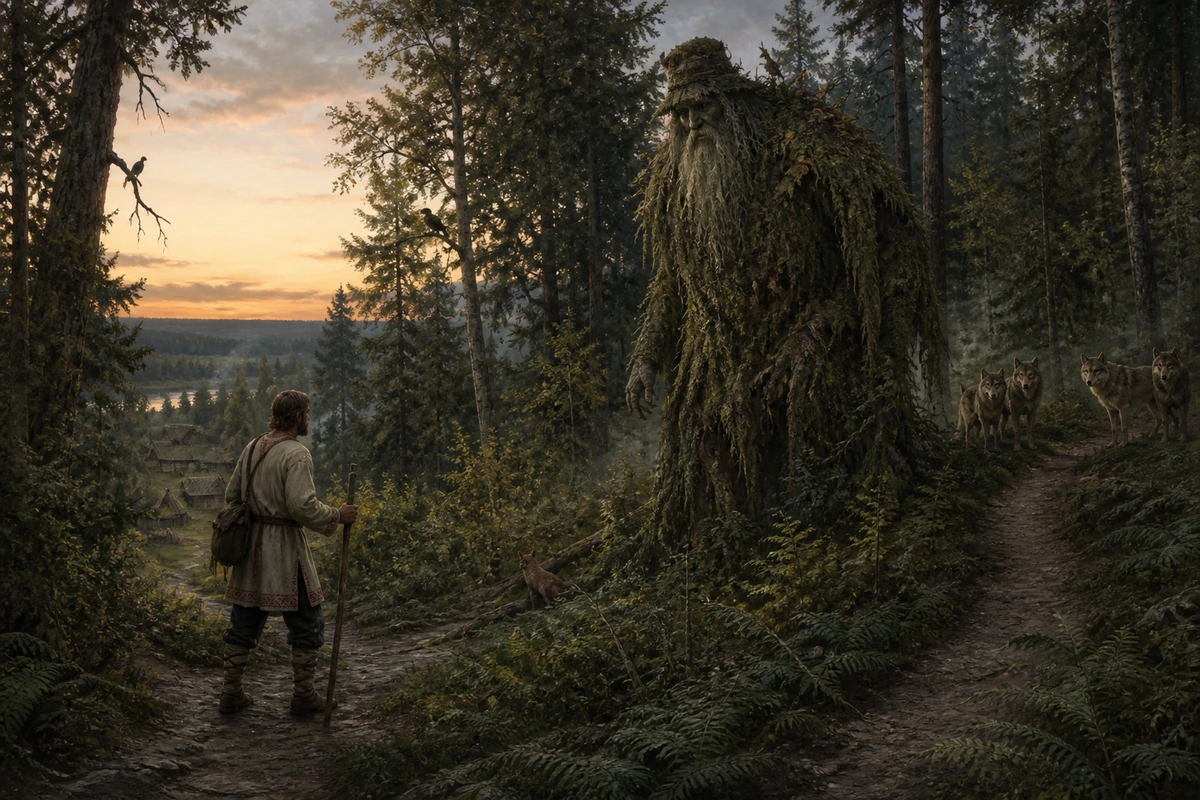
The Leshy is a master of the forest in East Slavic folklore—not a Norse god and not one standardized creature found across every Slavic tradition. Russian leshii, Ukrainian lisovyk, and related regional names describe a family of woodland beings whose appearance and behavior change from place to place. The common thread is sovereignty over a forest that humans enter but do not fully control.
What is a Leshy?
The word leshii is related to the Russian word for forest. Folklore usually treats the being as the “owner” or master of a particular woodland and its animals. The Ukrainian lisovyk likewise grazes or governs forest creatures. This is a spirit of place rather than an abstract modern “god of nature.”
Descriptions are famously inconsistent. A Leshy can resemble a peasant, an old man, a tree, an animal, or something visibly inhuman. Some accounts say he can grow as tall as the trees or shrink to the height of grass. Others give him backward shoes, reversed clothing, unusual eyes, horns, or no shadow. These details were never a single official checklist; variation is a defining feature of oral tradition.
Leading people astray
The Leshy’s best-known action is confusing travelers. A familiar path doubles back, a voice calls from the wrong direction, or the spirit takes the appearance of someone the traveler knows. The experience dramatizes a practical danger: away from village fields and roads, the forest could erase human bearings very quickly.
Folklore offered several ways to break the spell. A lost person might turn clothing inside out, switch shoes to the opposite feet, pray, or use a verbal formula that reversed ordinary order. Such remedies mirror the Leshy’s own backwardness and restore the boundary between the human world and the forest.
Hunters, herders, and forest animals
The Leshy was not always hostile. Hunters and herders could attempt to bargain with the forest master for game, safe passage, or protection of livestock. Some traditions describe agreements between herders and a Leshy, while others warn that he could scatter cattle, steal children, or drive a person into dangerous terrain. His response depended on local custom and on whether humans respected the forest’s rules.
Wolves and bears often accompany him in later descriptions, but calling him simply their “king” makes a variable tradition sound more fixed than it is. The stronger claim is that woodland animals belonged to his domain.
Folklore, not a recovered pagan scripture
Most detailed Leshy accounts were collected after the Christianization of the Slavic world. Some narrators explained forest spirits as fallen angels or unquiet dead; others retained older ideas about a nonhuman owner of the land. Scholars can identify continuities, but there is no surviving pre-Christian Leshy epic from which a complete biography can be reconstructed.
That uncertainty is part of the subject. The Leshy gives narrative form to an unstable frontier: the forest provides timber, pasture, game, and refuge, yet it can also swallow paths and expose human vulnerability. He is neither a conservation mascot nor an embodiment of pure evil. He is the forest encountered as an intelligent, unpredictable neighbor.