

The qilin is one of the great auspicious creatures of Chinese tradition. It is usually imagined as a composite, hoofed animal and may have one or more horns, scales, a dragon-like head, flames, or cloud forms. Its appearance changes dramatically across time and media. For that reason, describing the qilin as simply a “Chinese unicorn” is convenient but misleading: it belongs to a different visual history and carries a wider set of associations.
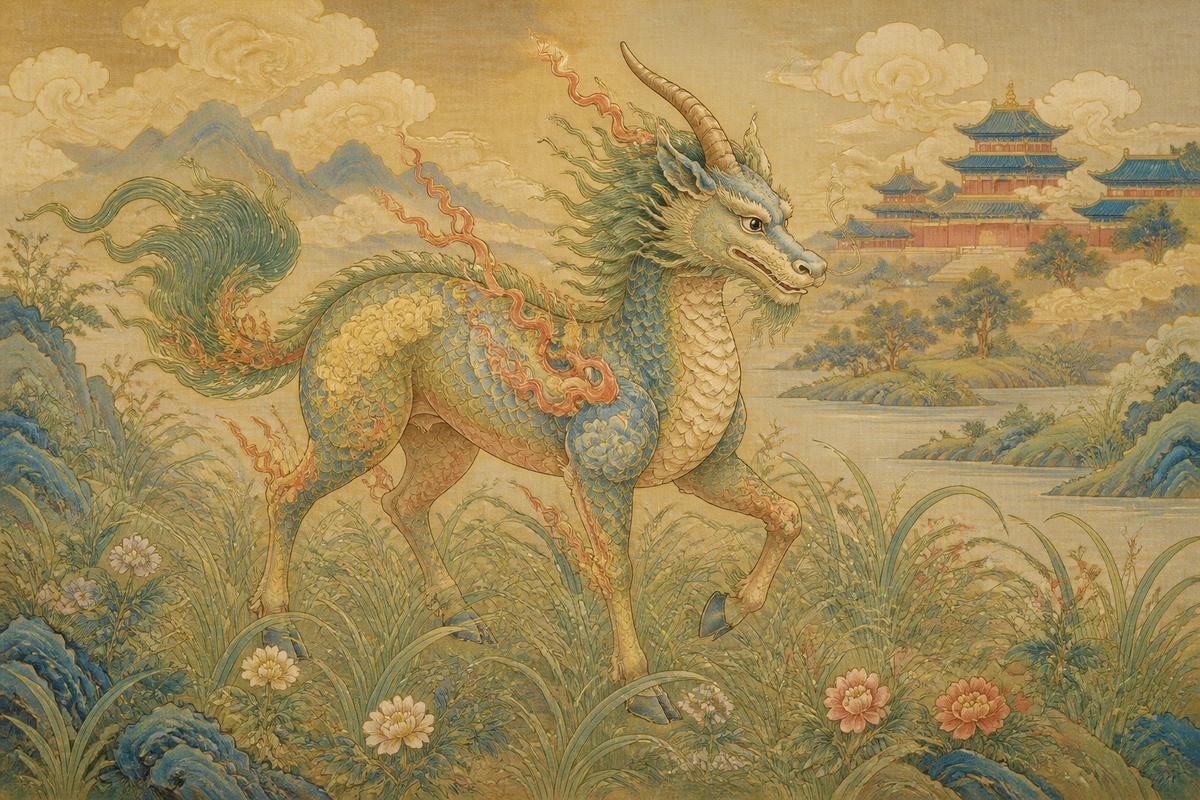
An auspicious animal, not a fixed species
Chinese texts and artworks do not offer one zoological blueprint. Qilin can appear deer-like, horse-like, ox-like, scaled, horned, bearded, or surrounded by supernatural flames. A Metropolitan Museum of Art textile describes the creature as a composite animal with hooves and usually a single horn. The variety is not an error to be solved; it is part of a long tradition in which artists adapted auspicious beings to new materials, regions, and audiences.
The qilin’s gentleness is equally important. Later descriptions say it avoids harming living things, sometimes walking without crushing grass. This idealized conduct helps explain why the creature signifies humane power rather than brute force.
Sages, rulers, and fortunate omens
The qilin appears in poetry and historical omen literature as a rare sign. Its arrival may announce a sage, confirm virtuous government, or mark an extraordinary birth. It is famously linked with Confucius: later tradition connects a qilin with both the sage’s birth and the period near his death. These are religious and literary associations, not datable eyewitness biology.
In decorative art, the qilin could express hopes for talented children and family success. It also appeared on rank badges and elite textiles. The same creature could therefore carry political, familial, and spiritual meanings without being reduced to a generic charm for “prosperity.”
The giraffe identified as a qilin
One of the most revealing episodes occurred in 1414, when a giraffe sent from Bengal reached the court of the Yongle emperor. Court officials celebrated the unfamiliar animal as a living qilin and evidence of auspicious rule. Paintings of the giraffe with its keepers circulated in several versions.
The episode shows mythic classification at work. The giraffe did not establish what every qilin had always looked like. Instead, an astonishing foreign animal was interpreted through an existing language of omen, legitimacy, and visual tradition. The political flattery surrounding the identification also deserves attention: auspicious signs could help authorize a ruler.
Qilin in art and performance
Qilin appear on paintings, ceramics, architectural ornaments, garments, and embroidered badges. Their bodies may blend traits associated with dragons, deer, horses, oxen, lions, or other animals. Flames do not necessarily mean aggression; in East Asian religious art they can mark supernatural energy.
Qilin dance traditions also survive in some southern Chinese and diaspora communities. Their forms should not be collapsed into one universal Lunar New Year custom, nor confused automatically with lion or dragon dance. Local martial arts lineages, musical patterns, costumes, and ritual meanings differ.
How to read the qilin today
The qilin endures because it joins gentleness with authority. It can stand for a ruler whose strength does not injure, a child expected to bring honor, or the rare arrival of moral excellence. Its form remains flexible, but its auspicious force depends on more than decoration: the creature tests whether power is worthy of the harmony it claims to announce.