
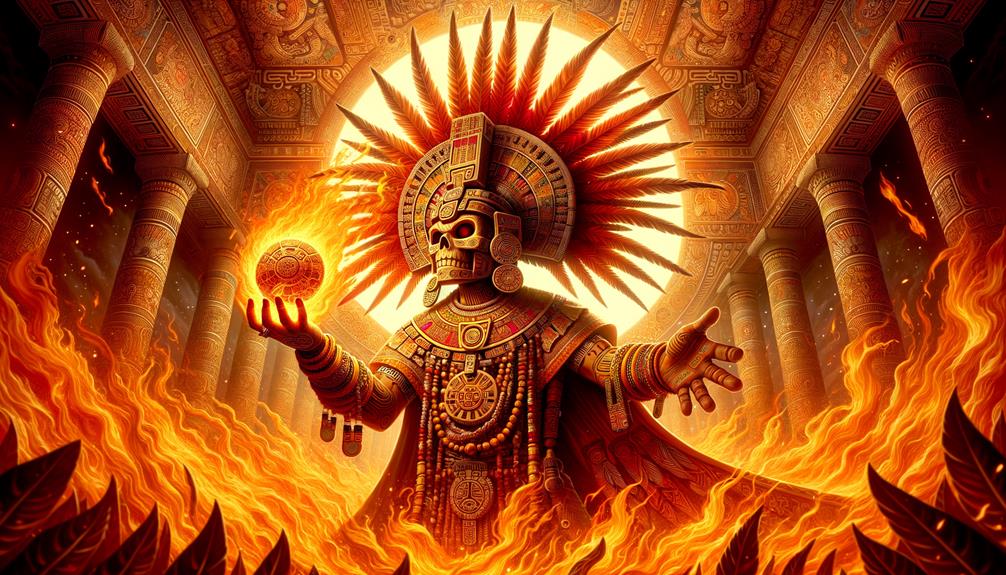
Xiuhtecuhtli is a Mexica deity of fire, turquoise, rulership, and the turning of time. He is closely linked with Huehueteotl, the “Old God,” but museum labels and scholars do not always treat the two names as perfectly interchangeable. Their overlapping images join the young, brilliant force of flame to the ancient hearth that supports the cosmos.
What the name means
Xiuhtecuhtli is commonly translated “Turquoise Lord.” The Nahuatl root xihuitl can refer to turquoise and, in related forms and contexts, to a year or vegetation. The name therefore resonates with precious blue-green material, heat, rulership, and calendrical renewal. Reducing it to “fire god” loses that network of associations.
Xiuhtecuhtli and Huehueteotl
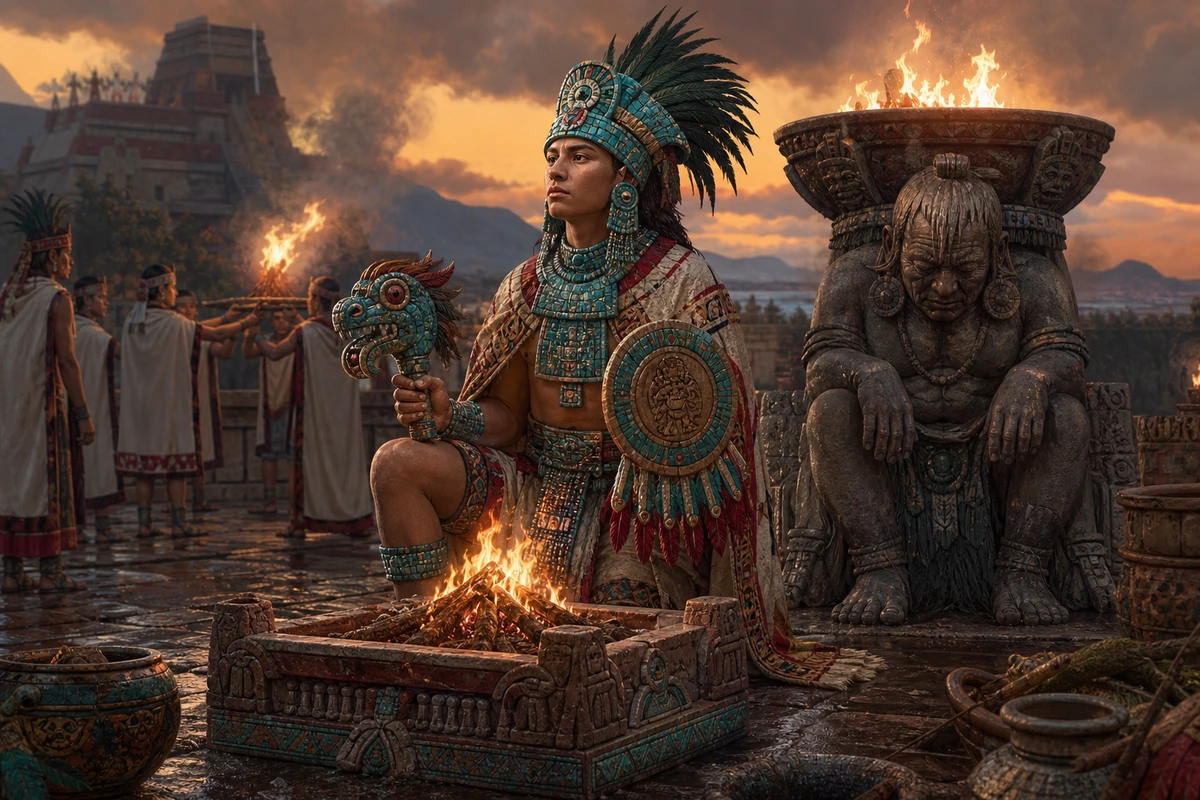
Huehueteotl means “Old God.” Sculptures across central Mexico often show an aged, wrinkled figure seated beneath a heavy brazier. Mexica sources also name Xiuhtecuhtli-Huehueteotl, and the identities can merge. Other evidence contrasts a vigorous turquoise-adorned Xiuhtecuhtli with the bent old fire bearer. It is safest to describe a related fire-deity complex whose distinctions vary by period and source.
Fire at the centre of the cosmos
The household hearth transformed raw food, warmed the living, and received offerings. At a larger scale, sacred fire occupied the centre where the four directions and the vertical levels of the cosmos met. Brazier imagery and quincunx designs make fire an ordering presence, not merely a destructive element.
How Xiuhtecuhtli appears
Images identified as Xiuhtecuhtli can be youthful and richly dressed, with turquoise mosaic ornaments, a butterfly-shaped pectoral, and fire-related insignia. Codices also show the pointed turquoise-coloured headdress known as the xiuhuitzolli, a sign of rulership. Huehueteotl’s aged face and head-brazier form create a markedly different visual emphasis.
Ixcozauhqui and other names
Colonial Nahua sources use additional titles, including Ixcozauhqui, “Yellow-Faced,” in fire ceremonies. Names may mark aspects, cult titles, local forms, or related deities rather than characters in a fixed family tree. A single English name cannot capture every ritual identity recorded by Sahagún’s informants.
Izcalli and the renewal of the hearth
Xiuhtecuhtli was central to Izcalli, the final twenty-day period of the Mexica solar calendar. Rites involved renewed fire, food offerings, images of the deity, and ceremonies that changed according to the year. Colonial descriptions include sacrifice, but they must be read in their historical and rhetorical context rather than reduced to sensational detail.
The 52-year Binding of the Years
The New Fire ceremony held when the 260-day and 365-day counts returned to the same alignment was a separate, far larger renewal. Every 52 years, old fires were extinguished. Priests watched the Pleiades from Huixachtecatl, today Cerro de la Estrella; a new flame was kindled and carried outward to temples and homes. Xiuhtecuhtli’s domain made fire the medium through which time itself began again.
Fire, rulers, and turquoise
Turquoise was a precious material of long-distance exchange and elite display. Its visual link with Xiuhtecuhtli connected heat and renewal with political authority. The fire serpent xiuhcoatl shares the turquoise/year root, but it is not simply Xiuhtecuhtli in animal form; its mythology and iconography also belong to solar weapons and other deities.
Long history, changing gods
Old fire-god sculptures occur centuries before the Mexica empire at sites including Cuicuilco and Teotihuacan. We do not know that earlier peoples used the later Nahuatl names or held identical beliefs. Archaeologists trace continuities in posture, brazier, and cosmic symbolism while keeping linguistic and historical differences visible.
Sources and further reading
- INAH, “El fuego antiguo de Teotihuacan: Huehuetéotl”
- Museo Nacional de Antropología, sculpture of Huehueteotl
- INAH, the Binding of the Years and New Fire ceremony
- Bernardino de Sahagún, Florentine Codex, Books 1, 2, and 7