
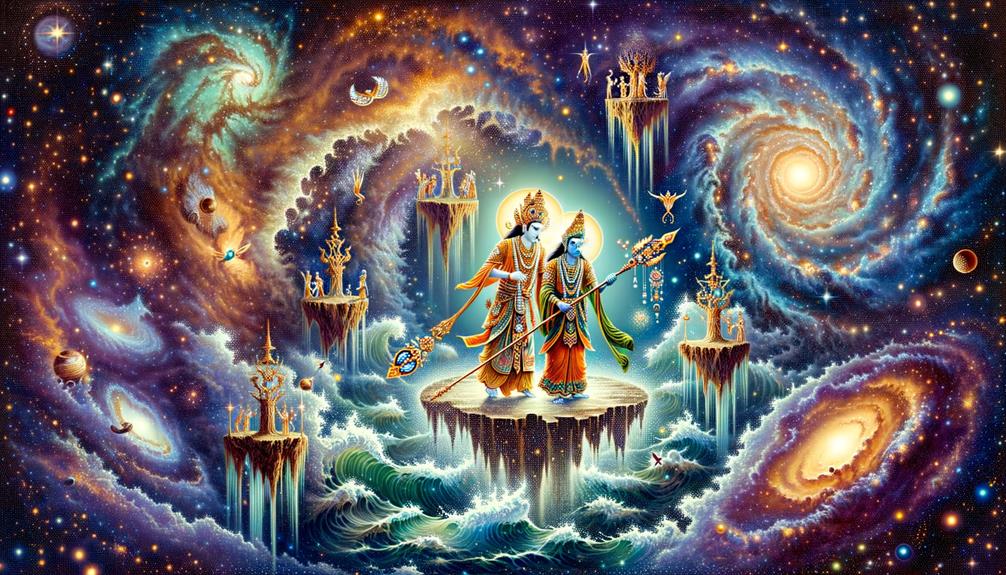
Izanagi and Izanami are the divine pair who generate the Japanese islands and many kami in the earliest surviving Japanese chronicles. The Kojiki and Nihon Shoki preserve related versions, but their details differ. The story is a sacred account of origins, death, pollution, and purification rather than a scientific description of geography.
The Spear and Onogoro
In the Kojiki, the heavenly kami command Izanagi and Izanami to complete and solidify the drifting land. Standing on the Floating Bridge of Heaven, they stir the brine below with a jeweled spear. Drops from the spear form Onogoro, where they descend, raise a pillar, and build a palace.
The Marriage Rite and First Children
The pair circle the pillar and exchange greetings. Izanami speaks first. Their first child, Hiruko, is set adrift, and Awashima is also not counted among their proper offspring. After consulting the heavenly kami, they repeat the rite with Izanagi speaking first.
The text connects the failed birth with the woman’s first greeting. That gendered explanation belongs to the ancient narrative and its social setting. It should not be presented as a rule that governs Shinto in every period.
The Eight Great Islands
The Kojiki lists the birth of the “Eight Great Islands” in this order:
- Awaji
- Shikoku
- Oki
- Kyushu
- Iki
- Tsushima
- Sado
- Honshu, named in the text through an older poetic title
More islands follow. “Eight” has a conventional sense of a complete or great set, and the list reflects the geographic knowledge and political outlook of the court that preserved the myth.
The Birth of Kami
Izanagi and Izanami next generate kami associated with houses, seas, winds, mountains, fields, fire, and other parts of the ordered world. These are not all offspring in the same biological sense. The genealogy organizes places, processes, and ritual powers through divine birth.
Izanami’s Death
Izanami is fatally burned while giving birth to the fire kami Kagutsuchi. From her sickness and death come more kami. Izanagi kills Kagutsuchi in grief, and further deities arise from the blood and body. Creation therefore continues through loss and violence as well as marriage.
Izanagi in Yomi
Izanagi travels to Yomi, the land of the dead, to bring Izanami back. She says she has eaten the food of Yomi and must consult its powers, warning him not to look at her. He breaks the condition, sees her decayed body, and flees. Izanami sends pursuers, but Izanagi escapes and blocks the slope of Yomi with a great boulder.
Across the barrier, Izanami vows to take one thousand lives each day. Izanagi answers that he will cause fifteen hundred births. The exchange connects mortality with continued generation. It is not a claim about actual daily population figures.
Purification and the Three Precious Children
Contact with Yomi leaves Izanagi polluted. He removes his clothing and washes, producing kami through each stage of purification. In the Kojiki, Amaterasu is born from his left eye, Tsukuyomi from his right eye, and Susanoo from his nose.
This episode is a major mythic precedent for misogi, purification with water. Modern Shinto purification practices are diverse and should not be reduced to a reenactment of every detail in the story.
Frequently Asked Questions
Did Izanagi and Izanami create all of Japan?
The myth describes the divine birth of a court-centered map of islands. It does not list every island now within Japan’s borders.
Is Yomi the same as Buddhist hell?
No. Yomi is the shadowy land of the dead in these early myths. Later Japanese traditions influenced one another, but Yomi and Buddhist hells have different textual histories.
Did Izanami stay evil after death?
The text portrays her as the power of death after the separation. Calling her evil imposes a moral category that does not explain her role.