
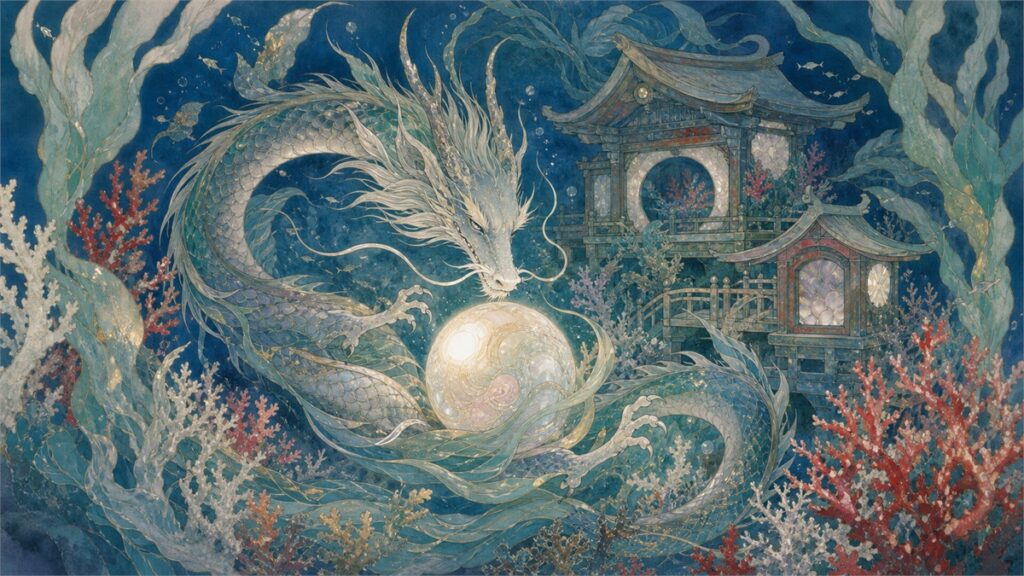
Accuracy note: Ryūjin is a common modern name for a dragon king of the sea, but Japanese sources contain several sea deities and dragon-palace traditions. They should not all be collapsed into one biography.
The Myth of Ryujin

At the bottom of the deep blue, Ryujin, the mighty dragon god of the sea, holds court in his grand coral palace Ryugu-jo. This powerful deity from Japanese folklore rules the ocean world with a commanding presence. His divine influence touches every creature and current, a example to his oceanic mastery. Central to his might rests a lustrous pearl, gleaming with the sea’s quintessence.
One legend encapsulating Ryujin’s authority and wisdom involves a jellyfish. Long ago, the sea god tasked the creature with retrieving a monkey’s liver to heal his ailing daughter. When the jellyfish failed, Ryujin stripped it of its bones, leaving it perpetually soft and gelatinous – a lingering reminder of its shortcoming.
Ryūgū-jō: Palace Under the Sea
Ryūgū-jō, the majestic underwater palace of the sea god Ryujin, shimmers beneath the waves – an awe-inspiring tribute to the ocean’s hidden marvels and enduring splendor. This extraordinary residence, meticulously crafted from red and white coral adorned with precious gems, serves as the mighty Sea Dragon’s lavish abode. Within these mystical walls, the passage of time flows uniquely; a century in the human world equals a single day, offering a glimpse into Ryujin’s divine authority and supernatural essence.
Ryūgū-jō extends beyond mere architecture; it symbolizes the ocean’s cyclical nature. Each of its four ends captures a distinct season, embodying life’s perpetual rhythm and renewal. Here, Ryujin’s influence over the seas remains relevant importantly, his divine power permeating every inch of this mythical grandeur.
In modern times, a station in Katase-Enoshima captures the essence of this legendary underwater palace, bringing the mythical grandeur of the Sea Dragon King’s residence into physical form. Through Ryūgū-jō, the palace offers insight into the ocean’s mysteries and the important interconnection between nature, time, and divine power.
Ryujin’s Magical Powers

With the magic pearl in his grip, Ryujin commands awe-inspiring abilities – breathing fire, shapeshifting into any form, even a human guise. His metamorphic talents symbolize fluidity and versatility within nature’s world.
The vast ocean bends to Ryujin’s whims. A mere thought summons tsunamis, storms, and marine creatures obeying his every command. This control reflects his dual role – guardian or chaotic force. Fishermen offer gifts, not just reverence, but a pact seeking calm seas.
Ryujin’s fire-breathing melds water and flame, embodying the eternal dance of creation and destruction. His powers exemplify perpetual transformation between these primal forces.
Shinto Worship and Beliefs
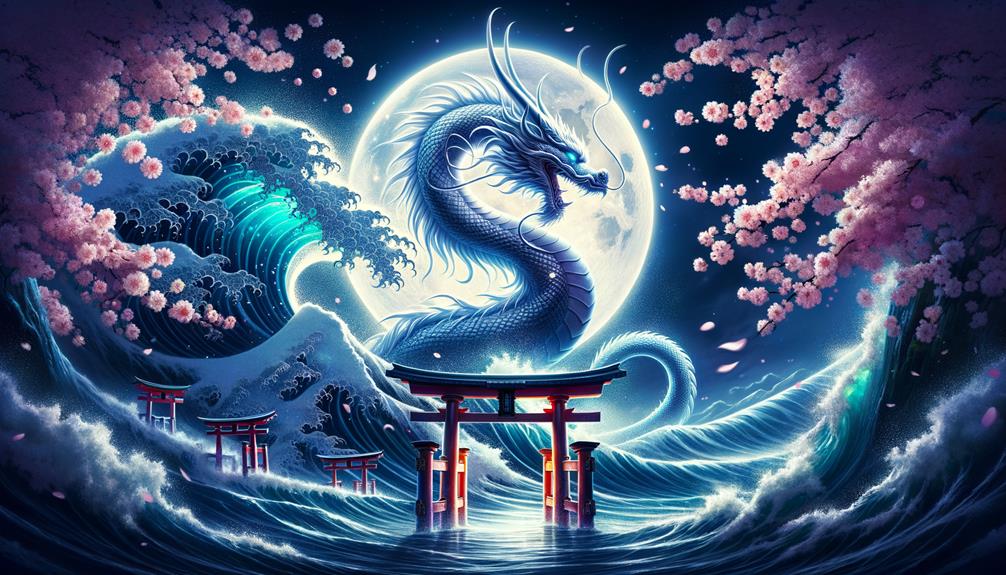
Contemplating Ryujin evokes visions of an ancient sea guardian, its might and wisdom celebrated through sacred rites and tributes at shrines. These customs reflect connections to the ocean’s providence and the Dragon God’s patronage over maritime livelihoods. Through Shinto practice, worshippers venerate Ryujin as a spiritual mentor serving as a spiritual guide, a quintessential embodiment of the seas’ enduring influence.
Ryujin’s Divine Attributes
Shinto beliefs deeply connect humanity with the life-sustaining oceans. Ryujin, the Dragon Sea God, personifies this sacred bond. A revered deity, Ryujin embodies the ocean’s elemental powers through a majestic dragon form. In Shinto, Ryujin’s influence reaches beyond the waves, intertwining with Japan’s imperial heritage. Ancient traditions claimed emperors descended from this sea god, solidifying their divine right to rule and harmony with nature.
Countless shrines across Japan honor Ryujin through fervent worship, showcasing the cultural significance of the ocean’s bounty. This reverence reflects the heroic journey of the Japanese people navigating life’s challenges beside the sea’s sustenance. Prayers to Ryujin seek blessings for bountiful harvests and plentiful fishing, a hope echoing the everlasting human-ocean kinship.
Rituals and Offerings
Ryujin rituals enchant with earthy symbols – seafood, sake, rice offered by farmers and fishers. Community stalwarts gratefully present sustenance from nature’s bounty, entreating rain and bountiful harvests. Purification ceremonies cleanse spirits before approaching sacred shrines. Coastal processions and dances exude reverence, dragon motifs honoring the sea deity’s mystique. These rituals foster harmony with the elements, ensuring safe seas and fertile fields.
Symbolism in Shinto
As rituals unfold, the symbolism of venerating Ryujin, the mighty dragon water deity in Shinto, surfaces – a powerful force associated with life’s changes. Ryujin stands tall among Shinto deities as the sea god, deeply revered in a nation historically tied to the ocean. Shinto practices honor Ryujin through agricultural and fishing rites, acknowledging society’s reliance on the sea for sustenance and prosperity.
Ryujin’s presence mirrors Japan’s important connection with water. Shrines like Daikai Jinja in Osaka serve as sacred spaces where devotees offer prayers and rituals, seeking the dragon’s favor and protection. These shrines represent more than worship sites; they echo fishing’s historical significance to Japanese society.
Venerating Ryujin recognizes the dragon’s role in human experience, not just mythologically but as an essential force ensuring harmony between humanity and nature.
Legends and Tales
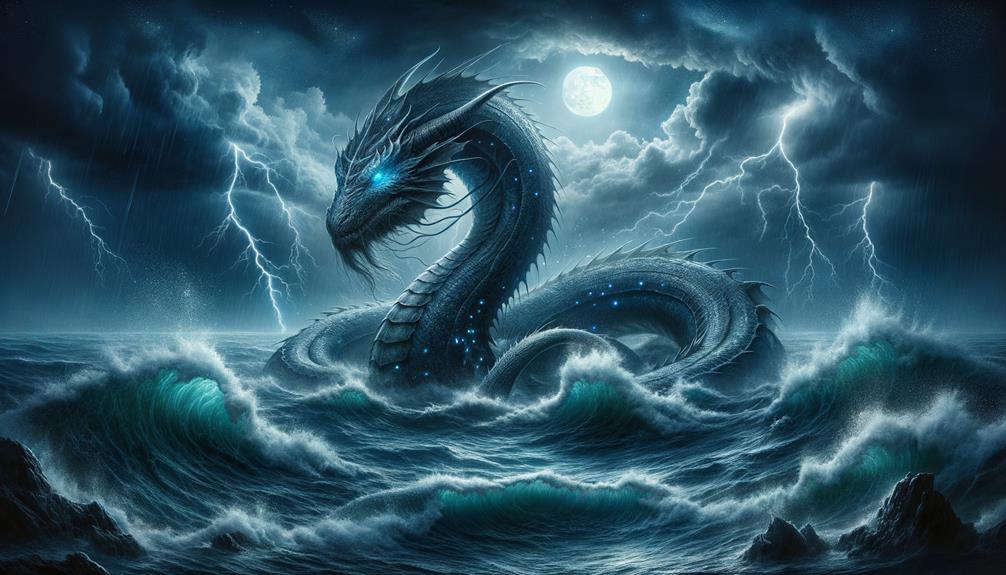
Ryujin, the mighty dragon sea god, weaves his influence through ancient Japanese tales. His power shapes the fortunes of mortals and divine beings. One story tells how Ryujin aided Empress Jingu in defeating a Korean fleet by controlling the waters, showcasing his command over the sea.
Another tale recounts Ryujin’s daughter, Toyotama-Hime, marrying a hunter prince. Their lineage traces back to Emperor Jimmu, Japan’s first emperor, connecting the divine and mortal worlds.
Ryujin’s magical pearl, a recurring symbol, grants its owner control over oceans and marine life, emphasizing his role as guardian of the waters.
These stories illustrate Ryujin’s aid to humans, his links to Japan’s imperial family tree, the symbolic power of his pearl, and his veneration in Shinto as a water deity revered by agricultural and fishing communities.
Ryujin in Art and Culture
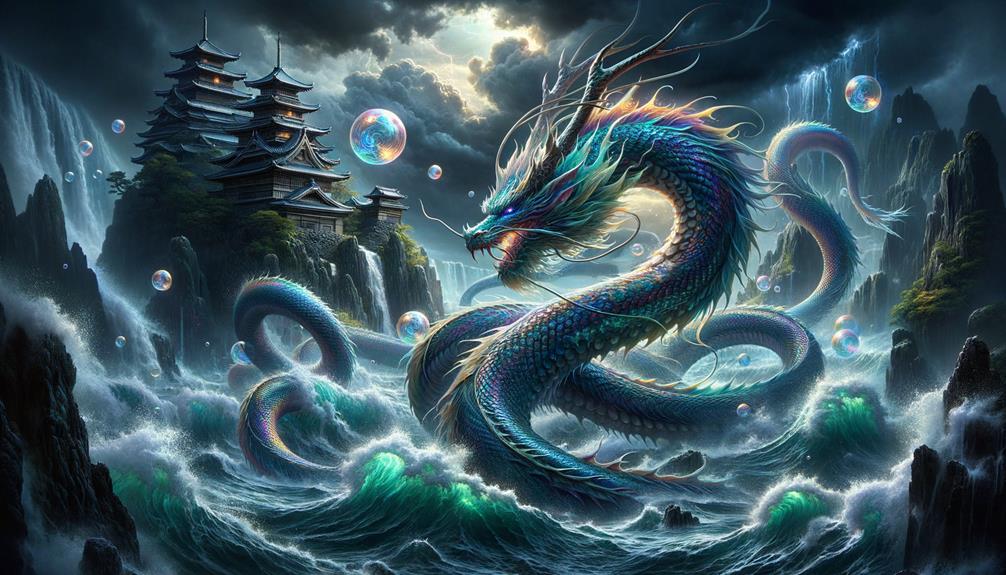
Throughout history, artists captured the awe-inspiring dragon sea god Ryujin in various forms. Whether as a dragon or human figure, Ryujin’s mythological significance inspired creators across different eras. His power to command oceans, breathe fire, and shapeshift sparked creative expression.
Ancient works depicted Ryujin ruling the seas, while medieval pieces showed him interacting with other deities. The Muromachi period portrayed his symbolic transformations. Modern media offers diverse contemporary interpretations, reflecting evolving perceptions.
| Time Period | Representation |
|---|---|
| Ancient | Commanding seas |
| Medieval | Divine interactions |
| Muromachi period | Symbolic shifts |
| Modern | Diverse portrayals |
Ryujin’s lasting legacy across artistic mediums, from ancient scrolls to digital art, showcases his important cultural impact. Each depiction bridges past and present, ensuring this mythological figure remains revered through continuous creative exploration.
Sources and related reading
- Kagutsuchi Fire God Birth on MythologyVault
- Amenouzume Dawn Goddess Tales on MythologyVault
- Kokugakuin University: Encyclopedia of Shinto