
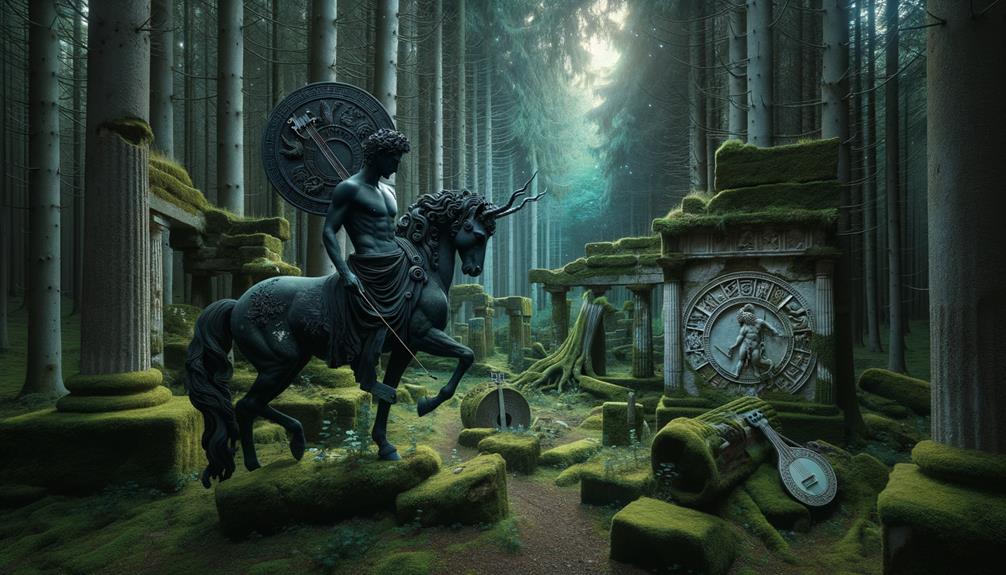
Centaurs are composite figures from Greek myth with a human upper body joined to the body of a horse. Ancient stories do not give every centaur the same ancestry or character. The violent group at the wedding of Pirithous and the wise Chiron belong to related but distinct strands of the tradition.
Origins in Greek myth
A well-known genealogy begins with Ixion. After Ixion desired Hera, Zeus formed a cloud in her likeness, usually called Nephele. Ixion’s union with the cloud produced a figure named Centaurus, who then mated with mares on Mount Pelion and fathered the centaur people. Pindar preserves an early version of this ancestry.
Ancient writers also offered other origins and rationalized explanations. The variation matters because Greek mythology was not governed by one official account. Stories changed by author, region, and period.
The battle with the Lapiths
The most prominent centaur story is the Centauromachy, the battle between the centaurs and the Lapiths. At the wedding of Pirithous and Hippodamia, the centaurs became drunk and tried to carry off the bride and other women. The Lapiths fought them, with Theseus joining the battle in many versions.
Greek and Roman artists repeatedly depicted this conflict. The south metopes of the Parthenon show Lapiths and centaurs in close combat. Those sculptures demonstrate the importance of the scene in classical art, but their meaning should not be reduced to a single modern slogan. Viewers have interpreted the battle through contrasts such as restraint and violence, civic order and disruption, or Greek identity and an imagined outsider. Such readings are interpretations of the art and myth, not statements spoken by the figures themselves.
Chiron is different
Chiron is often grouped with the centaurs because of his form, but his genealogy and behavior set him apart. He is the son of Cronus and the nymph Philyra, not a descendant of Ixion and Nephele. Ancient sources place him on Mount Pelion and describe him as wise, just, skilled in healing, and associated with the education of heroes.
Accounts connect Chiron with Achilles, Jason, Asclepius, and other figures, though student lists vary among authors. In the Iliad, Achilles uses remedies taught to Patroclus by Achilles, who learned them from Chiron. Pindar also presents Chiron as a teacher and guardian. His tradition shows why claims that all centaurs represent uncontrolled appetite are too broad.
Other named centaurs
Nessus appears in the story of Heracles and Deianira. After attempting to assault Deianira while carrying her across a river, he is shot by Heracles. Nessus then gives deceptive instructions about his blood, which later contribute to Heracles’ death. Pholus is another centaur associated with Heracles and the jar of wine that leads to conflict with other centaurs.
These stories share themes of hospitality, violence, and broken boundaries, but the characters are not interchangeable. Chiron, Nessus, Pholus, and the wedding guests have separate roles and sometimes separate family histories.
Centaurs in art and later culture
Centaurs appear on Greek pottery, temple sculpture, Roman mosaics, medieval manuscripts, and later European painting. Their mixed anatomy lets artists place human gesture and horse movement in one body. Later writers and artists have used them for meanings that range from instruction and astronomy to danger and comedy.
There is no historical or biological evidence that centaurs existed. A later rationalizing tradition suggested that people unfamiliar with mounted riders could have imagined horse and rider as one being. That is an ancient attempt to explain the story, not a proven account of how the myth began.
Sources
- Tzetzes, Chiliades 7, preserving the Pindaric ancestry of the centaurs
- Ancient source excerpts concerning Chiron
- Metropolitan Museum of Art, Greek Art from Prehistoric to Classical
- Ancient source excerpts concerning Nessus