
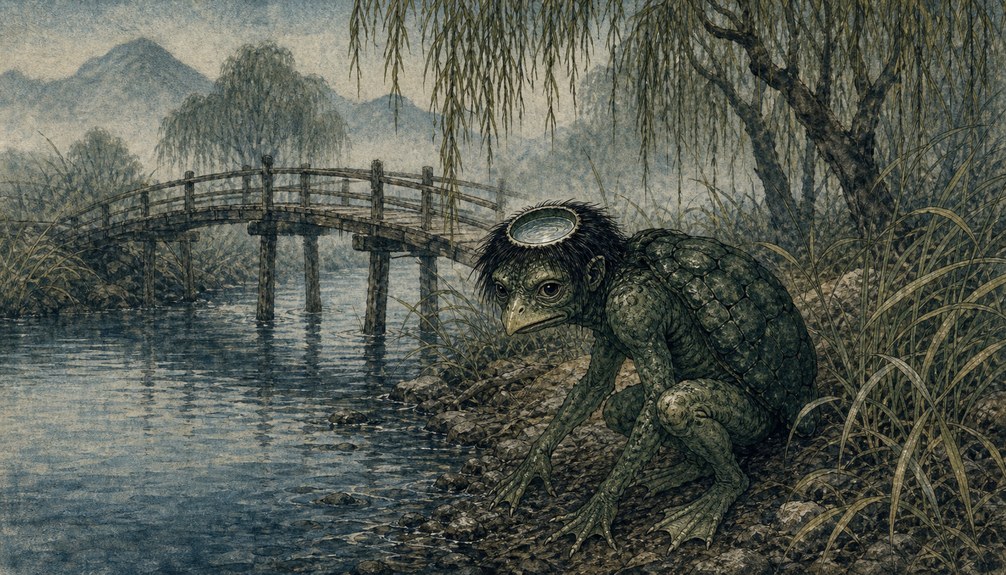
The kappa is one of Japan’s best-known yokai, a broad category of strange beings and uncanny phenomena. Kappa stories center on rivers, ponds, irrigation channels, and other bodies of water. The creature can be comic, helpful, predatory, or deadly depending on the region and the tale.
Names and regional variation
Kappa is commonly written with characters meaning “river child.” Regional names include kawataro, gataro, and many local forms. Folklore recorded across Japan does not describe one perfectly standardized animal. Appearance, behavior, seasonal movement, and methods of protection vary by place.
Edo-period encyclopedias and artists helped establish a recognizable national image. Later books, prints, advertising, manga, and mascots made that image even more consistent. Local traditions remain more varied than the familiar modern character design.
What a kappa looks like
A common depiction combines parts of several animals: a turtle-like shell, frog-like or webbed limbs, a beak, scales or slick skin, and sparse hair. The defining feature is a shallow cavity or dish on top of the head. It holds water that sustains the kappa’s strength when it leaves its river or pond.
A late Edo-period wooden netsuke in the British Museum shows a seated kappa. The museum describes the creature as having the body of a turtle, the head of a monkey, the limbs of a frog, and a saucer-shaped cavity containing vital fluid. Other artworks look more bird-like, reptilian, or human.
Danger in the water
Many kappa stories warn of drowning. The creature may pull people, children, or horses into the water. Some tales describe violent attacks and the removal of a legendary organ called the shirikodama. That organ belongs to folklore, not human anatomy.
Because these stories are tied to dangerous water, they have often been read as warnings about rivers and ponds. That interpretation is plausible in many settings, but kappa lore is not only a safety lesson. It also includes ritual, humor, local identity, water-deity traditions, and stories told for entertainment.
Courtesy, sumo, and cucumbers
Popular accounts say that a kappa observes etiquette. If a person bows, the kappa may bow in return and spill the water from its head dish, leaving it weak. Some stories add that refilling the dish earns its gratitude. The trick depends on the creature’s manners as much as its physical weakness.
Kappa are also associated with sumo wrestling and with cucumbers. Offerings may carry a person’s name, and cucumber sushi rolls are called kappamaki. These well-known motifs do not occur in every local account and should not be presented as universal rules.
Helpful and comic kappa
Not every encounter ends in harm. Captured or defeated kappa may promise to stop attacking people, teach bone-setting or medicine, help with farm work, or protect a household. Stories about an arm being pulled off and later returned in exchange for a promise occur in several forms.
This mixture of threat and negotiation is typical of the tradition. The kappa lives near human settlements but outside ordinary social rules. It can sometimes be brought into a relationship through a vow, an offering, or a display of courtesy.
From feared yokai to mascot
Modern kappa often appear as friendly green characters in signs, toys, anime, and town mascots. Communities still use kappa imagery near waterways, sometimes as a playful warning for children. That modern friendliness should not erase the older tales of drowning and assault, just as the darker stories should not erase humorous and helpful versions.
There is no zoological evidence for kappa as a species. The creature belongs to folklore, art, religious history, and popular culture. Its importance lies in the many ways Japanese communities have used a water-dwelling outsider to speak about danger, obligation, place, and human conduct.
Sources
- British Museum, Edo-period kappa netsuke
- Yokai Encyclopedia, historical names and sources for kappa
- Yokai Encyclopedia, regional kappa lore
- International Research Center for Japanese Studies, Kaii-Yokai Densho Database