

The story commonly called “Pandora’s box” comes chiefly from Hesiod’s Theogony and Works and Days. In the Greek text, Pandora opens a large storage jar, a pithos, not a small box. The familiar box entered later European tradition through a change in translation.
Pandora in Hesiod
Zeus creates Pandora as part of his response to Prometheus’s theft of fire for humanity. He orders Hephaestus to shape her from earth and water. Athena teaches her weaving and dresses her. Aphrodite gives her beauty and desire, while Hermes gives her speech and a deceitful character in Hesiod’s hostile description.
The gods call her Pandora, a name usually understood as “all-gifted” or “gifted by all.” Hermes takes her to Epimetheus. Prometheus had warned his brother not to accept a gift from Zeus, but Epimetheus accepts Pandora and recognizes the danger only afterward.
The jar, not the box
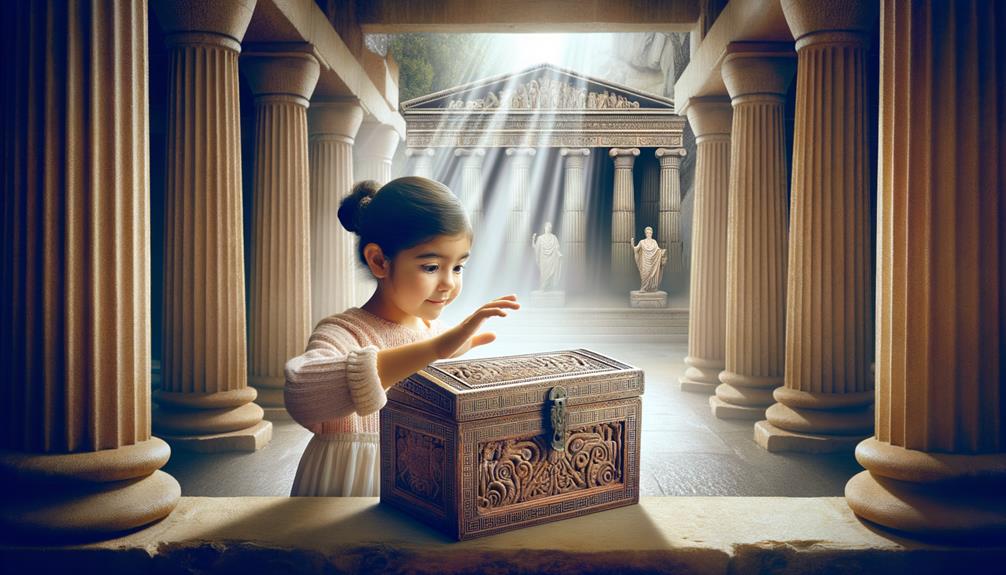
Hesiod uses the Greek word pithos, which means a large jar used for storage. The expression “Pandora’s box” became standard after the Renaissance scholar Erasmus used a Latin word for a smaller container when retelling the myth.
This distinction matters because a storage jar would have been an ordinary and substantial household object. The ancient story is not about an ornate magic chest, even though later art and literature often portray one.
What Hesiod says Pandora released

Works and Days says that people had previously lived without toil, painful disease, and other evils. Pandora lifts the jar’s lid, and its contents scatter among humanity. Diseases then move silently because Zeus has denied them speech.
Hesiod does not say that Pandora was given a clear command never to open the jar. He also does not present a detailed scene in which curiosity overwhelms her. Those elements became prominent in later retellings. In Hesiod, the episode belongs to Zeus’s plan to punish humanity.
Why Hope remains inside

Only Elpis remains beneath the rim when Pandora closes the lid, following the will of Zeus. The Greek word can mean hope or expectation. Hesiod does not state plainly whether its confinement benefits or harms humanity.
Two broad readings remain common. Hope may be preserved as comfort amid suffering, or it may be withheld so that mortals cannot know what is coming. The text supports debate, not the simple claim that hope escaped and became a guaranteed remedy for every evil.
Gender and responsibility in the myth

Hesiod’s treatment of Pandora is openly hostile to women. The Theogony describes women collectively as a burden imposed on men. Reading Pandora only as a warning about female curiosity repeats that bias without examining it.
The chain of responsibility is broader. Prometheus deceives Zeus and steals fire. Zeus designs the punishment. The gods construct and equip Pandora. Epimetheus ignores a warning and accepts Zeus’s gift. Pandora opens the jar within that divine plan. Modern readers can analyze the text’s gender politics without turning its claims into facts about women or human nature.
Frequently asked questions
Was Pandora’s container a box?
No. Hesiod calls it a pithos, a large storage jar. “Box” comes from a later translation tradition.
Was Pandora forbidden to open the jar?
Hesiod does not record such a command. The explicit prohibition and a strong focus on curiosity belong to later versions.
Did Hope escape?
No. Hesiod says Hope, or Expectation, remained inside when the lid was closed.
What is the moral of the story?
Hesiod uses the myth to account for labor and suffering in a world governed by Zeus. Later readers have found themes of curiosity, punishment, gender, deception, and uncertain hope, but no single modern moral captures the whole text.