
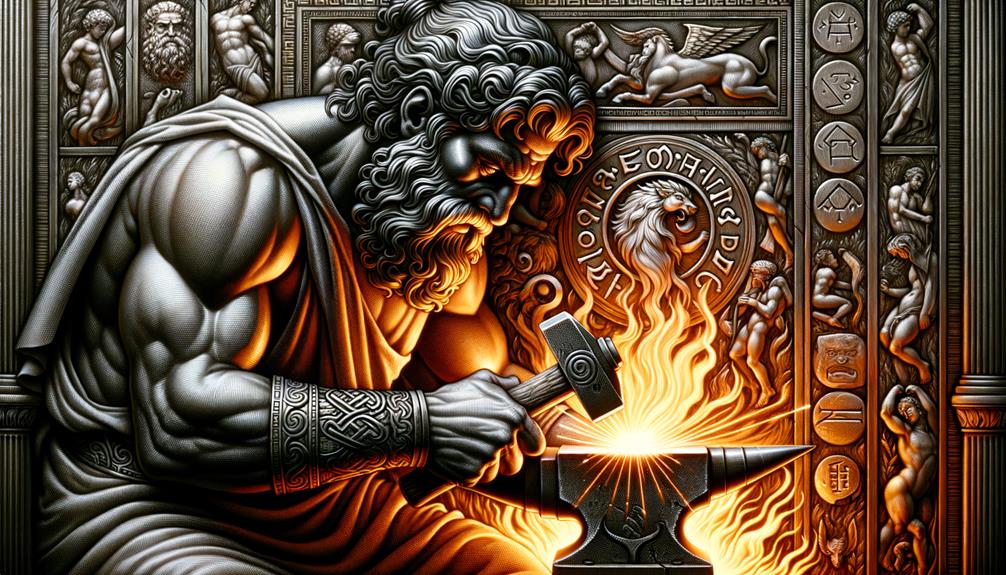
Hephaestus is the Greek god of metalworking, skilled manufacture, and fire controlled for craft. He forges armor, jewelry, palaces, traps, tripods, and animated attendants. Ancient poetry also describes him as physically disabled. That difference is not a contradiction of his expertise: the myths repeatedly make technical intelligence and embodied adaptation central to his power.
Roman authors identify him with Vulcan, but the Greek and Roman gods have their own cult histories. Volcano imagery became especially strong through later associations; Hephaestus’s earliest importance is broader than uncontrolled eruption.
Birth and fall: conflicting accounts
Hesiod says Hera bore Hephaestus without intercourse, in rivalry with Zeus. Homeric narratives do not form one matching account. In the Iliad, Hephaestus recalls Zeus throwing him from Olympus after he defended Hera; elsewhere he describes being cast away by his mother and sheltered by Thetis and Eurynome.
Modern summaries often select one fall and one reason. The sources instead preserve competing explanations for his parentage, disability, rejection, and return. Mythic variants can express family conflict, divine hierarchy, and the undervaluing of craft without yielding a medical biography.
| Work or tradition | Creation | Theme |
|---|---|---|
| Iliad 18 | Achilles’ new armor and cosmic shield | Craft turns the world of war and peace into divine art |
| Iliad 18 | Golden attendants with intelligence, speech, and strength | Artificial life and assistance are imagined within divine technology |
| Odyssey 8 | Invisible net trapping Aphrodite and Ares | The physically underestimated maker defeats other gods through design |
| Hesiod | Pandora fashioned from earth | Craft, beauty, divine purpose, and human consequence |
| Vase-painting tradition | Binding throne and return to Olympus | Hephaestus compels recognition and is led back by Dionysus |
The shield of Achilles
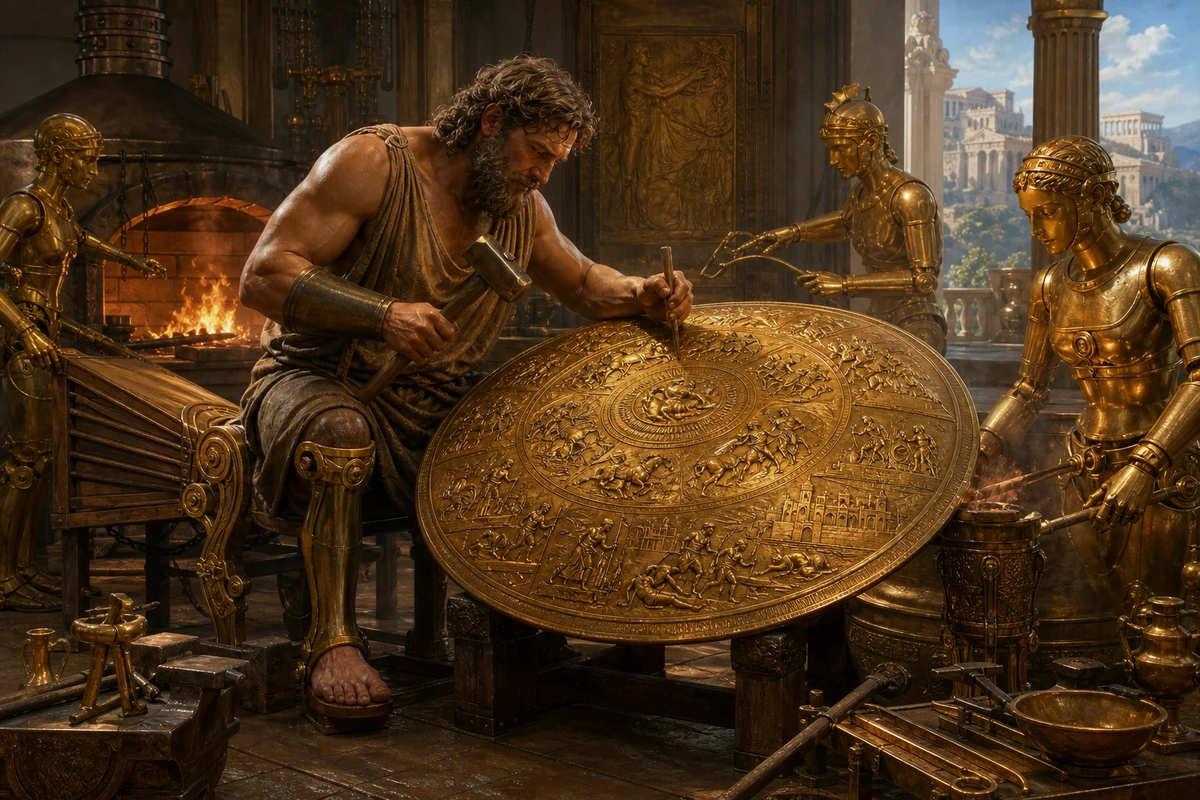
When Thetis asks for new armor for Achilles, Hephaestus creates a shield filled with the earth, sea, sky, cities, agriculture, dance, judgment, warfare, and the stream Ocean. The description is not a manufacturing blueprint. It is an extended poetic image of a whole social and cosmic world carried into battle.
The scene also shows the god’s workshop as a place of automation. Self-moving tripods and golden female attendants support him. Ancient epic therefore imagines responsive crafted beings long before modern robotics, while embedding them in divine poetry rather than engineering documentation.
Disability and divine craft
Ancient language marks Hephaestus’s legs or gait as different, and other gods sometimes laugh at him. The poems also show him designing mobility and workplace support. He remains indispensable: Zeus’s household, heroes, and Olympian gods rely on objects no one else can make.
Representing him only as grotesque repeats the mockery without the counterpoint. Treating disability as magically erased also loses the tradition’s insistence that a disabled god can possess unmatched skill, social agency, sexuality, anger, and honor.
Marriage and relationships
The Odyssey pairs Hephaestus with Aphrodite in the comic and painful story of her affair with Ares. In the Iliad, his wife is Charis. Later retellings often merge the sources into one fixed marriage, but the ancient poems differ.
Hephaestus is also closely connected with Athena in Athenian civic and craft life, including festivals and the Hephaisteion. Shared patronage of skilled work does not make them a consistently married couple.
Cult, Lemnos, and volcanic landscapes
Lemnos was a major center of Hephaestus tradition and cult. Athens honored him among artisans and citizens. Workshops, furnaces, and metallurgical fire offered immediate ways to understand divine transformation: ore and scrap become valuable objects through heat, knowledge, timing, and labor.
Later Greek and Roman geography located divine smithies under volcanic islands and mountains. Those stories strengthened the link between subterranean fire and smithcraft, but “god of volcanoes” should not replace his wider role as maker.
Accuracy note
This article preserves conflicting birth, fall, and marriage traditions; treats Homer’s automata as poetry rather than lost technology; and represents disability as part of Hephaestus’s identity without making it a punishment that cancels his authority.