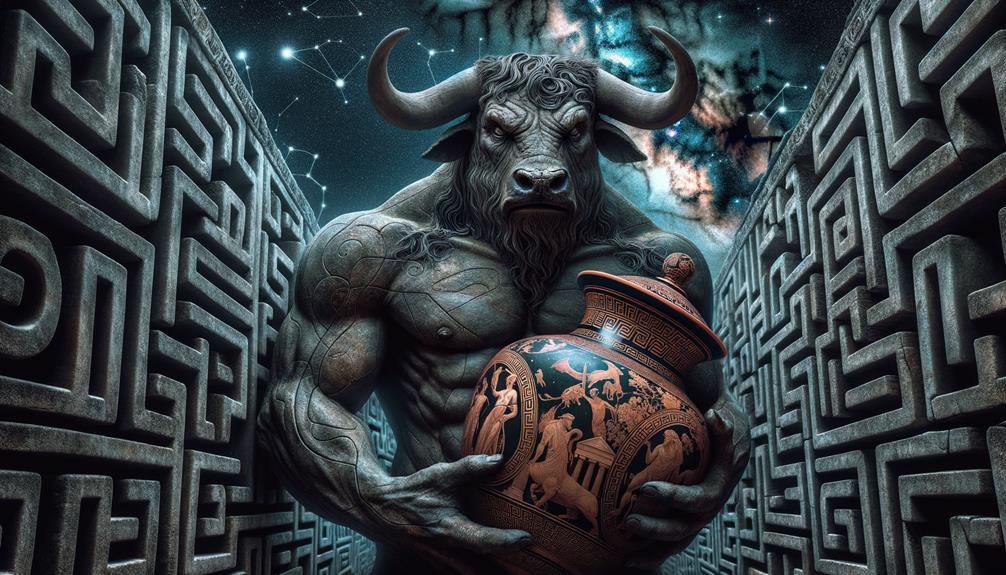
The Minotaur is a creature of Greek myth associated with King Minos of Crete, the Labyrinth built by Daedalus, and the Athenian hero Theseus. Ancient authors and artists did not preserve one perfectly consistent version. The number and timing of the Athenian victims, the Minotaur’s name, and details of the killing vary across the tradition.
The birth of the Minotaur
Minos sought a sign that he should rule Crete and received a magnificent bull from the sea, sent by Poseidon. Minos was supposed to sacrifice the animal but kept it instead. In punishment, Pasiphae, the wife of Minos, was made to desire the bull. Daedalus constructed a wooden cow that allowed the union, and Pasiphae gave birth to the Minotaur.
Ancient sources also call the creature Asterion or Asterius. It is commonly described in later summaries as having a man’s body and a bull’s head, although ancient art could vary the proportions. Minos ordered Daedalus to confine it in the Labyrinth, a structure designed so that escape was exceptionally difficult.
The Athenian tribute
The tribute arose from conflict between Minos and Athens after the death of Minos’s son Androgeos. Athens was required to send young people to Crete for the Minotaur. The familiar total is fourteen, seven young men and seven young women, but sources disagree about how often the tribute was sent. Some give an annual cycle, while others say every third or ninth year.
Those differences are a normal feature of Greek myth. Saying that the sacrifice happened at one fixed interval without naming a source gives a false sense of certainty.
Theseus and Ariadne
Theseus joined one group sent from Athens and intended to kill the Minotaur. Ariadne, daughter of Minos and Pasiphae, helped him. In the best-known version, she gave Theseus a thread so that he could mark his route through the Labyrinth and find the exit after the fight.
Ancient art often shows Theseus killing the Minotaur with a sword or club. A Greek cup in the British Museum places the fight inside an architectural setting that may represent the Labyrinth. The encounter was one of the most frequently represented deeds of Theseus.
The story continues after the escape. Theseus leaves Crete with Ariadne, but traditions differ about why she does not reach Athens with him. He also fails to replace his ship’s dark sail with the promised light one. His father Aegeus sees the dark sail, believes Theseus dead, and dies. The hero’s victory is therefore followed by loss rather than a simple happy ending.
The Labyrinth and Knossos
Modern discussion often connects the Labyrinth with the large Bronze Age palace complex at Knossos. The complex has many rooms and corridors, and bulls appear in Cretan art. These similarities may help explain why the myth became attached to Crete, but they do not prove that the Labyrinth or Minotaur was a historical fact.
The label “Minoan” is itself modern. Archaeologist Arthur Evans used the name for the Bronze Age civilization of Crete, drawing it from the mythical King Minos. It is therefore circular to treat the modern archaeological label as evidence that Minos existed.
What the myth can and cannot show
The story has supported many interpretations involving kingship, tribute, family transgression, confinement, and Athenian identity. Ancient Athenian art made the defeat of the Minotaur a major part of Theseus’s heroic image. Modern psychological readings of the maze and monster can be useful as later interpretations, but they are not established facts about what every ancient audience believed.
No evidence shows that a human-bull hybrid lived beneath Knossos. The Minotaur belongs to myth and visual culture. Archaeology can clarify the Cretan setting and the long importance of bull imagery without turning the story into a literal historical report.
Sources
- Ashmolean Museum, Myths of the Labyrinth
- British Museum, cup showing Theseus and the Minotaur
- British Museum, red-figure vessel showing Theseus killing the Minotaur
- Pseudo-Apollodorus, Bibliotheca, Book 3