
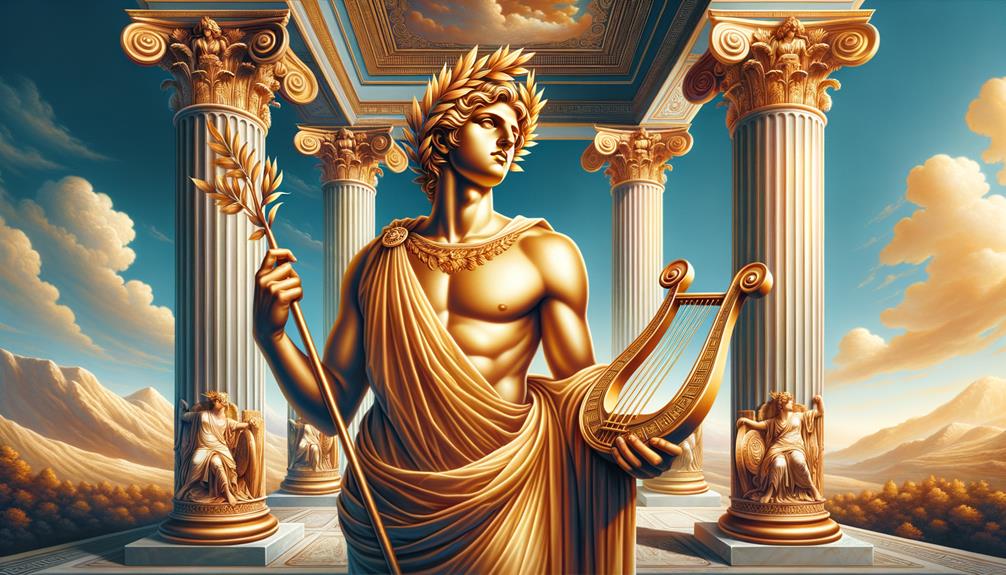
Apollo is an ancient Greek god of music, prophecy, healing, plague, archery, and civic order. He is often linked with the sun in later Greek and Roman thought, but early sources distinguish him from the sun god Helios.
Apollo in the surviving tradition
The Homeric Hymn to Apollo tells of his birth to Leto and his twin relationship with Artemis. Its Delian section celebrates his birth on Delos, while its Pythian section explains his arrival at Delphi and defeat of the serpent associated with the site. Delphi became his best-known oracle, where the Pythia delivered responses that priests interpreted for visitors.
Texts, objects, and evidence
Apollo’s lyre and kithara connect him with music, while the bow can bring sudden death or plague. In the Iliad he sends disease into the Greek camp after Agamemnon dishonors his priest Chryses. The same god can purify, heal, and establish ritual order. This pairing is common in ancient religion and should not be separated into a good side and an evil side.
Key points
- Family: Apollo is a son of Zeus and Leto and the twin brother of Artemis.
- Delphi: The oracle had Panhellenic importance and received questions from individuals and states.
- Art: Youthful images often show a lyre, bow, laurel, or tripod. Identifying an unlabeled figure still depends on context.
- The arts: Apollo is especially tied to music and song. A general title such as god of all art or creativity is a modern simplification.
How to read the material
No single myth gives Apollo a complete biography. Epic, hymns, tragedy, cult titles, inscriptions, and objects emphasize different functions. Later Roman and modern retellings also shift his solar identity.