

Janus is a Roman god of beginnings and passages whose two faces express a distinctive kind of watchfulness. Doors, entrances, the opening of the year, and the movement between war and peace all help explain him. His double face is not evidence of deceit or a divided personality.
For a clearer picture, it helps to replace vague claims about “duality” with the explanations offered by Roman sources. Ovid’s Fasti gives Janus a speaking role, while Augustus’s account of his achievements connects the god’s closed shrine with a public claim of peace.
Why does Janus have two faces?
In Book 1 of the Fasti, lines 89–144, Ovid asks Janus to explain his unusual appearance. The god offers more than one answer. He first relates his form to the separation of an originally confused cosmos, then turns to a much more familiar object: a door.
A doorway has two sides, one toward the outside and another toward the household. A porter watches people coming in and going out. In Ovid’s explanation, Janus can perform that vigilance in both directions without turning his head. The poem specifically associates his simultaneous gaze with east and west.
Looking backward and forward in time is an understandable interpretation of Janus, especially at New Year. It should not, however, replace the concrete explanation Ovid actually supplies. Nor does the poem establish a simple rule that one face must be young and the other old.
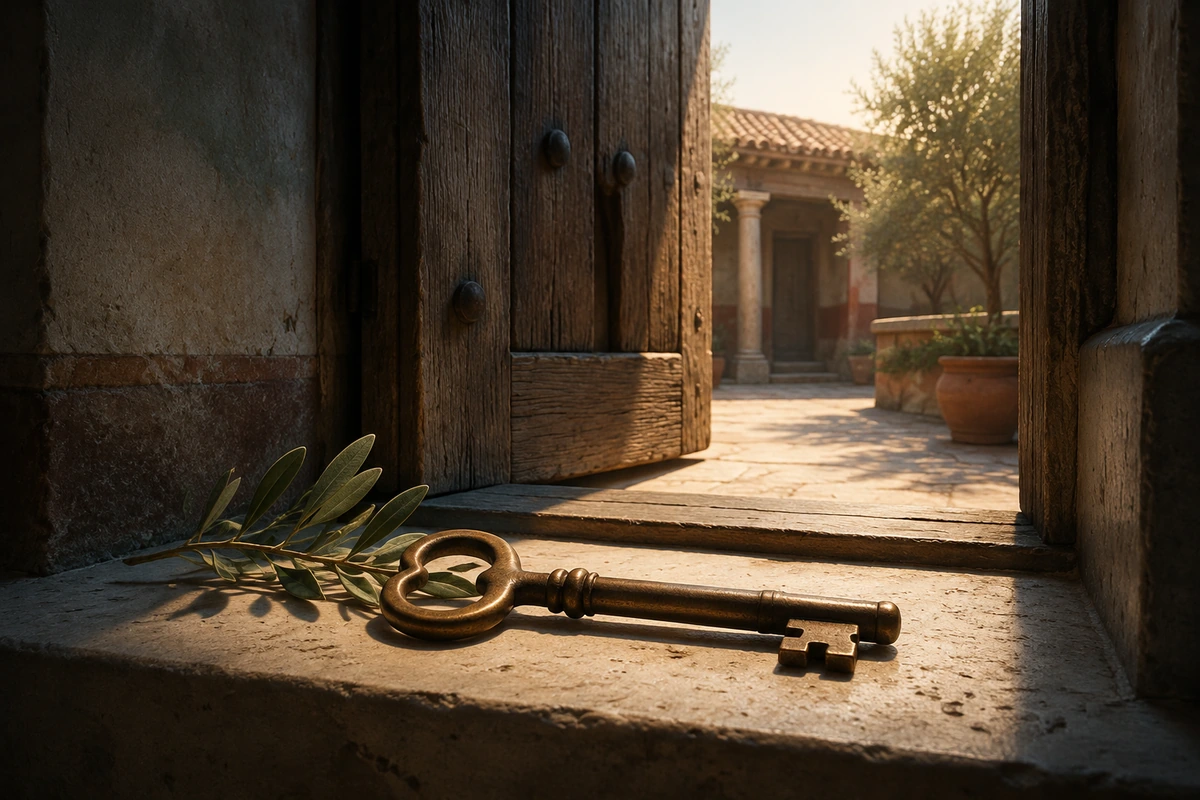
The key, the staff, and ritual access
Ovid introduces Janus holding a staff in his right hand and a key in his left. These are not incidental accessories: the god describes his responsibilities through opening, closing, and guarding entrances. Later, when the poet asks why Janus receives incense and wine before other gods, Janus answers that his guardianship of thresholds allows access to them.
The logic is one of ritual precedence rather than a contest to find the strongest deity. To begin an approach to the gods, a worshipper first acknowledges the divine guardian of the opening. Ovid develops a consistent connection between an everyday threshold and the beginning of sacred action.
New Year wishes and gifts
The poem’s January opening links Janus with a favorable start to the year. In the dialogue at lines 171–226, Ovid asks about good wishes, dates, figs, honey, and gifts of money. Janus explains sweet foods as a hopeful sign: the coming year should be as pleasant as its beginning.
Ovid does not make this a solemn list and move on. His Janus jokes about the appeal of cash and offers a pointed reflection on the desire for wealth. The passage combines ritual explanation with the poet’s commentary on Roman life. It is more specific than saying that Romans celebrated every new project in exactly the same way.
Why were the shrine’s doors opened or closed?
At Fasti 1.277–288, Ovid turns to the doors associated with Janus in public religion. Janus explains that they stand open during war so the people who have gone out can return. In peace, he closes them to keep peace from departing. This is the poem’s symbolic explanation, not a mechanical claim that shutting a door could end every conflict.
Another primary source shows how politically important that symbolism became. In section 13 of the Res Gestae, Augustus states that the Senate ordered Janus Quirinus closed three times while he held leadership. He contrasts this with a tradition of only two closures before his birth.
Augustus also defines the relevant peace as something secured by victory across Roman territory on land and sea. His statement should be read as his own presentation of his achievements, not as a neutral claim that nobody anywhere was suffering from Roman warfare. Keeping that wording in view reveals how religious ceremony could help express imperial authority.
Mythic explanations are not the same as a biography
Ovid also has Janus tell of receiving Saturn in Italy and links an image of a ship on coinage with Saturn’s arrival. Within the poem, Janus recalls a landscape beside the Tiber before the Rome familiar to Ovid’s readers. These passages are mythic explanations of places and symbols, not documentary evidence for a human king’s reign.
The most useful way to understand Janus is through the relationships the sources repeatedly emphasize: inside and outside, departure and return, the first offering and the worship that follows, the opening year and its hoped-for course. His two faces make sense within that network of passages. They need no invented psychology, clockwork symbolism, or universal ceremony for every life event.